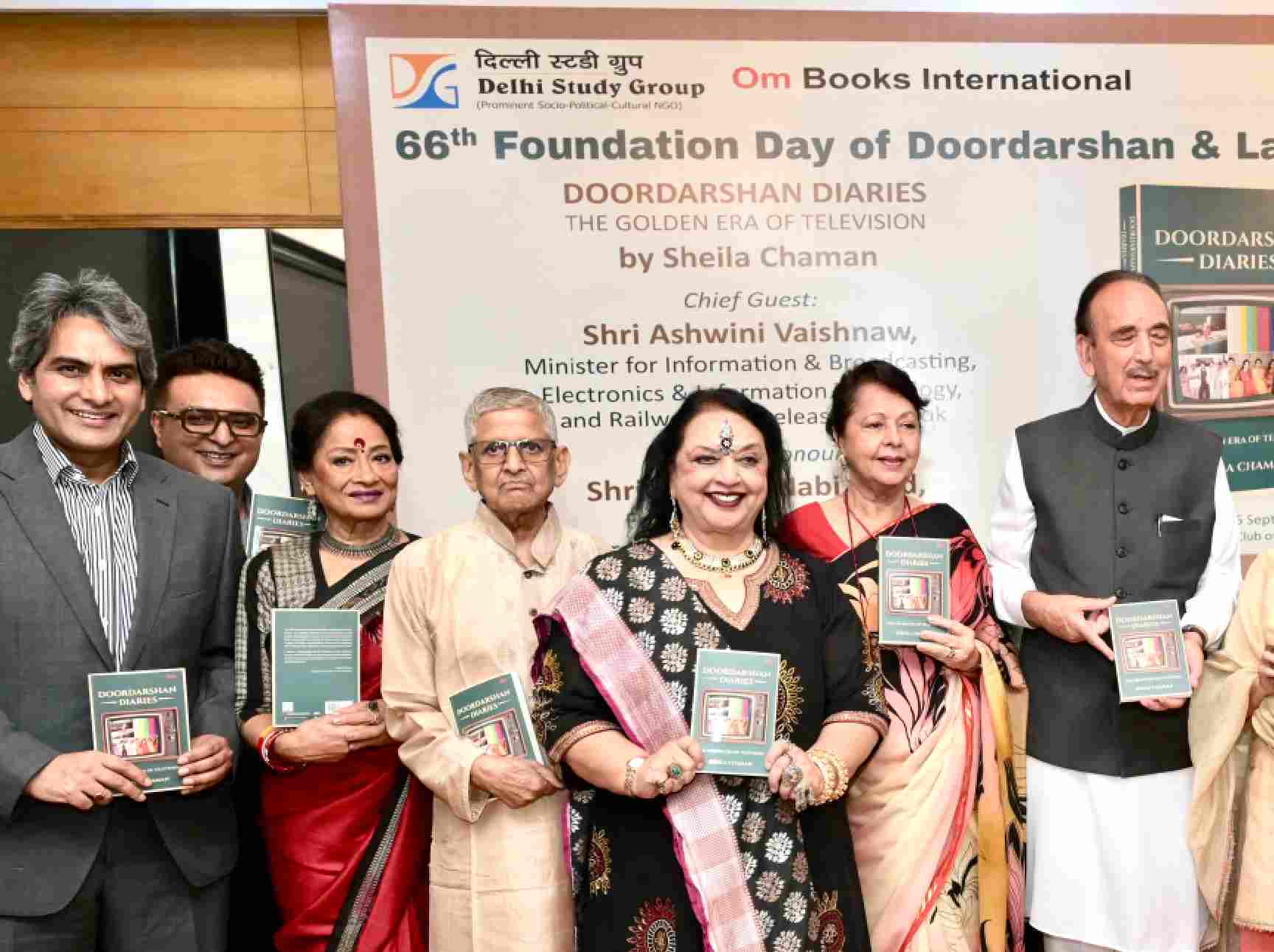
Sheila Chaman is a name that an entire generation that grew up with Doordarshan — the once single, soulful window to Indian television — will never forget. The English newsreader, whose career spanned three decades, has just released her book Doordarshan Diaries. Truly a labour of love, it chronicles the golden era of Doordarshan alongside Chaman’s own journey through the decades that shaped India.
“When I began writing the book in 2020 (during Covid), I wanted to share my experiences of Doordarshan and guide those aspiring to join this so-called glamorous world,” says Chaman. “It is a lot of hard work and much goes on behind the scenes that goes unnoticed. It was then that I decided that such a vast canvas of such a gigantic organisation needs to be properly represented by its multifarious departments with first-hand experiences by the personnel who were there at that time. To tell the story of how the transition and transformation of the channel from black and white to colour took place and how every other TV channel in India today is actually an offspring of the mother channel — Doordarshan.”
She adds that she contacted ten of her former colleagues for their inputs, worked with their insights, and put together the manuscript. Doordarshan Diaries was eventually published by Om Books and launched on September 15, 2025 — Doordarshan’s 66th Foundation Day.
Behind the camera and beyond the script
With a multitude of memories, Chaman says it was a challenge to decide what to include in the book. “Every day and every bulletin was like a flight take-off and landing — slight caution at the beginning and relief after its successful telecast at the end,” she recalls.
She recounts one memorable instance: “Once while reading the news from the pages (before the teleprompter was introduced), one of the main light bulbs went off, plunging the studio into semi-darkness. As I looked down to read the next line, I realised I could not see it! Since I had gone through the pages before going on air, I could vaguely make out some words and recollect the sentence and spoke it out as if I had read it from the page. Thankfully, this was almost at the end of the bulletin, and it all went off without a hitch. Viewers did not find anything amiss; only we in the studio knew what had happened.”
Also Read: Delhi’s sludge crisis undermines Yamuna clean-up
The day she “saved the news”
Another tense moment came during a live bulletin. “I was on air when the floor manager snuck in a new page which was a sort of breaking news (those days there was no ‘Breaking News’),” she recalls. “The page had to be read out first. So my eyes read ‘Prime Minister Giani Zail Singh…’ Instinctively I knew this was incorrect. Either the editor had dictated it wrongly or the typist had made a hurried mistake, but if I read out the wrong statement, it would be I who’d face suspension! So I read out ‘President Giani Zail Singh’ and later mentioned ‘Prime Minister Rajiv Gandhi’, which was the correct version. The producer thanked me afterwards — I had saved the day for all of us.”
She also remembers a later encounter with President Giani Zail Singh, who, she says, had remarkable candour and simplicity. When Chaman asked him what makes a good president, he told her that his daughter once said she wanted a husband who agreed with her on everything. “To this, Giani ji replied, ‘Beta, tainu pati nahi, tainu rashtrapati chahida hai’ (Child, you don’t want a husband, you want a president).”
Encounters with future legends
Chaman recounts another incident when she was about to go on air and noticed a young man sitting on the studio floor, watching her keenly. Irritated, she objected to having an outsider in the studio but was told he was a new recruit observing the process. The year was 1993 — and the young man was none other than Prannoy Roy, who would later launch NDTV.
Remembering colleagues and moments of history
Doordarshan Diaries also features recollections from other newsreaders. Jyotsna Rai, one of the first Hindi news presenters of the 1980s, shares a vivid memory. During a lamp-lighting ceremony with Prime Minister Indira Gandhi, the PM turned to her and said, “Jyotsna, mera diya toh hawa se bujh gaya” (The wind has blown my lamp off). Just days later, Indira Gandhi was assassinated — and Jyotsna had to announce the devastating news to the nation on Doordarshan.
Upholding the sanctity of news
For Chaman, news has always been serious business. “It is not something to be hyped, made fun of, or put across in a tantalising, titillating manner. Tell the story as it is — the How, What, When, Why and Where of any event needs to be told and answered in a credible manner for the viewers,” she asserts.
“We all had some unspoken rules that we adhered to — minimal makeup, stud earrings (no danglers to distract), national dress (the sari for women and shirt, tie, and coat for men), no hype or emotions — just deliver the news as it is! I think news has its own status and needs to be delivered with respect. News anchors should create that aura. I trained a batch of newscasters in 1999, all of whom are today brilliant anchors across channels — and that makes me proud.”
Lessons from a lifetime
Chaman believes television is a balance between face and voice. “One need not be very beautiful or attractive to be a newsperson. A presentable face with a good voice, modulation, articulation, diction, pronunciation, and knowledge of current affairs is what’s required,” she notes.
Looking back, the ace newsreader says she has cherished every moment of her long association with Doordarshan. “I am what I am today because of it,” she says. “From my very first programme Mirror of the World as presenter to my roles as interviewer, newsreader, correspondent, stringer, documentary producer, and trainer — it has been a learning and evolving journey. I have tried to encapsulate it in my book.”
Also Read: Delhi’s fragile foundation: 55% surge in building collapses exposes civic failures
Revisiting the golden age of Indian television
Doordarshan Diaries revisits the heydays of national television — from the Emergency years to the transition to colour broadcasts, from the telecast of iconic serials like Mahabharat, Ramayana, Hum Log, and Wagle Ki Duniya to the commissioning of landmark films such as Satyajit Ray’s Sadgati.
As Salma Sultan, one of Doordarshan’s most recognisable faces, puts it, “Sheila’s initiative to stay connected with the glorious past of Doordarshan will help new generations become an integral part of this amazing journey.”
Doordarshan Diaries is sure to be a nostalgic trip for older viewers and an invitation for the youth to rediscover their roots in a gentler, quieter India.