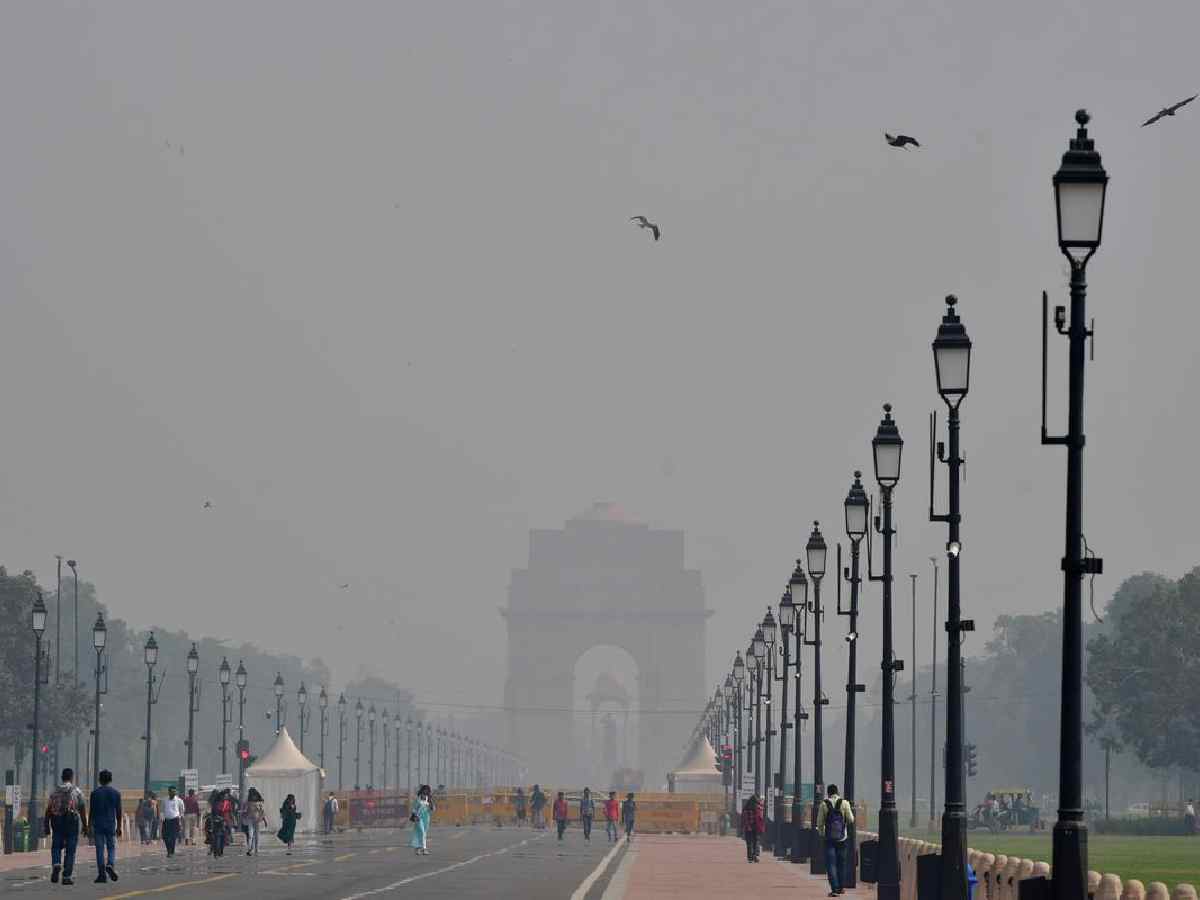
As Delhi battles severe air pollution every year, environmental experts have said that while emergency measures like the Graded Response Action Plan (GRAP) provide temporary relief, they have failed to address the root causes, underscoring the need for long-term solutions such as a major overhaul of public transport.
“GRAP is a well-designed policy by the Commission for Air Quality Management (CAQM) and functions as an emergency response to some extent, but it has failed to bring about a significant reduction in pollution levels in Delhi,” environmentalist Sunil Dahiya said.
Dahiya, who has over 14 years of experience as a strategist and research analyst on environmental issues, claimed that GRAP is based on an “outdated emission inventory,” and there is no mechanism to track whether the implemented measures have reduced the overall emission load across the NCR.
GRAP is divided into four stages, each prescribing a set of pollution-control measures aimed at preventing further deterioration of air quality.
“Although tools such as the Decision Support System (DSS) and the Real-Time Advanced Air Source Management Network (R-AASMAN) exist, they are not linked in a way that allows assessment of GRAP’s success in reducing absolute emission loads in Delhi-NCR,” Dahiya said.
The DSS, developed by the Indian Institute of Tropical Meteorology (IITM), Pune, under the Ministry of Earth Sciences, provides modelling-based inputs to policymakers for managing Delhi’s air pollution, while R-AASMAN, developed in collaboration with the Delhi Pollution Control Committee (DPCC) and IITM, is used for real-time source identification.
Noting that Delhi rarely records ‘good’ air quality days during the remaining months of the year, Director of the Chintan Environmental Research and Action Group, Bharati Chaturvedi, urged for concrete solutions such as decongestion, improved public transport, an end to biomass and waste burning, and stronger monitoring systems.
“GRAP should be phased out gradually, as it is akin to applying an ointment to a fracture. It was introduced as a measure to provide temporary relief to citizens while authorities worked simultaneously on long-term solutions. If we do not look beyond GRAP, the city will continue to face the same situation year after year,” Chaturvedi told PTI.
She also stressed the need to strengthen pollution control authorities and create clearer growth avenues for scientists.
In November 2025, the CAQM tightened GRAP norms, advancing several pollution-control measures to earlier stages.
The revised schedule shifted multiple actions from higher alert stages to lower ones, meaning restrictions are now triggered sooner as the Air Quality Index (AQI) worsens.
Under the new framework, several curbs that previously fell under Stage II (‘Poor’ AQI 201-300) are now enforced at Stage I.
These include uninterrupted power supply to discourage the use of diesel generator sets, deploying additional personnel to streamline traffic at congestion-prone points, issuing pollution alerts through media, and augmenting CNG and electric public transport fleets with higher service frequency and differential fares to promote off-peak travel.
Measures earlier listed under Stage III (‘very poor’ AQI 301-400) have been moved to Stage II, such as staggering working hours for government offices in Delhi, Gurugram, Faridabad, Ghaziabad, and Gautam Buddh Nagar.
Similarly, restrictions previously applicable only in Stage IV (‘severe+’) now apply at Stage III (‘severe’ AQI 401-450). These include allowing public, municipal and private offices to operate with 50 per cent staff while the remainder work from home.
Harjeet Singh, Strategic Advisor to Fossil Fuel Non-Proliferation Treaty initiative, emphasised the need for an “uncompromising airshed-level governance model” that overrides “state politics”, and a massive investment in public transport.
“Systemic change demands that we stop managing the pollution and start managing the source. We need to break our reliance on fossil-fuelled private transport and hold industrial polluters accountable year-round,” Singh said, comparing reliance on ‘GRAP’ to “trying to douse a forest fire with a garden hose.”
Reacting to the statements by the environmental experts, a CAQM official told PTI that they review the GRAP measures periodically, examining areas where they can be revised and made more stringent.
“We are actively examining areas where they (GRAP) can be revised and made more stringent. At the same time, we are particularly emphasising on better implementation of existing norms,” the CAQM official said.
The official added that activities identified under the GRAP framework are assessed from an implementation perspective to ensure effectiveness on the ground, and that work is underway to introduce stricter measures backed by robust enforcement mechanisms.
GRAP was first notified by the Ministry of Environment and Forests in 2017 for implementation through the Supreme Court-mandated Environment Pollution (Prevention and Control) Authority.
Delhi recorded the highest annual average PM10 concentration in the country in 2025 at 197 micrograms per cubic metre, nearly three times higher than the national standard of 60 micrograms per cubic metre, according to an analysis.
Meanwhile, Delhi’s air quality slipped to ‘very poor’ category on Wednesday morning, according to data from the Central Pollution Control Board (CPCB).
Five out of 39 monitoring stations recorded ‘severe’ air quality at 6 am, while 32 stations remained in the ‘very poor’ category.
According to the CPCB classification, an AQI between 0 and 50 is considered ‘good’, 51 and 100 ‘satisfactory’, 101 and 200 ‘moderate’, 201 and 300 ‘poor’, 301 and 400 ‘very poor’, and 401 and 500 ‘severe’.