On a cool evening in Mehrauli, long after most galleries had shut their doors, an unusual art gathering was still in motion. Inside QLA, guests moved between paintings, conversations, and music as After Hours, hosted by Dhoomimal Gallery and Gallery Silver Scapes, brought renewed attention to two important figures of Indian modernism—Abdulrahim Appabhai Almelkar and Akkitham Narayanan.
Unlike conventional exhibition openings, the event was structured as a late-evening viewing and interaction, allowing audiences to engage more informally with works that rarely circulate in public settings. Organisers said the aim was to create a space where modernist art could be encountered outside institutional frameworks, and where viewers could engage with its intellectual and aesthetic concerns without the constraints of formal gallery hours.
The exhibition foregrounded Almelkar’s distinctive visual language, rooted in rural life, Indian mythology, and indigenous traditions. Though widely recognised during his lifetime, Almelkar’s work has received comparatively less public attention in recent decades. The event coincided with the release of Almelkar: The Resurrection – Letters & Lines of a Master, edited by Archana Khare-Ghose, which brings together archival material, personal correspondence, and critical essays examining the artist’s philosophy and practice.
His letters, including those addressed to his mentor Hiralal Khatri, offer insight into the spiritual and intellectual influences that shaped his work. Scholars such as Rehaman Patel and Deepak Kannal, whose essays appear in the publication, situate Almelkar within broader discussions of Indian modernism and its engagement with questions of identity, tradition, and modernity.
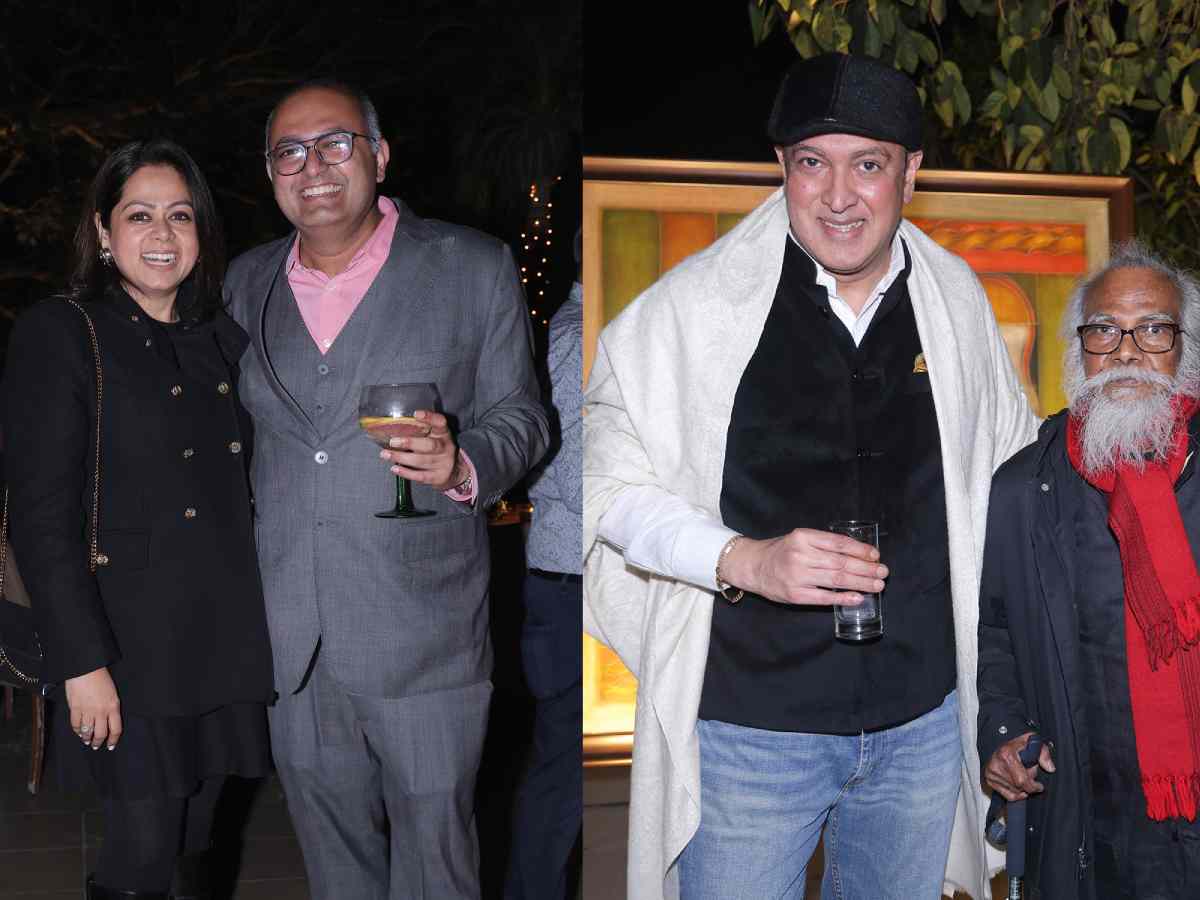
In contrast, Narayanan’s paintings offered a markedly different sensibility. Known for his abstract compositions informed by geometry and metaphysical inquiry, the senior artist attended the event in person, drawing attention from younger artists and collectors eager to engage with one of the remaining practitioners of early post-Independence abstraction.
The gathering drew a cross-section of Delhi’s art and cultural community, including artist Jatin Das, businessman Ajitabh Bachchan, and cultural commentator Suhel Seth, alongside collectors, curators, and emerging practitioners. Their presence reflected the continued influence of modernist artists on India’s contemporary art ecosystem.
While the atmosphere remained informal, the underlying focus was on reconnecting audiences with artists whose contributions shaped the trajectory of Indian modern art. By combining exhibition, archival scholarship, and direct interaction, After Hours underscored the continued relevance of modernist practice in contemporary cultural conversations.
For many attendees, the evening served not merely as a social gathering, but as a reminder that the legacy of Indian modernism remains a living and evolving presence—one that continues to find new audiences beyond the walls of museums and formal institutions.