For filmmaker, writer, and theatre practitioner AK Srikanth, storytelling has never belonged to a single medium. Across short films, literature, theatre, and now feature cinema, his work has consistently explored fragile emotional landscapes shaped by silence, longing, guilt, and internal collapse rather than dramatic spectacle.
Over the last decade, Srikanth has quietly built a body of work that includes Soul Cages, The Ghost of the Lighthouse, Slow Rivers, Filter Coffee, Arangetram, Dvija, Beyond the Rains, and The Prophet — films marked by restrained performances, atmospheric visuals, and deeply interior storytelling. His creative work has travelled internationally across film and theatre spaces since 2010, gradually establishing him as a filmmaker drawn more to emotional immersion than conventional narrative excess.
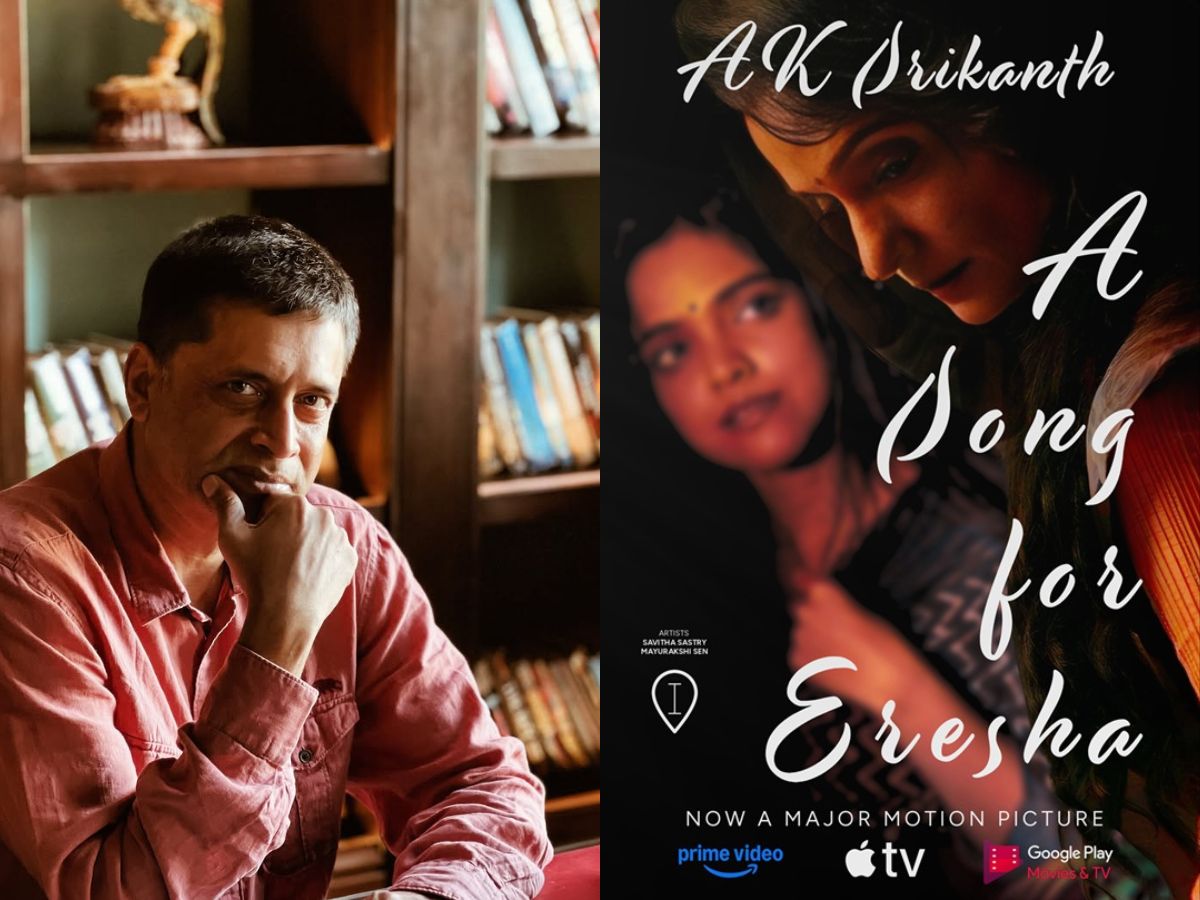
Now, with A Song for Eresha, Srikanth has entered long-form storytelling in an unusual way — releasing the story simultaneously as a literary novel, audiobook, and feature film adaptation directed by himself.
“Stories often evolve in the mind before they take form,” he says. “With A Song for Eresha, I had the rare opportunity to explore the same narrative both as a writer and as a filmmaker. Each medium revealed something different and something deeper about the story.”
The feature film recently premiered in the United Kingdom and is streaming on Amazon Prime Video (UK) and Apple TV, while the novel is available internationally across paperback, ebook, hardcover, and audiobook formats.
But for Srikanth, the project was never simply about adaptation. “The novel and the film were never competing versions,” he says. “The novel allowed me to go deeper into the psychological lives of the characters, while cinema allowed me to express those emotions through silence, atmosphere, visual rhythm, and physical space.”
Also Read: Preeti Jhangiani on cinema, comeback, and carving her own path
Stories built on silence
Much of Srikanth’s work resists emotional loudness. His films often unfold slowly, with characters carrying emotional burdens that remain partially unspoken. “What people call ‘slow storytelling’ is often misunderstood,” he says. “It is not really about slowness. It is about emotional immersion.”
That philosophy shapes A Song for Eresha as much as his earlier works like Slow Rivers or The Ghost of the Lighthouse. The emotional worlds he creates are often driven by absence, restraint, and psychological instability rather than overt drama.
“A Song for Eresha is about unrequited love, emotional dependency, forbidden attachment, and the dangerous ways people romanticise longing,” he says. “These emotions usually exist beneath the surface rather than in dramatic declarations.”
He describes the story as one centred on “emotional erosion rather than emotional explosion”.
“If I had pushed it toward louder sentimentality or conventional catharsis, I think it would have lost its emotional honesty,” he says.
The changing audience
Srikanth believes streaming platforms and global viewing habits have significantly changed audience expectations around pacing and storytelling styles.
“Earlier, audiences were conditioned to expect constant narrative movement and emotional signalling,” he says. “Now viewers are watching Korean cinema, Scandinavian dramas, Japanese storytelling, and European arthouse films. Their emotional vocabulary has expanded.”
That exposure, he says, has created greater openness towards quieter forms of cinema. “With OTT platforms, audiences are more willing to engage with stories that trust them emotionally rather than constantly explaining everything,” he says. “I think that is a very healthy shift.”
For A Song for Eresha, the atmosphere itself became part of character psychology. “I wanted audiences to inhabit the emotional instability of the characters rather than observe them from a distance,” he says. Srikanth sees the growing global reach of independent Indian cinema as one of the most encouraging developments in contemporary filmmaking.
Read More: Krishna Gautam on cinema and self-discovery