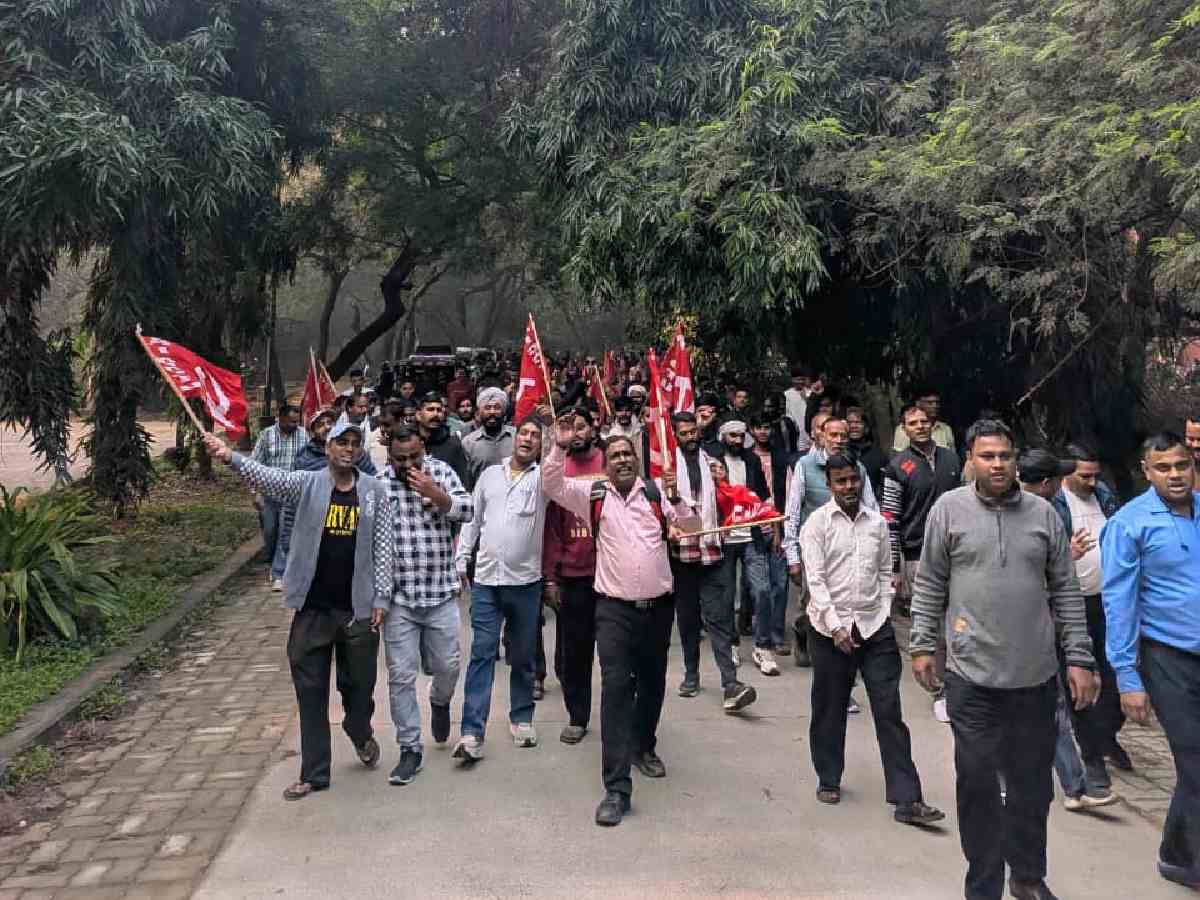
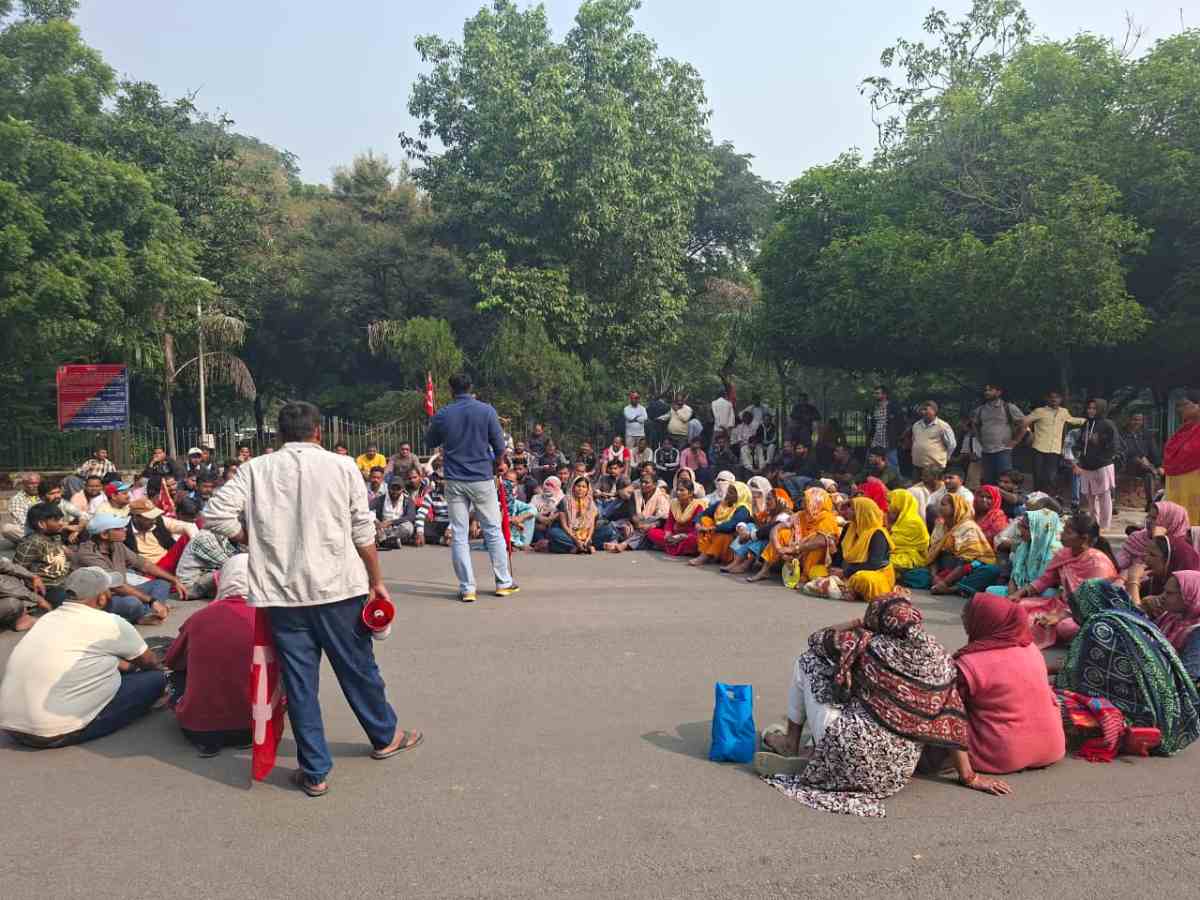
Contractual workers who maintain essential services at Jawaharlal Nehru University (JNU) are on strike, highlighting their working conditions. On November 9, when the strike entered its 8th day, contractual workers across several departments alleged that the university administration and private contractors repeatedly ignored their demands for fair wages, statutory benefits and safe working conditions.
While sanitation workers continued to stay away from work, mess workers reported for duty wearing black badges to register their protest. Workers from sanitation, mess, security, horticulture and maintenance departments have raised concerns over unlawful salary deductions, non-payment of statutory bonuses, arbitrary suspensions, retrenchment, inadequate staffing and the denial of basic employment benefits.
More than 500 contractual workers are reportedly affected by these grievances. Their demands include fair wages, statutory benefits and safer working conditions.
For many women workers, the struggle also concerns maternity benefits, workplace harassment and the fear of losing their livelihoods if they speak up.
Unanswered demands
The current agitation follows months of attempts by workers to secure administrative intervention. According to the All India Central Council of Trade Unions (AICCTU), more than 500 workers submitted a detailed charter of demands to the Assistant Labour Commissioner (ALC) on September 10.
Workers subsequently organised a campus-wide protest march on September 24 and 25, following which the Labour Conciliation Officer convened a formal hearing between the workers’ union, AICCTU and the JNU administration.
The Labour Commissioner directed the university to halt retrenchment, issue salary slips, form a grievance committee and provide safety equipment.
The union had postponed a planned strike in late September after the administration reportedly assured workers that it would issue a compliance circular. However, workers allege that the administration failed to implement several key directions.
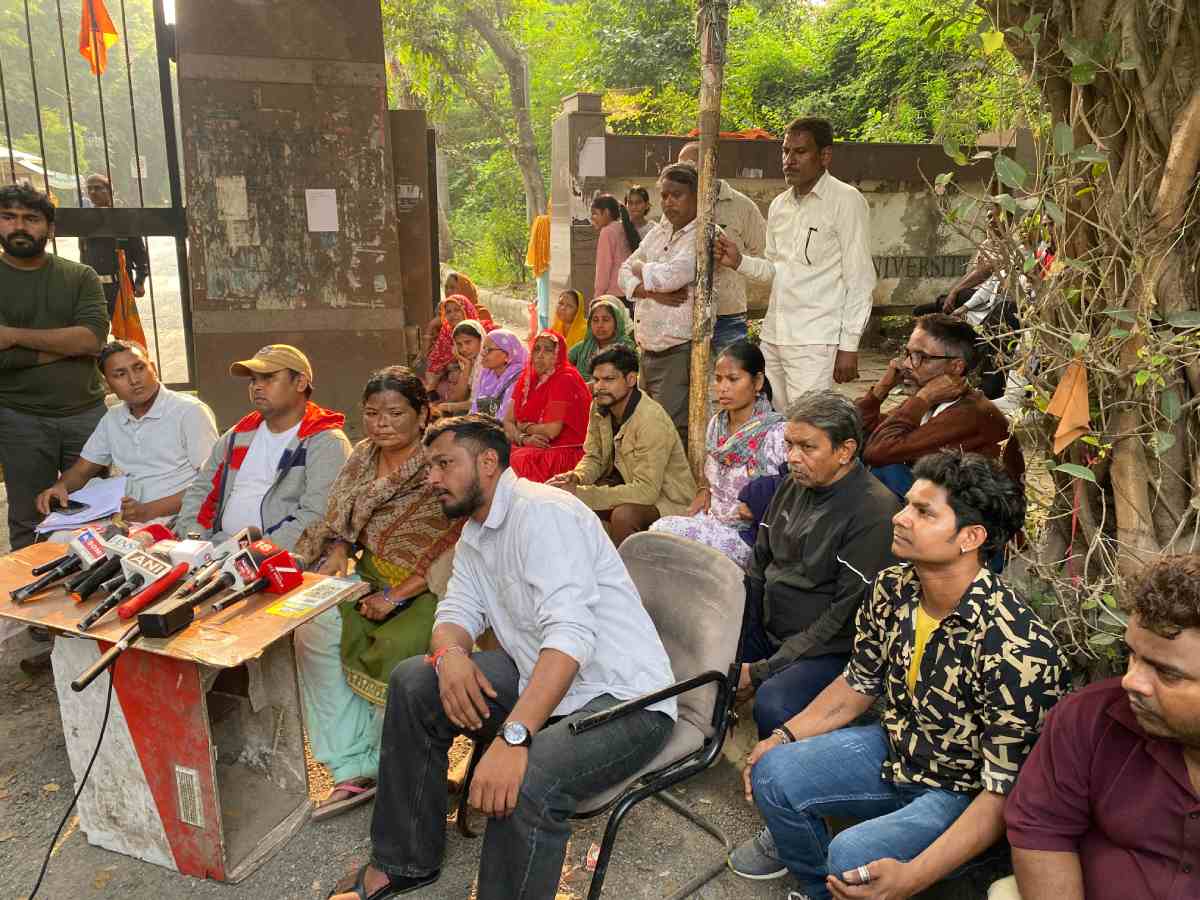
Surya, an AICCTU member, said another round of negotiations took place on the night of November 9. The meeting involved the Deputy Registrar, representatives of the security company and AICCTU members.
“During the meeting, they told us that they would listen to our demands, including the issues we had raised earlier. But our major demands are still not being addressed. We have been struggling for a long time, and there is still no concrete resolution. That is why the strike continues,” he said.
He added that workers have repeatedly approached the administration but have received little beyond assurances.
According to another AICCTU-affiliated woman worker, Anju, employed at Tapti Hostel, “We have been trying to speak to the administration for eight days, but nobody is listening. They repeatedly tell us to go home if we have no work. Instead of understanding why we are protesting, they tell us to leave.”
Working conditions
A shortage of sanitation workers has emerged as a major concern during the strike. Surya questioned how a small workforce could reasonably maintain a sprawling university campus.
“Imagine just 25 people cleaning a campus as large as JNU. How are they supposed to manage such an enormous area? They have to work continuously, and they do not even have proper safety precautions. It is shocking and dangerous,” he told Patriot.
Workers allege that inadequate staffing forces sanitation employees to handle excessive workloads while exposing them to occupational hazards. They have demanded additional workforce and mandatory protective equipment.
The ALC had directed the university management to provide mandatory safety equipment to sanitation workers. However, workers allege that the direction has not translated into adequate protection on the ground.
Denial of maternity benefits
Women contractual workers have raised specific concerns regarding maternity benefits and workplace harassment.
Aditi Mishra, President of the Jawaharlal Nehru University Students’ Union (JNUSU), expressed concern over the administration’s alleged failure to listen to the workers.
“Their concerns are simply not being heard. Women workers are not even receiving maternity leave. These are the basic rights, and the administration cannot keep ignoring them. The workers have raised several demands, but their grievances remain unaddressed,” Mishra said.
She further alleged that workers face arbitrary salary deductions even for minor delays, often due to technical failures beyond their control.
“If a worker punches in even two minutes late, their salary gets deducted. There have also been instances when the biometric attendance machine remained non-functional for an entire week. Later, workers discovered that their salaries for that week had been deducted. How can workers be penalised for a technical failure that is not their fault? If the machine is not working, the administration should fix it rather than make workers bear the financial consequences. They cannot keep citing a lack of funds to justify every problem,” she said.
Highlighting the severe staff shortage in sanitation, she said workers had made a basic demand that the administration increase the workforce and provide an official list of the employees deployed across the campus.
She pointed to the situation at Barak Hostel, one of the largest hostels on campus, where, according to her, only two women workers are deployed against a requirement of at least six.
Also Read: JNU hostels: seepage, broken windows, and a missing audit
“Barak Hostel is one of the biggest hostels, yet only two women workers are assigned to clean it. We need at least six of them. How can two people manage the workload meant for six workers? The administration expects them to do the work of an entire workforce without providing the necessary manpower,” she added.
Manju Devi (name changed), a 30-year-old contractual worker, alleged that workers face threats whenever they participate in protests or demand their rights.
“They threaten us when we speak up. They tell us to stop protesting, take leave and sit at home. They say that if we want to continue demonstrating, we should not come to work,” she alleged.
She said that such pressure creates an atmosphere of fear among contractual employees, many of whom cannot afford to lose their jobs.
“There are workers who leave because they cannot tolerate this pressure anymore. What option do they have? They need their jobs, but they also need to speak about the problems they face. If speaking up means risking your livelihood, how is anyone supposed to fight for their rights?” said Manju.
Another woman worker, Sunita (name changed), alleged that intimidation has forced several employees to leave their jobs. She also raised concerns about how the university treats workers who approach its Internal Complaints Committee (ICC) with sexual harassment complaints.
According to Sunita, women who raise complaints or pursue cases through the ICC often face additional pressure, making it difficult to keep working.
“Many workers have left their jobs because of the harassment and pressure they face. Instead of ensuring a safe and supportive workplace, the authorities find minor pretexts to threaten or terminate us. Even seemingly trivial issues, such as not wearing a cap or an identity badge or failing to punch in on time, are used as grounds to threaten us with dismissal. This constant intimidation makes it increasingly difficult for workers to continue their jobs,” she alleged.
She also questioned the absence of adequate support for older women workers. Several women over 50 continue to do physically demanding work despite health concerns, she said.
“These women also have health problems. They are getting older, but they still have to do physical labour. There is hardly any concern about their health or the conditions in which they work,” she added.
The alleged denial of maternity benefits adds another dimension to this insecurity. For women workers, the absence of paid maternity support can mean choosing between their health, childcare responsibilities and the income on which their families depend.
Safety concerns
Safety concerns extend beyond sanitation work. Anju described the deteriorating condition of the building where she works and the risks workers face while carrying out their duties.
She recalled an incident in which a portion of the ceiling collapsed and alleged that the administration failed to introduce adequate safety measures afterwards.
“Something as serious as a ceiling collapsing has happened, but workers still have to work without proper safety arrangements. Nobody seems to understand the risks we face every day,” she said.
“I earn just Rs 19,000 a month and have to pay Rs 5,000 in rent and support my son’s education,” she said.
The incident, she argued, reflects the larger neglect of workers who perform essential tasks inside university buildings.
Workers say they cannot be expected to continue working in potentially dangerous spaces without proper inspection, protective measures and accountability.
Shivering through winter nights
Security workers have also highlighted the absence of basic facilities at their workplaces. Rakesh (name changed), a contractual security worker, described the difficulties of working night shifts during the winter.
“JNU gets extremely cold at night. There are so many trees and green spaces across the campus, and the temperature drops further after sunset. We have to remain outside for hours, but we do not even get proper sweaters or warm clothing,” he said.
He described how security personnel often spend long hours shivering outside.
“We sit outside and shiver through the night. There is no proper shelter room where we can go inside and protect ourselves from the cold for some time. We are expected to remain outside, standing or sitting in the open. Nobody thinks about what it means to work like this for an entire night,” he said.
Their concerns also raise questions about the university’s and private security contractors’ responsibility to provide basic facilities to employees who work through the night.
Despite several attempts, the JNU administration did not respond to questions regarding the workers’ allegations, the Labour Commissioner’s directions or their pending demands at the time of publication.