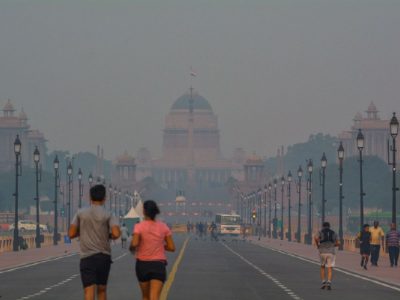
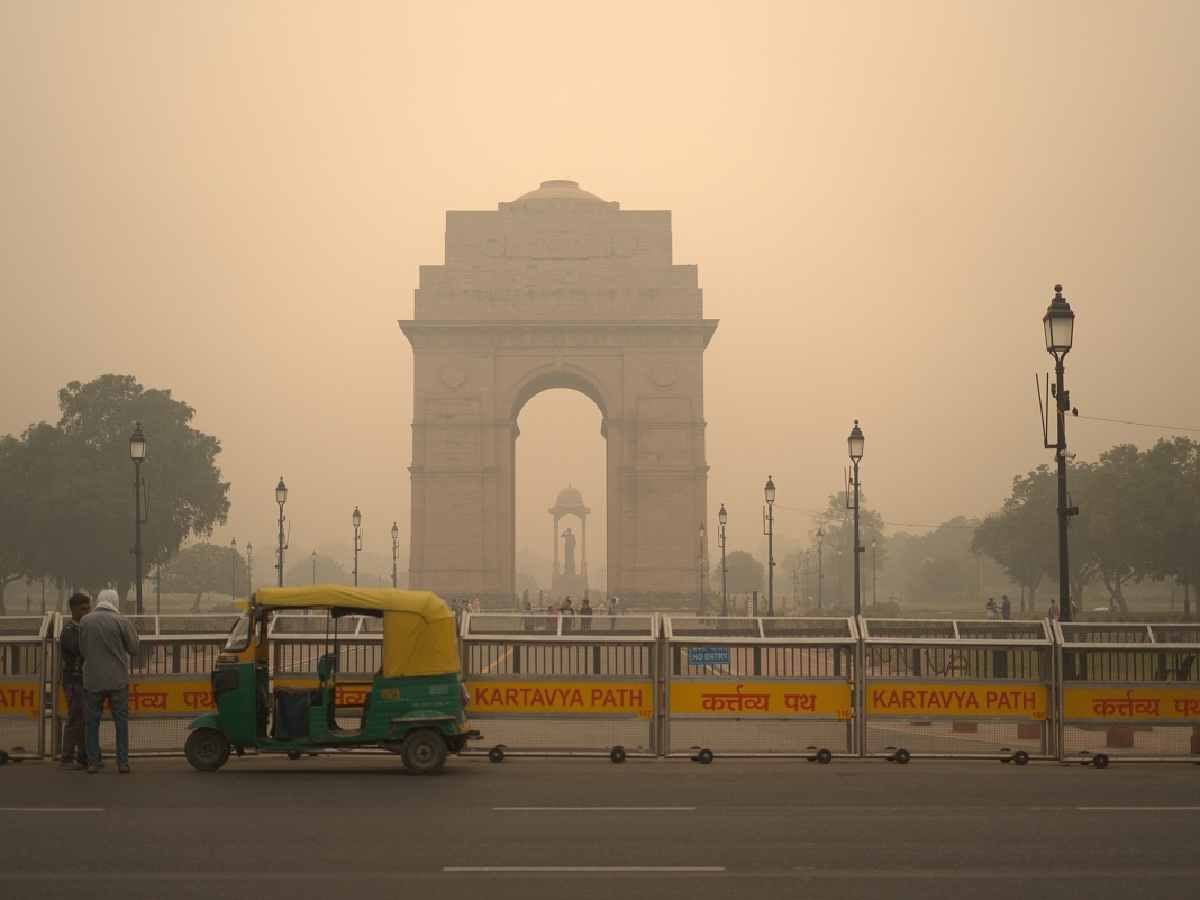
Delhi’s air quality showed further improvement on Monday, with the Air Quality Index (AQI) dropping to 239 from 265 a day earlier. However, pollution levels remained in the ‘poor’ category for the fourth consecutive day, according to official data.
The improvement has been gradual since November 19, when the national capital recorded an AQI of 280. The index subsequently declined to 270 on November 20, 265 on Saturday and 239 on Sunday, indicating a steady fall in pollution levels.
Data from 56 monitoring stations across the city showed that 36 stations continued to record ‘poor’ air quality, while eight fell in the ‘very poor’ category. The remaining 12 stations reported ‘moderate’ air quality.
Uttam Nagar emerged as the most polluted location in the city, recording an AQI of 332, followed by IGNOU Maidan Garhi, where the index stood at 330.
Vehicular emissions remained the biggest source of fine particulate matter (PM2.5) pollution in Delhi, accounting for 38.6 per cent of the estimated contribution on Sunday, compared to 33.1 per cent a day earlier, according to real-time source apportionment estimates of the Air Quality Early Warning System.
Biomass burning, which includes agricultural residue burning and the use of solid domestic fuels such as wood and dung cakes, contributed 24.2 per cent to the pollution load. Waste burning, including the burning of municipal waste, plastic, rubber and electronic waste, accounted for another 14.9 per cent.
Secondary organic aerosols contributed 8.9 per cent, while secondary inorganic aerosols made up eight per cent of the estimated PM2.5 concentration. Other sources included road dust, soil and mineral particles at 2.2 per cent, mixed combustion at 1.6 per cent, industrial emissions at 1.5 per cent and coal combustion at 0.2 per cent.
The improvement in pollution levels was supported by favourable weather conditions, particularly northwesterly winds reaching speeds of up to 15 kmph. These winds helped disperse pollutants and prevented their accumulation close to the ground.
The maximum atmospheric mixing depth was estimated at around 1,500 metres on Sunday. A higher mixing depth allows pollutants to spread over a greater vertical distance, reducing their concentration near the surface.
Despite the recent improvement, the Air Quality Early Warning System has indicated that Delhi is likely to remain in the ‘poor’ category from Monday through Wednesday. The outlook for the following six days suggests that pollution levels could fluctuate between the ‘poor’ and ‘very poor’ categories.
The forecast mixing depth is expected to decline from 1,500 metres on Sunday to 1,200 metres on Monday, before reaching 1,000 metres on Tuesday and 1,100 metres on Wednesday.
The ventilation index, which measures the atmosphere’s ability to disperse pollutants, is projected at 6,000 square metres per second on Sunday and 6,500 square metres per second on Monday. It is expected to fall sharply to 3,500 square metres per second on Tuesday and 3,200 square metres per second on Wednesday.
According to the forecasting agency, a ventilation index below 6,000 square metres per second, along with average wind speeds of less than 10 kmph, creates unfavourable conditions for pollution dispersal.
Northwesterly winds could reach speeds of up to 20 kmph on Monday, offering some relief by facilitating pollutant dispersion. However, the lower ventilation index forecast for Tuesday and Wednesday could hamper the movement of pollutants.
The India Meteorological Department (IMD) has forecast moderate fog for the day, and the maximum temperature is likely to touch 25 degrees Celsius.
Meanwhile, weather stations across Delhi recorded varying temperatures on Sunday.
Safdarjung, the city’s base weather station, registered a maximum temperature of 27.6 degrees Celsius, 0.9 degrees above the seasonal average. Palam recorded 24.5 degrees Celsius, two degrees below normal, while Lodhi Road registered 27.2 degrees Celsius, 1.2 degrees above normal.
The Ridge and Ayanagar recorded maximum temperatures of 26.5 degrees Celsius and 26.2 degrees Celsius, respectively.
The minimum temperature at Safdarjung settled at 11.8 degrees Celsius, 0.5 degrees above normal. Palam recorded 12.9 degrees Celsius, while Lodhi Road registered 12.8 degrees Celsius, 2.8 degrees above the seasonal average.
The Ridge recorded a minimum of 13.5 degrees Celsius, matching the seasonal normal, while Ayanagar registered 12.3 degrees Celsius, 0.7 degrees below normal.
As per the Central Pollution Control Board (CPCB), an AQI reading between zero and 50 is classified as ‘good’, 51-100 as ‘satisfactory’, 101-200 as ‘moderate’, 201-300 as ‘poor’, 301-400 as ‘very poor’ and 401-500 as ‘severe’.