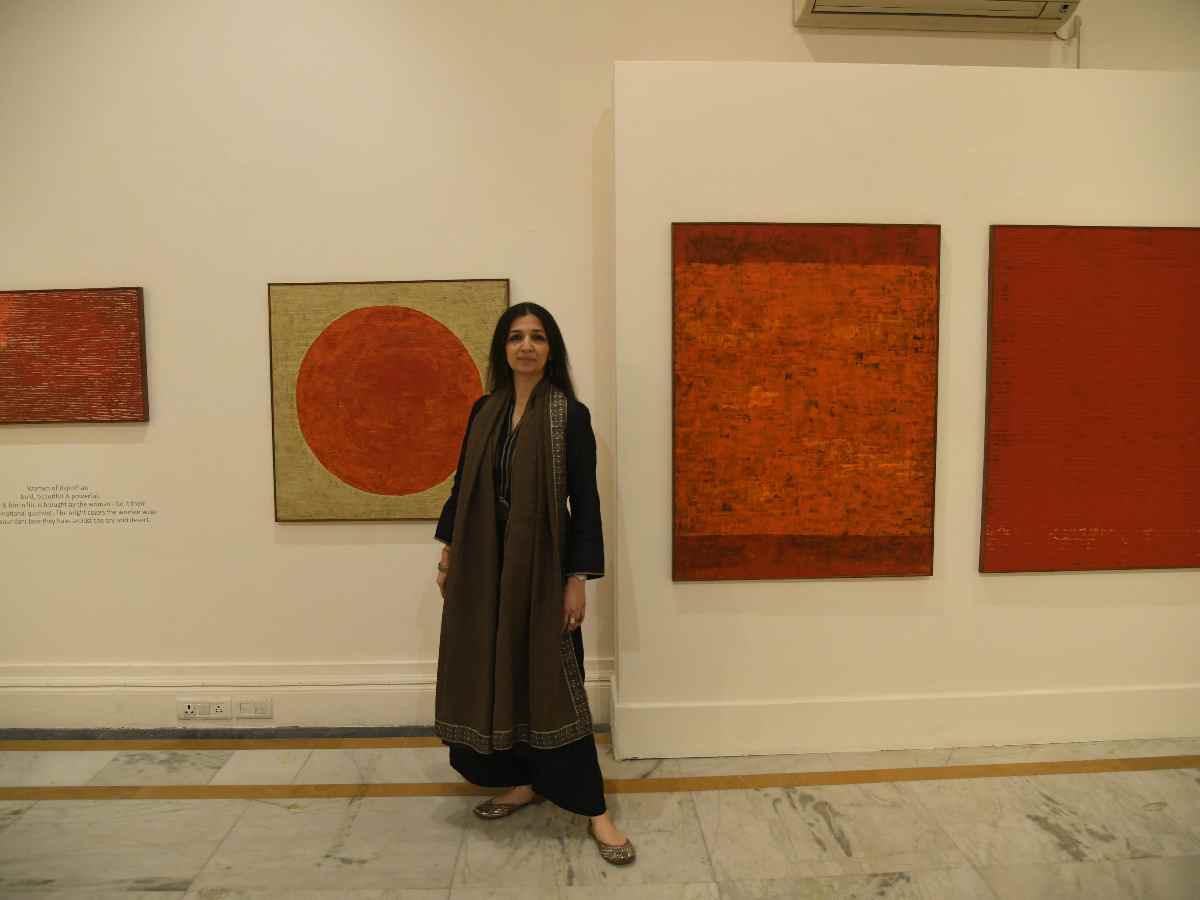
On a winter evening at Bikaner House, the desert arrived quietly — layered in acrylic, shaped by metal edges, and alive with movement. Sehrā-e-ret – The Dancing Dunes, the debut solo exhibition by architect and artist Mansi Trehan, unfolded as a contemplative encounter with sand, memory and form.
Held at Kalamkar Gallery, the preview on January 3 drew architects, artists and dancers. Chief Guest Professor KT Ravindran and Guest of Honour Padmashri Geeta Chandran underscored the exhibition’s central idea: that architecture, dance and painting can share a common language of rhythm and space.
Where architecture loosens its lines
Trehan comes from a four-decade-old architectural practice — Planners Group Pvt Ltd — and has spent over eighteen years designing institutional and healthcare buildings in Delhi. That training informs her paintings, but without rigidity. Structure softens into flow.
Her 31 paintings, executed in acrylic on canvas and wooden boards, are built using an unusual tool: the patti, a rectangular metal sheet commonly used on construction sites. In her hands, it becomes a painting instrument, creating layered textures that feel scraped, built and eroded.
“Any everyday product can become a painting tool,” Trehan says. “It’s about being sensitive to your surroundings.”
The desert as inner landscape
Inspired by the shifting sands of Jodhpur and Jaisalmer, Sehrā-e-ret presents the desert not as a fixed geography but as a living force — constantly moving, remembering, erasing and renewing.
“The desert has a quiet power,” Trehan said. “It is always moving yet deeply still. As we walk through life, we leave traces behind. Sometimes the wind preserves them, sometimes it erases them.”
That tension between memory and impermanence runs through the exhibition. Dunes ripple and dissolve, surfaces bearing the suggestion of time passing patiently rather than dramatically.
Painting on surfaces with a past
Several works are painted on wooden boards, some reused from architectural models. For Trehan, surfaces that carry history allow greater freedom.
“When a surface already has a past, it invites experimentation,” she says.
The choice reflects her tactile relationship with materials, shaped by years spent moving between construction sites and studios.
Women, colour and quiet strength
The presence of Rajasthan’s women runs through the exhibition — not as figurative representation but as emotional force. Their strength emerges through colour, texture and movement.
“Women play multiple roles; they are all-encompassing,” Trehan says. Having grown up around strong women, she channels that experience into layered compositions that hold both restraint and vitality.
When dance enters the canvas
A trained Bharatanatyam dancer who completed her arangetram under Geeta Chandran in 2006, Trehan sees movement as integral to painting.
“Much like dance,” she explains, “painting directs the viewer’s eye — layer by layer — into a certain rhythm.”
The canvases respond accordingly, drawing attention and releasing it in measured cadence.
A debut that feels inevitable
Though Sehrā-e-ret marks Trehan’s first solo exhibition, it feels less like a departure and more like a convergence. Architecture, dance and painting — long intertwined in her practice — come together here with clarity.
“For me, these are all ways of telling larger stories,” she says. “Through art, I want to evoke stillness and introspection.”
In a city that rarely pauses, Sehrā-e-ret – The Dancing Dunes offers a moment of quiet — where texture becomes memory, landscape turns inward, and movement finds its calm.
An FIR over Jamia protests alleges Congress MPs Imran Pratapgarhi and Imran Masood unlawfully entered…
Delhi's 'Namo Yamuna River Safari' cruise will launch before Chhath, offering 40-minute family trips between…
Delhi's Old RTR flyover reopens for light vehicles today after repair work following road cracks,…
Visits to Govindpuri, Jangpura, Saket and Mayur Vihar show unlabelled corrosive substances sold for Rs…
Rescue teams recovered two bodies from the debris of a collapsed under-construction house in northeast…
Built on Jawaharlal Nehru’s vision, the Delhi landmark has witnessed the evolution of a young…
