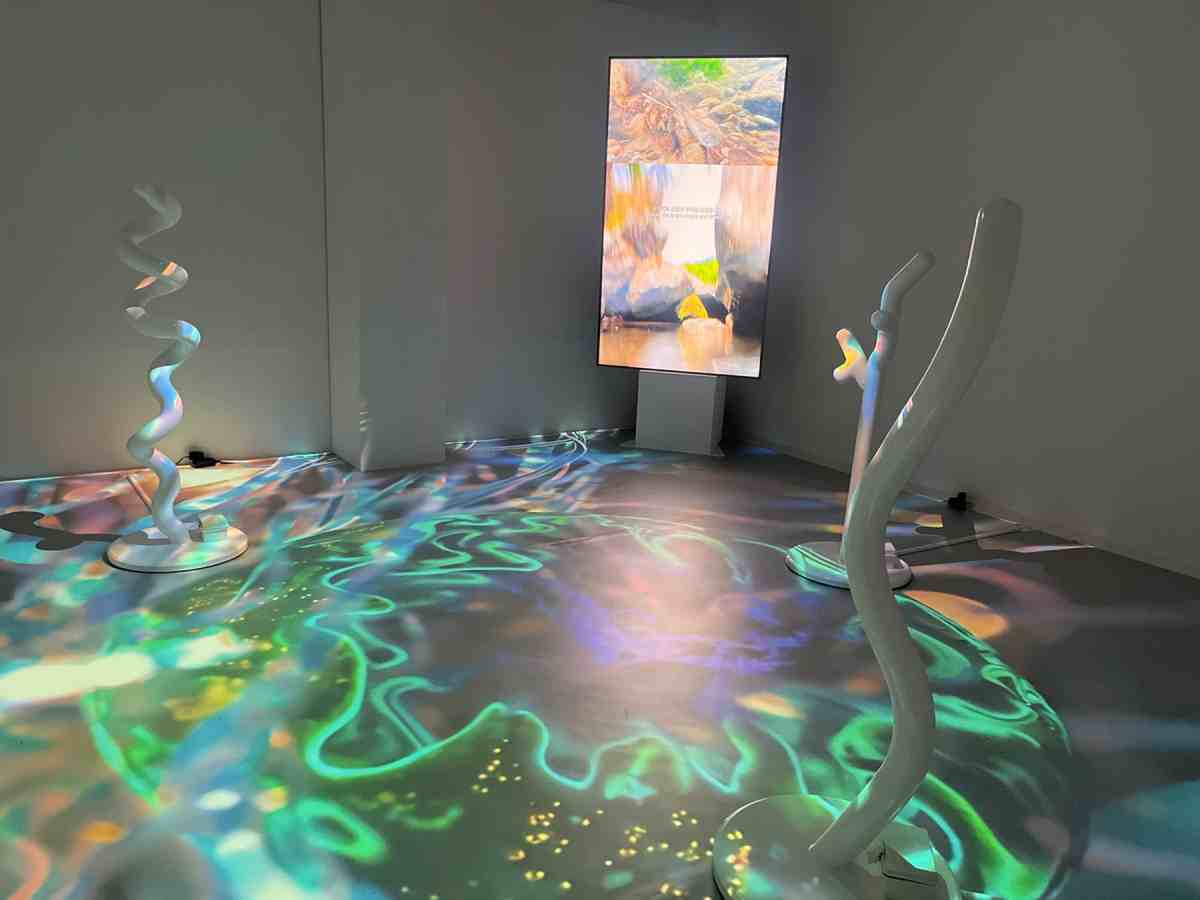
Art Work 'Liquid Vision' by artist Hyewon Kwon
The glass bottles in Ocean Tears look almost decorative. Filled with tiny coloured fragments and arranged in rows, they catch the light inside the Korean Cultural Centre India gallery. It takes a moment to realise that the fragments are microplastics collected from the sea.
The installation is by South Korean artist Jung Eunhye, who works with the environmental art collective Eco Orot. Around 400 droplet-shaped bottles, fishing nets, branches and marine litter form the work. The materials appear delicate, but their origins are troubling.
“People often say the bottles look pretty,” Jung said. “That is heartbreaking.”
Ocean Tears is among four works in Aqua Paradiso, alongside Kwon Hyewon’s Liquid Vision, BOO Jihyun’s Where is it going, and Eco Orot’s Plastic Mandala. The exhibition is on view in New Delhiuntil August 19.
The plastic inside beauty
Jung collected the microplastics from Hamdeok Beach in Jeju. Preserved inside glass bottles, the fragments no longer resemble waste. They look like beads or coloured stones, a transformation that creates unease.
The artist describes them as remnants of human consumption that have spread through oceans and coastlines around the world.
The installation also includes bird nests woven from discarded fishing nets and branches. The nests point to the interconnectedness of land and sea.
“Plastic strings now appear in the nests of forest birds and seabirds alike,” Jung said.
In Plastic Mandala, Jung uses debris gathered from beaches to create circular patterns inspired by a dead red sea turtle and the return of a green sea turtle. The work is repeatedly assembled and dismantled, suggesting that plastic never truly disappears but continues moving through water and across land.
Rivers through a machine
Kwon Hyewon’s Liquid Vision approaches water from another perspective. The two-channel video and interactive sculpture installation imagines Earth’s water systems through the eyes of an extraterrestrial exploration robot.
The work follows rivers through valleys, wetlands and reservoirs. Visitors can touch three sculptures to trigger images and fragments of memory, mimicking the act of reading a machine’s recollections by hand.
The installation explores what happens when rivers are understood through screens, maps and data. Water can be measured and monitored, but the work points to the gap between recording a river and experiencing it directly.
Lamps after labour
BOO Jihyun’s Where is it going uses squid fishing lamps that once illuminated fishing boats. Installed with circulating water and LEDs on an abandoned vessel, the lamps cast shifting reflections across the work.
The artist frequently reuses discarded fishing equipment. Here, the lamps retain their connection to labour while taking on new meanings linked to movement and reuse.
The installation asks a simple question: “Where does the water we use come from, and where does it go?”
The question also applies to the lamps themselves. Like water, they have passed through cycles of use and abandonment. Water moves through homes, pipes, rivers and seas, while waste follows its own routes through the same landscapes.
Water as more than utility
At the exhibition’s opening, South Korean Ambassador to India Lee Seong-ho spoke about the shared cultural importance of water in India and Korea.
“In both cultures, water has spiritual meaning beyond its utility,” he said.
He referred to purification rituals, sacred offerings and the belief that a dip in the Ganges can cleanse the soul.
Aqua Paradiso offers no direct solutions to pollution or climate change. Instead, it stays with the evidence: plastic preserved in glass bottles, fishing nets woven into nests, abandoned lamps, and rivers translated into data and memory.
In Ocean Tears, water carries waste. In Liquid Vision, it becomes memory and information. In Where is it going, it moves alongside the remains of labour.
Together, the works invite viewers to consider what water absorbs from human activity—and what it eventually returns to us.
The Supreme Court will hear a plea on Sunday seeking contempt action against authorities for…
Over 7,000 protesters, including CJP chief Abhijit Dipke, were detained as security forces sealed off…
Mamata Banerjee called Delhi’s crackdown “beyond Emergency” after being detained during a protest against Gyanesh…
From kuttu ki poori and sabudana to paneer and festive desserts, these restaurants have put…
Sonam Wangchuk condemned the arrests of student and youth leaders in Delhi, calling the situation…
Court said Sharjeel Imam apparently violated bail conditions by contacting media but refused to cancel…

