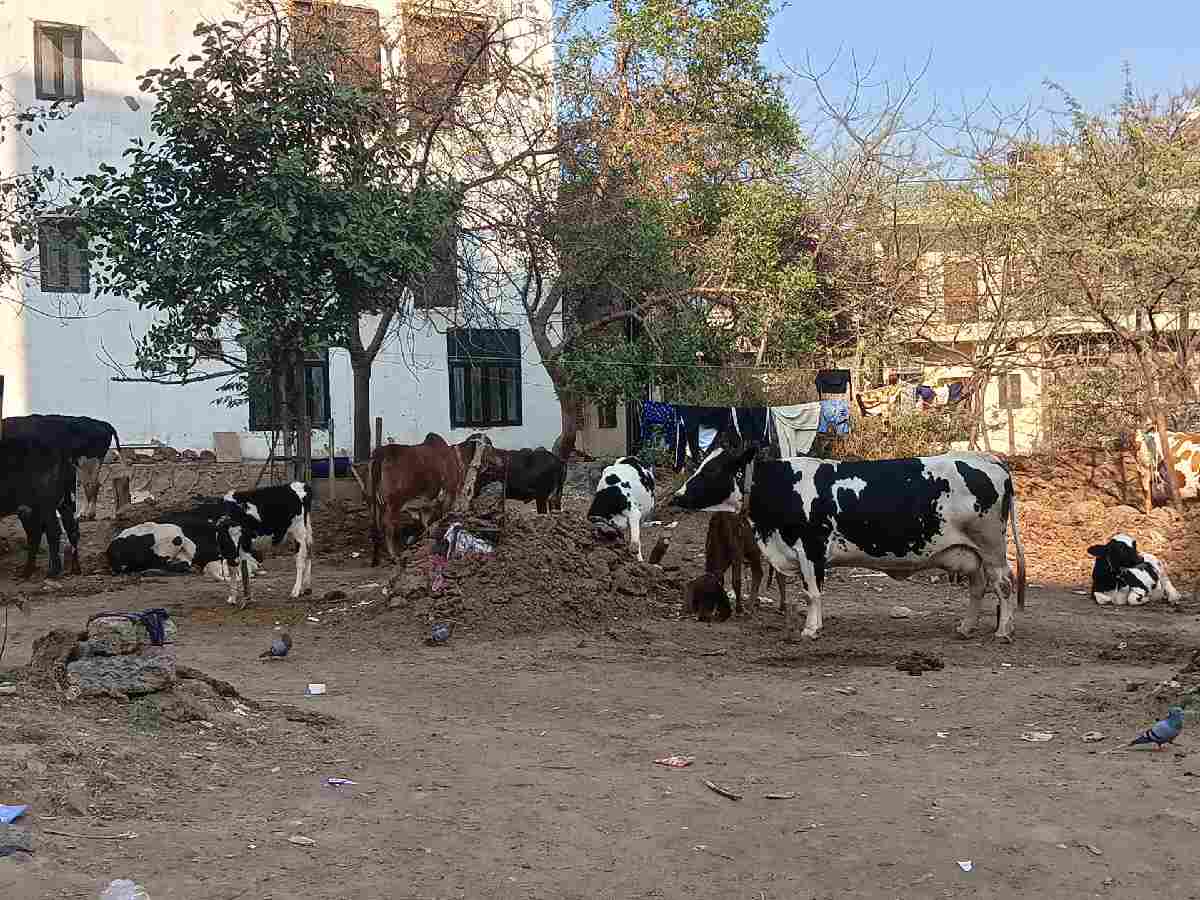
Lado Sarai's farmlands now hold only buildings
A sprawling parking lot now occupies what once was fertile farmland in Lado Sarai, a village with deep historical roots. Once an agrarian hamlet and mainstay of the Delhi Sultanate during the Lodi dynasty, Lado Sarai has transformed into a bustling urban village, its rural charm lost to urbanisation.
Changing landscape
Some residents of Lado Sarai trace their lineage back to the Sultanate era, though many families have since moved away. Once thriving on agriculture, the village gradually turned urban. Farms disappeared, replaced by densely packed houses. With time, urbanisation extinguished the agricultural way of life entirely.
Unfortunately, the urbanisation remained unchecked as large tracts of farmland were transformed into residential and commercial spaces. An entire generation that once depended on farming was told to work as one would in a town, with the authorities and the administration thinking they were doing a fairly decent job in bringing the residents of these villages into the mainstream.
Raj-era demarcations
These villages were referred to as Lal Dora habitations, named after the red lines used by the British to demarcate them. Presently, there are 357 such villages, of which 309 have been declared urban. Earlier this year, the Municipal Corporation of Delhi approved a proposal to grant urban status to the remaining 48 villages.
Once implemented, the selected villages will become eligible for structured urban planning and upgraded municipal services, including roads, drainage, sewerage networks, drinking water supply, street lighting and waste management systems.
The villages identified under the proposal are spread across North, North-West, North-East, South, South-West and South-East Delhi, where development pressure has risen sharply in recent years. Most of these villages are in the South West and North revenue districts, each hosting 69 villages.
The shadow of 1957
In 1957, administrators exempted these spaces from regulation under the Delhi Municipal Act, and six years later, the erstwhile civic body decreed that these areas need not adhere to building regulations. Consequently, the Lal Dora areas remain haphazard and underserved by civic utilities.
Thus, even after the aforementioned urbanisation, the situation has mostly remained the same. Building bye-laws are lacking, and structures keep emerging out of cramped spaces. Even if no new building is made, new floors still keep getting added beyond what Delhi’s seismic zone can handle. “The structural integrity is always in question here. People keep building either way,” said Rakesh Solanki, a resident of Lado Sarai.
Widespread problem
It’s not just Lado Sarai — 11 other villages in the Mehrauli constituency are also facing the same problem of unchecked proliferation of such buildings, including Katwaria Sarai, Ber Sarai, Masoodpur, Rajokri, Kishangarh, Kusumpur, Motilal Nehru Camp, Saket, Vasant Kunj, and Sewa Basti.
Much like Lado Sarai, many urban villages in Delhi are struggling with the impact of rapid urbanisation.
The collapse of a house on May 30 at the Saidulajab village in Saket triggered unrest in the national capital. Situated within Lal Dora zones, the settlements here are exempt from many of the building regulations that apply elsewhere in the city.
Multi-storey structures
The moment one ventures into the locality, one can see four to five-storeyed buildings dotting the skyline. None of these structures is meant to sustain the weight of these buildings, say residents and experts, adding that when a tragedy like this unfolds, people are mostly left to fend for themselves.
The situation remains similar the further north we move. To put matters into perspective, on June 2, an LPG cylinder blast shook Burari’s Mukundpur village as well. The blast had resulted in an entire house collapsing on itself, leaving 11 injured at the time of reporting. This incident also occurred in a Lal Dora area.
Neglect in plain sight
According to residents, multiple buildings with floors extending beyond permitted limits – with over five storeys in some cases – have sprung up in the area. “The government does most of its crackdowns on buildings in this area, including Burari. They keep coming to demolish buildings in Ashok Vihar and Shalimar Bagh; however, Mukundpur is left untouched. Civic officials barely come here unless absolutely necessary,” said Shiv Gurjar, a resident.
The lack of the civic agency’s presence is made only more obvious with the state of roads, as dust flies across the breadth of the village with the slightest breeze. The drainage system also remains in need of upkeep, with almost all of it being uncovered.
Also Read: From Gymkhana to Habitat Centre: a look at Delhi’s most iconic institutions
An official highlighted that even with the urbanisation of these spaces, the entire system present in Delhi would have to be overhauled to ensure the villages properly adhere to the laws, which have been streamlined. The lack of building bye-laws also means that there remains an absence of safeguards for residents building houses or adding floors to existing ones.
Lack of safety
Similar concerns have been reported from Sarai Kale Khan. Without any space left to breathe in the narrow alleys, the ancient village is slowly being choked by urbanisation. While the drainage issue remains a cause for concern among its people, especially after a heavy but momentary downpour that was felt in NCR the past week, the big problem is still the lack of safety measures. The dust storm in April 2025 still remains imprinted in the residents’ minds.
Rajveer Phogat, a resident and part of the village panchayat, which meets only to reminisce at the chaupal, remembers the alarm caused during the dust storm. “It was during the storm that we realised that most of the buildings in the area were unsafe. Bits and pieces of cement were being hurled here and there. The bigger the house, the worse it would get if the worst came to pass. Thankfully, nothing bad has happened till now. We have also survived a lot of earthquakes, but if one house falls, many others will follow,” he said.
NSUI president Vinod Jakhar was detained during a protest demanding an FIR over alleged assault…
SC refused an urgent hearing on a plea against NDMC’s Central Park closure over the…
Devotees visiting Hanuman Mandir and Gurdwara Bangla Sahib, shoppers, a gig worker and a couple…
Delhi Police has deployed over 6,000 personnel, 220 CAPF companies and additional CCTV cameras across…
A 30-foot cockroach effigy will be burned alongside Ravan in Pitampura's Ramlila to promote cleanliness,…
Delhi Police told a court no cognisable offence was found against CM Rekha Gupta over…


