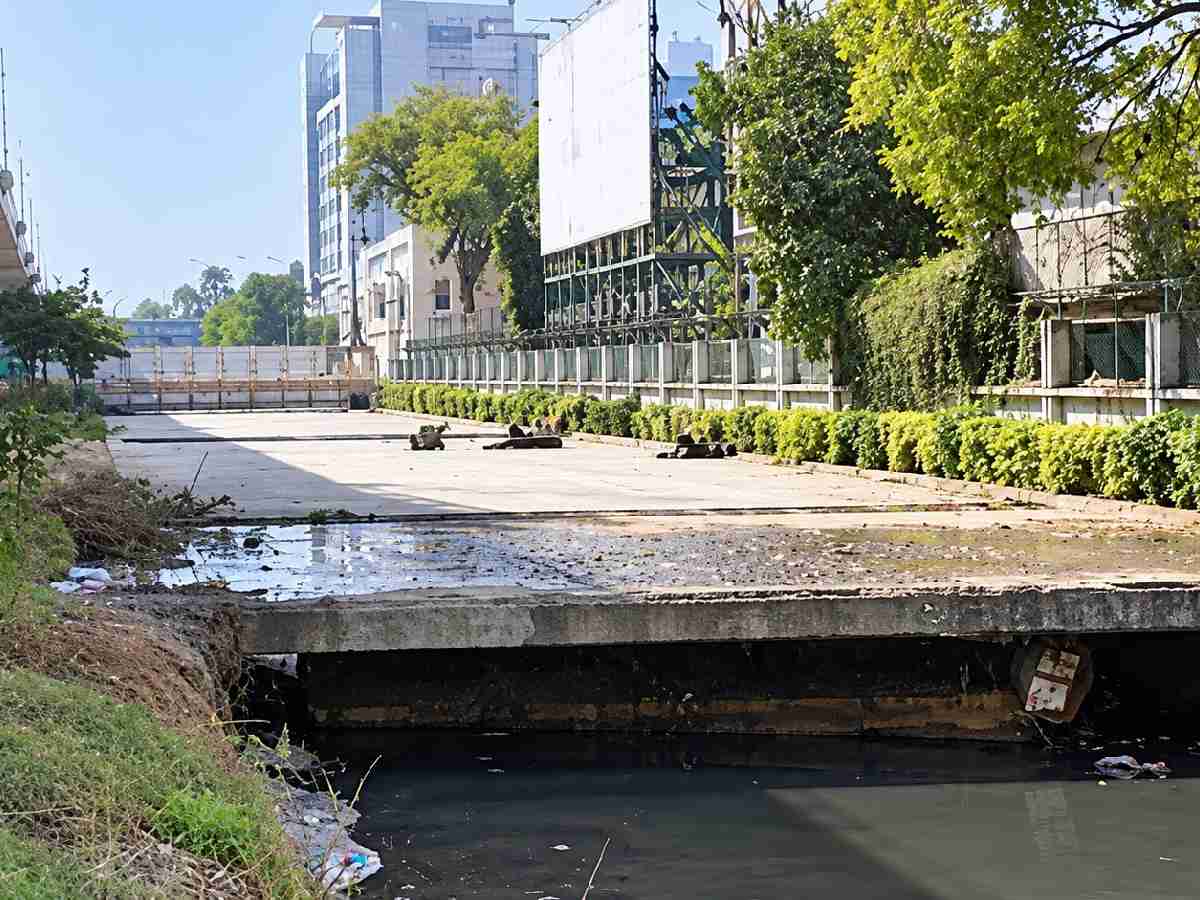
Waste and stagnant wastewater accumulate along the banks of a drain in Sahibabad
The Central Pollution Control Board (CPCB) identified high pollution levels at Sahibabad drain and inadequate tapping arrangements at 11 locations during inspections between May 2025 and April 2026.
At the Sahibabad drain, near the Shaheed Nagar Metro station on GT Road, wastewater was found to be moving through a wide channel carrying debris from nearby settlements and commercial areas. During a site visit, solid waste was visible along sections of the drain. The channel is one of the locations identified in a recent Central Pollution Control Board (CPCB) monitoring report.
The report covered drains discharging into the Yamuna in the Delhi-NCR stretch. It identified solid waste at 32 locations and inadequate tapping arrangements at 11 drains. Arrangements to intercept wastewater and direct it towards the sewerage system or treatment facilities before it reaches the river were found to be lacking.
Of the 11 drains, the report said seven had non-functional tapping arrangements, one was not operating, and three were functional but overflowing.
The CPCB identified 12 major hotspots, including drains in Palam, Ramesh Nagar, Nangloi, New Moti Nagar, Mungeshpur, Shahdara, Shahdara Link Road and Sahibabad.
Also Read: Where do we belong?’: Delhi tenants worry over SIR deletions
Recurring waste
The CPCB report recorded the highest average biochemical oxygen demand (BOD) at Sahibabad drain, at 393.25 milligrams per litre. Its average chemical oxygen demand (COD) was 858.67 milligrams per litre. Although the figures do not, by themselves, identify the precise contribution of each household, commercial establishment or other source connected to the drain, they indicate a substantial pollution load.
BOD measures the oxygen microorganisms need to break down organic matter in water. High levels indicate a substantial presence of biodegradable organic pollution. COD measures the oxygen required to oxidise pollutants chemically and is another indicator of the pollution load in a water sample.
For workers who clean drains, the work involves removing waste that collects in and around the channel.
“We come here to remove the waste that has collected along the drain and clear the sections that are blocked. Plastic, household rubbish, and other materials are mixed with the dirt. Sometimes we clean one part, but waste still builds up further down the drain. After some time, more waste collects in the same place. We can clean the section assigned to us, but we cannot control everything that enters the drain from different directions. If wastewater keeps coming and plastic continues to be thrown into the channel, the work has to be repeated,” said a worker.
The CPCB report separately recommends regular cleaning, preventing solid waste dumping and restoring tapping systems that are not functioning.
Also Read: 24 hours, no more: the rules on police detention
Shahdara drain
The report identified three drains in the Shahdara network with inadequate tapping arrangements.
During a visit near the Shahdara drain, wastewater was seen moving through the channel, with waste present along sections of its banks. The drain connects to the larger system that collects and discharges wastewater.
“People often see us cleaning the drain and think that the whole problem is being handled. But cleaning the channel is only one part of the work. If wastewater is coming through a damaged pipe, or if the arrangement meant to divert it isn’t working, the water will keep entering the drain. We can remove the visible rubbish or plastic, but we cannot repair a sewer line or change the direction of the wastewater ourselves. Those things require the concerned department of Irrigation and Flood Control Department and the Delhi Jal Board (DJB) to inspect the site and carry out the repair,” said a sanitation worker.
The CPCB report recommends restoring non-functional tapping arrangements and regularly cleaning drains. It also calls for preventing solid waste from entering the channels.
Also Read: Health warnings force Delhi-NCR pet owners to rethink costumes
What experts examine
Experts assessing polluted water commonly examine indicators such as BOD, COD, dissolved oxygen and faecal contamination. These measurements help establish the nature and extent of pollution, although individual indicators do not identify every pollutant or its source.
A water-quality scientist, SN Mitra, explaining the significance of such monitoring, said, “When we test a water sample, we are not simply looking at its colour or smell. We measure different parameters to understand what may be present in the water and how much pollution it carries. BOD tells us about the oxygen microorganisms use to break down organic matter, while COD gives a broader indication of chemically oxidisable pollutants. High values indicate a significant pollution load. However, read the figures alongside information about the drain, the surrounding area, and the wastewater entering it. Sampling at different points can help identify where water quality changes and where further investigation is needed.”
Administrative boundaries
The report monitored 52 sampling locations across the Sahibi river system, including the Najafgarh drain, Shahdara drain and associated drains. The exercise involved agencies including the National Mission for Clean Ganga, CPCB, the Delhi Pollution Control Committee and the DJB.
It recorded deterioration in water quality in the Sahibi river system after Najafgarh Jheel and identified significant pollution entering through drains originating in Gurugram.
The findings therefore cover pollution sources across administrative boundaries. Drains connected to the river system carry wastewater from different areas, and agencies responsible for sewerage, treatment, pollution control and municipal waste manage them.
An environmental scientist, Soumya Dutta, discussing the report’s findings, said, “Monitoring one drain can show the condition of the water at that particular point, but it does not always explain the entire route taken by the wastewater. It is important to examine where the drain begins, which smaller drains connect to it, whether sewage is being intercepted and where the water finally enters the river system. If a drain carries wastewater from more than one area, the investigation must also determine which sources contribute to the pollution. Water samples, inspections of infrastructure and records from the concerned agencies can be considered together to identify the points where action is required.”
Also Read: ‘Khoya-Paya’: how Delhi festivals handle missing children
The report identifies eight drains in the Sahibi network with inadequate tapping arrangements and three in the Shahdara network. It calls for authorities in Uttar Pradesh and Haryana to survey pollution sources and take remedial action.
At both Sahibabad and Shahdara, the drains form part of the everyday landscape, running alongside roads and populated areas. For people living and working nearby, the condition of these channels shows up in the wastewater, the rubbish along their edges, and the work required to keep them clear. The CPCB’s findings have placed these locations under scrutiny, while identifying pollution sources and maintaining the systems connected to the drains remain the responsibility of the concerned authorities.
A 15-year-old girl was injured when a balcony collapsed in northeast Delhi's Welcome area early…
AIMIM urged the Delhi Waqf Board to protect the Race Course Road mosque from demolition,…
Delhi woke up to poor air quality, with the AQI at 225 and minimum temperature…
Delhi HC will rule Oct 23 on AISA chief Neha Bora’s plea against a police…
A CREA analysis shows Delhi's winter AQI has seen no steady gain since 2022, with…
DMRC will plant over 28,000 saplings across 991 MCD parks in 3 months to offset…

