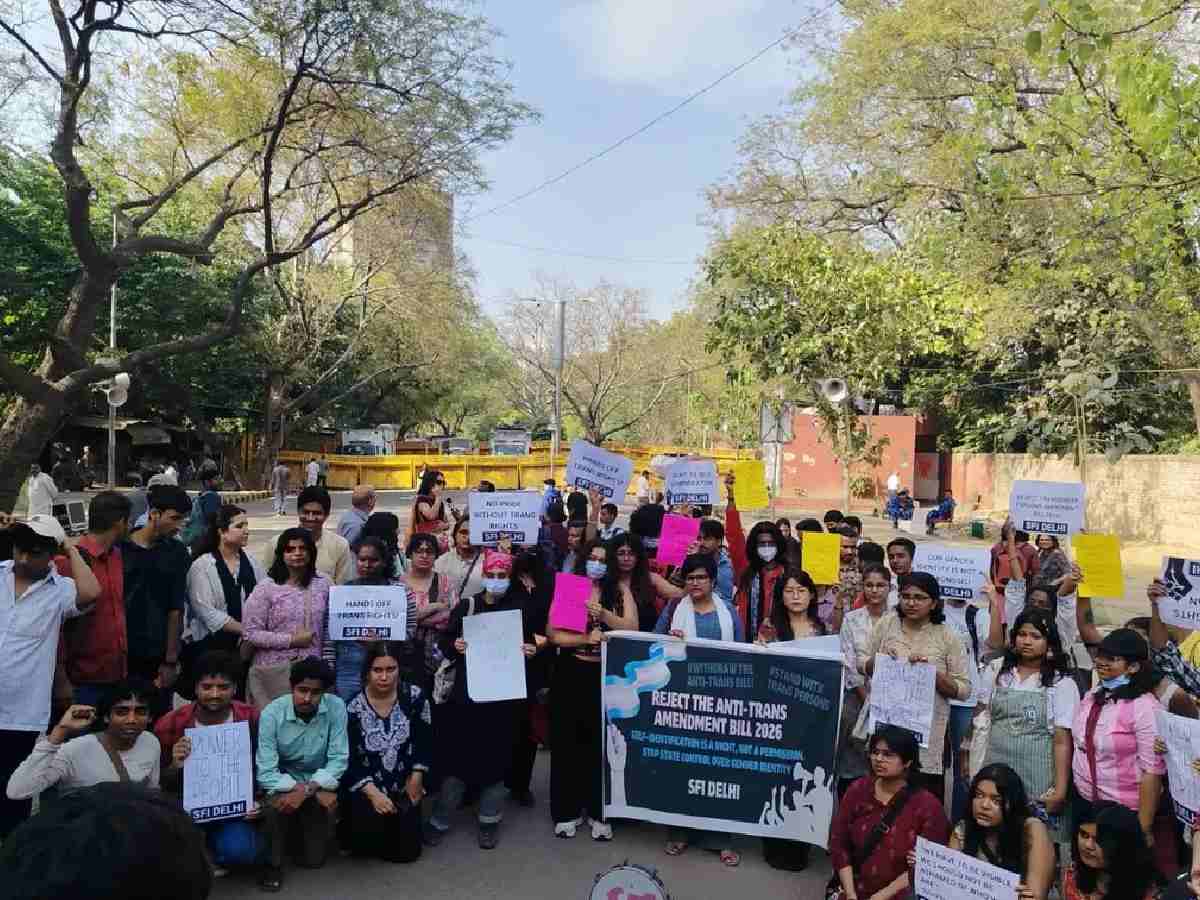
The enactment of the Protection of Transgender Rights (Amendment) Act, 2026, in May, comes as an important but incomplete remedy for transgender people in India, argue activists. While the Act acknowledges the rights of transgender people and makes provisions for their welfare, it leaves many affected groups outside its ambit, they say.
At the heart of the debate is the Act’s definition of transgender persons, which excludes individuals with “self-perceived” gender identities or varying gender expressions. The government has argued that the earlier definition (as specified in the 2019 Act) was too vague, and the new law was meant only for those who face “social exclusion” due to innate biological traits.
Cultural communities such as Kinners, Hijras, Aravanis and Jogtas, as well as individuals with medically verifiable intersex variations or congenital conditions, are covered by the new Act. The amendment also covers individuals who have been compelled to adopt a transgender identity through forced medical procedures, including mutilation or castration. By excluding self-identified gender identities, including trans men, trans women, and gender-queer individuals who do not fall into the categories listed earlier, the Act shifts the legal basis of transgender recognition from individual autonomy to biological and medical verification, claim critics.
‘Seismic’ shift
Raghavi Shukla, one of the first transgender lawyers to practice before the Supreme Court, says this “seismic” shift was the most contentious aspect of the amendment.
“It is no longer about who you say you are. It is about whether the system agrees.”
The Act is explicit about this exclusion. It states that the legislation never intended to cover the broader spectrum of gender identities or those with “self-perceived” gender identities.
Critics argue that the amended framework introduces medical scrutiny and administrative approval into the recognition process.
For those who cannot afford gender-affirming healthcare, the medical examination process could make legal recognition more difficult.
The amendment has raised concerns that trans men could lose legal recognition. While hijra communities have long enjoyed social and cultural recognition, trans men are less likely to fit into traditional gender categories.
The Act introduces provisions that require medical institutions to report gender-affirming procedures to district authorities. This, activists warn, could discourage individuals from seeking care. Further, Section 18 introduces penalties for “forced transgender identity.”
While intended to prevent exploitation, critics fear the provision could criminalise traditional support systems such as the gharana network. “There is no indication of evidence or data showing that existing laws were insufficient to address such harms. It risks criminalising care,” says Shukla.
Lower patient visits
The impact of the amendment is already being felt in hospitals.
In recent years, the ‘Transgender Clinic’ at the All India Institute for Medical Sciences (AIIMS) has witnessed a notable surge in young adults seeking medical support. As per data accessed by Patriot, since 2023, a specialised clinic has enabled gender-affirming surgery for at least 139 people (till January 2026). According to volunteer doctors associated with the clinic, however, patient visits have dwindled in the last few months.
“We have conducted seminars regarding the sensitisation required while dealing with trans persons around four to five months ago. Since February-March (the Bill was passed in March), the visits have been on the lower end. Sometimes the clinic has gone unattended,” a senior doctor said.
The Ram Manohar Lohia (RML) hospital, too, has been dealing with low patient visits.
In 2023, RML became the first government hospital in India to open a dedicated transgender outpatient department (OPD). However, when Patriot visited the hospital, the OPD was found locked, as was the toilet designated for transgender persons.
According to hospital officials, visits have remained low for the year. “We have conducted seminars and sensitisation programmes for transgender persons, but since the beginning of the year, the number of transgender patients visiting has remained low,” a senior doctor associated with the initiative said on the condition of anonymity.
Doctors have become cautious as well. According to Reva (name changed), a transfeminine person, many doctors have gone on the defensive because of the fear of being reprimanded by the authorities. “While many doctors sympathise with the community and us at large, they do not want to risk their practice. Many are resident doctors as well, and they fear that any association with a perceived ‘scandal’ could have professional consequences,” she said.
Stay order
On June 15, a Supreme Court bench led by Chief Justice Surya Kant stayed proceedings in four High Courts and sought responses to the Union government’s request to transfer all challenges to the law to the apex court. The government argued that having the cases heard together would help avoid conflicting judgments from different courts.
Solicitor-General Tushar Mehta has requested that the matter be placed before a three-judge Bench. Some critics have questioned whether this could be a step towards overruling the National Legal Services Authority vs. Union of India (NALSA) – a case which recognised the right of people to identify their gender.
Dr Jain argued that his challenge was based not on NALSA but on provisions introduced by the amendment itself. He contended that the law was not only unconstitutional but also unsupported by credible medical evidence.
After 12 years in theatre, the actor makes his international film debut with a role…
Protester alleges Delhi Police assaulted detainees, deleted phone videos, and detained minors during anti-CEC protest…
Shifting protests away from Jantar Mantar weakens democratic visibility and access to political power, an…
CM Rekha Gupta defends SIR and EC integrity, saying democracy can't be held hostage to…
AISA students march to Supreme Court over 'vote chori' claims against CEC, as police barricade…
DMRC extends closure of six central Delhi metro station gates until 5 pm citing security…

