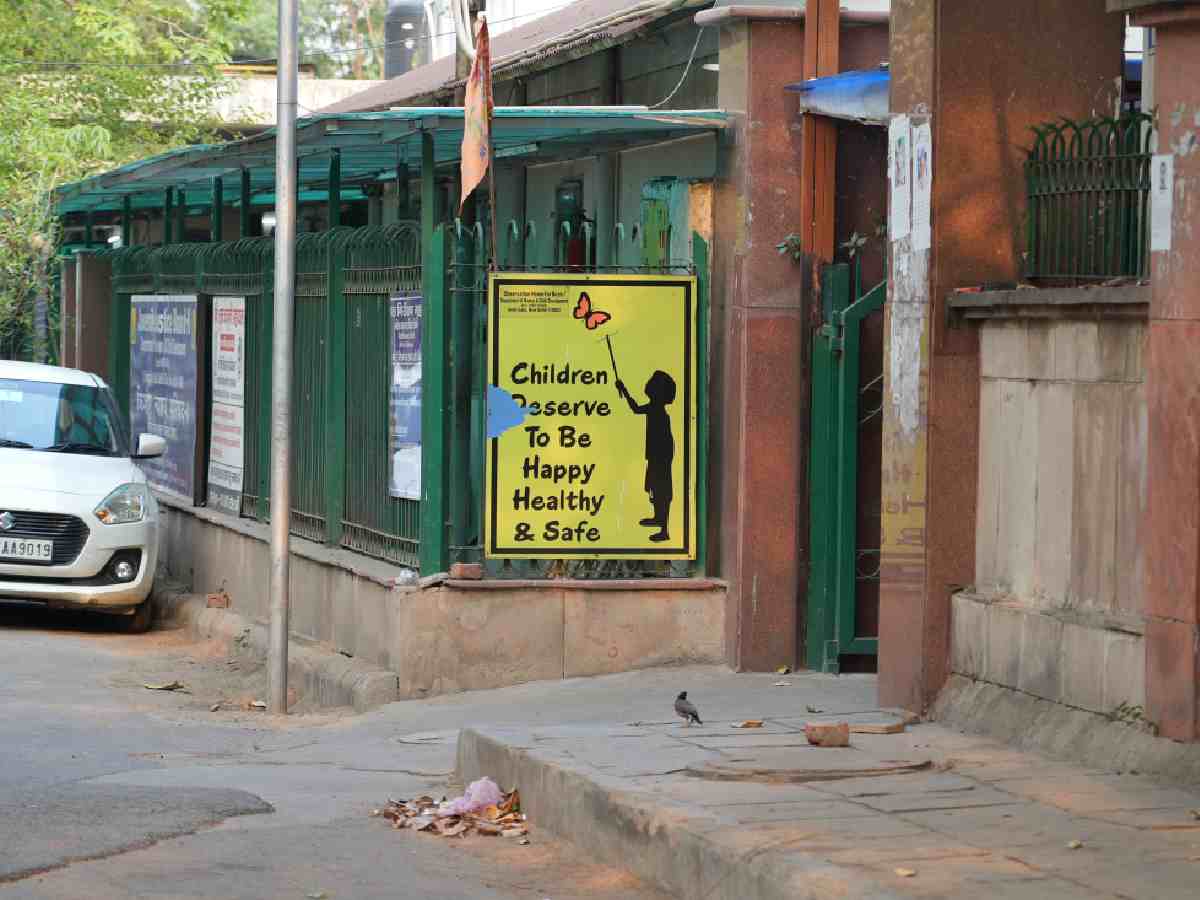
Observation home. Photo: Umar Dar
Set within a sprawling property in Kingsway Camp, the Observation Home for boys at the Sewakutir Complex appear as detached from civilisation as they feel. Though located in the heart of the national capital, the complex remains cut off from the daily hubbub. For most inmates, the only regular sound from the outside world is the rumble of the Delhi Police’s prison van making its daily visit.
Waiting at the precipice of the observation home’s entrance is mostly calm, with no serious situation unravelling. Apart from the police van, visitors are rare, mostly comprising representatives from non-governmental organisations, the courts, and the Women and Child Development department. Beyond this, footfall remains minimal. Yet, each time the prison van arrives, an uneasy chill creeps into the air.
As one such van arrives, a police officer and a security guard stationed at the entrance rush to the backdoor. With brisk efficiency, the officer unlocks the door to reveal a boy—barely 14—seated quietly inside. The officer extends a hand, helping him alight. Flanked by the guard, the boy is led inside. It will be a fairly long time before he sees the world outside again.
He is just one among many minors who must adapt to life inside Delhi’s network of shelter homes for juveniles in conflict with the law. Not just him, but a myriad of such minors have had to accustom themselves to the confined lives they now lead.
Is there enough space at Delhi’s child care institutions?
To understand the scale of the issue, Delhi hosts various types of juvenile facilities: Places of Safety, Observation Homes, and Special Homes. Yet, all these centres are reeling under the pressure of overcrowding.
According to data from the Delhi Police’s Special Police Unit for Women and Children (SPUWAC), as of April 8, 2024, the Adharshila Observation Home for Boys (OHB) at Kingsway Camp housed 163 inmates, while the OHB at Delhi Gate held 50, and the Observation Home for Girls at the Nirmal Chhaya Complex had five. Meanwhile, the Place of Safety for Boys at Majnu ka Tilla had 69 inmates, and the Place of Safety for Girls at Nirmal Chhaya housed none. The Special Home at Majnu ka Tilla held eight inmates.
However, the sanctioned capacities of these institutions paint a different picture: Adharshila OHB – 150, Delhi Gate OHB – 75, Nirmal Chhaya Observation Home for Girls – 20, Place of Safety for Girls – 30, Majnu ka Tilla Place of Safety – 60, and the Special Home – 40.
Despite Adharshila OHB’s relatively higher capacity, it struggles to maintain a liveable environment. The situation is no different at Majnu ka Tilla’s Place of Safety. Even though it accommodates selected juveniles, overcrowding remains unavoidable.
These categories were intended to streamline rehabilitation efforts. Yet, increasing overcrowding threatens to derail their reformative purpose.
Institutions for juvenile delinquents
The Juvenile Justice (Care and Protection of Children) Act, 2015 (JJ Act, 2015) defines key institutions for juveniles.
As per Section 2(40), an Observation Home is to be established by the State Government in every district (or group of districts), either directly or via a voluntary or non-governmental organisation, and registered under Section 47(1). These serve as temporary shelters for juveniles during inquiry processes. According to SPUWAC, these homes cater to children aged between 12 and 21. Children are further segregated by age and gender.
Under Section 2(56), a Special Home is established for juveniles who are found guilty following an inquiry. It is registered under Section 48 and offers rehabilitative services like education, skill development, counselling, behaviour therapy, and psychiatric support. The Juvenile Justice Board may order the placement of a child found guilty of a petty or serious offence—or a heinous offence if under 16—for up to three years. Separate facilities exist for girls aged above 10 and boys aged 11–15 and 16–18, based on offence type, age, and condition.
Also Read: City on the edge: Juveniles increasingly committing heinous crimes in Delhi, say police
Additionally, a Place of Safety is a facility—distinct from jails or police lockups—designated by the Juvenile Justice Board or Children’s Court to house juveniles during inquiry or post-conviction. These places are required to provide rehabilitation and reform for children above 18 or those who committed heinous crimes when aged 16–18. Reformative support during their stay includes education, therapy, and vocational training.
The State government is required to establish and maintain such Places of Safety, either directly or through NGOs, to ensure the care, treatment, protection, and development of children in conflict with the law. Separate provisions are made for juveniles aged 16 to 18 alleged to have committed heinous crimes, as well as those above 18 alleged or found to have committed offences when they were under 18, pending or post inquiry.
Thus, both Observation Homes and Places of Safety cater to undertrial juveniles mostly.
Overcapacity is more than just a number
Official estimates may suggest that capacity limits are respected, but the reality is more complex.
At Adharshila in Sewakutir, officials estimate that the home is currently housing around 200 inmates. Although capacities fluctuate, the consistently high numbers contribute to rising challenges—ranging from violence to drug abuse.
Routine inspections are conducted to control substance abuse. Juvenile Justice Board (JJB) members regularly visit the homes and conduct searches for narcotics. “There is some violence sometimes but nothing as such as blown out of proportion in recent times. Similarly, there is some drug abuse prevalent here, however, the inspections have prevented widespread usage,” said a senior official.
How successful is juvenile reformation?
A senior official from the Women and Child Development department confirmed that the government plans to demolish the current Observation Home at Sewakutir and replace it with a larger, modern facility. The new complex is expected to include an in-house probation officer, a move aimed at streamlining administrative and rehabilitative processes. While acknowledging that inmate numbers continue to rise, the official maintained that the total capacity across shelter homes remains “well under the capacity limit.”
However, infrastructure alone may not be enough to ensure effective reformation.
Shailabh Kumar, a lawyer and Head of Programmes at HAQ Centre for Child Rights, said that while conditions in Delhi’s juvenile homes are better than in many other states, the reform system lacks depth. He noted that children are offered limited vocational options and few educational pathways beyond basic schooling. “Their choices remain the same as they were before,” he said, pointing out that juveniles can only complete their high school education through open-schooling, with no provision for higher studies. The opportunities, Kumar added, are too narrow to enable meaningful rehabilitation.
Built on Jawaharlal Nehru’s vision, the Delhi landmark has witnessed the evolution of a young…
Delhi steps up NCR coordination to curb winter air pollution by enforcing strict border checks…
Police probe all angles, including a suspected breakup and CCTV footage, after a Class 12…
Two terror attacks, eight years apart, struck ordinary shoppers and changed festive celebrations in the…
NDMC to build a larger tulip garden with parking at Nehru Park, featuring seasonal blooms,…
A 17-year-old student was found burnt at an east Delhi school, with police probing a…

