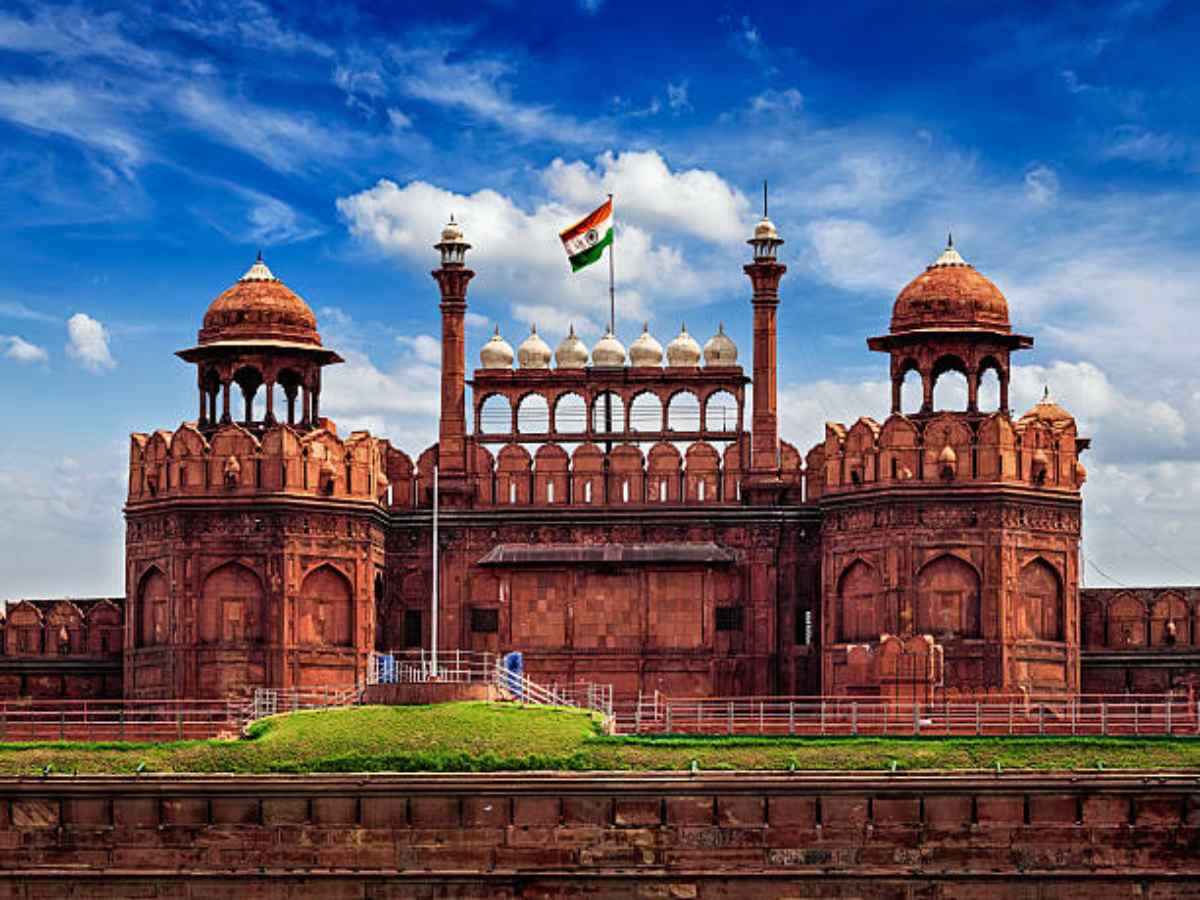
Red Fort
Delhi will celebrate its Foundation Day on November 1.
Is it the right day to celebrate the foundation of an ancient city? On November 1, 1956, Delhi’s young elected assembly was abolished, a change that even the council of ministers and the newly elected Chief Minister Gurmukh Nihal Singh had not anticipated. Delhi ceased to be a Part-C state and became a Union Territory.
That date is now Delhi Foundation Day, although it is certainly not the day the city was born. Kings, sultans and the British had already built, reshaped and, at times, broken Delhi many times over.
Cities, after all, do not have one birthday; they have many lives, and Delhi is an extreme example. It has been Indraprastha in legend, Lal Kot under the Tomars, a Sultanate Capital, Shahjahanabad under Shah Jahan, imperial New Delhi under the British, and the capital of a free republic. Yet the government marks November 1 because that was the day the States Reorganisation Act turned Delhi into a Union Territory and abolished its young assembly. Is that the right day to celebrate?
A birthday chosen by law
Across India, November 1 is a map-making day, marked by Andhra Pradesh, Karnataka, Kerala, Madhya Pradesh and others because the States Reorganisation Act of 1956 redrew the political map of the country. Delhi joined that calendar, although its circumstances were rather different. Before that day, it had been a Part-C state with an elected government, with Chaudhary Brahm Prakash becoming its first chief minister on March 17, 1952. The States Reorganisation Commission subsequently argued that a national capital could not be governed like an ordinary state, and on November 1 the assembly and the council of ministers were abolished. That legal change is what the state now calls a foundation.
There is, nevertheless, a case for November 1. A Capital is not only stone and memory; it is also a file, a budget and a chain of command. “A Capital has its own unique system,” says Dr Pradeep Kumar, who teaches political science at Satyawati College. “Central government institutions, ministries and foreign embassies are located here. So its administrative structure also needed to be distinct.” In that sense, 1956 marks the beginning of the administrative Delhi that continues to shape the city, even if it does not mark the beginning of Delhi itself.
The irony is that Foundation Day commemorates the moment Delhi lost an elected government rather than the moment it acquired one. Omesh Saigal, a former Chief Secretary of Delhi, recalled the aftermath: the city “went back to being governed by a chief commissioner, without an elected government but with a strong bureaucracy.”
Representative institutions returned only gradually, with the Municipal Corporation established in 1958 and an assembly returning after the 1991 National Capital Territory Act and the 1993 elections. To call the abolition of self-government a “foundation” is a little like celebrating a lock as if it were a door.
Other dates have a stronger claim to Delhi’s physical history. On December 12, 1911, King George V announced at the Delhi Durbar that the Capital would move from Calcutta to Delhi; three days later, on December 15, two foundation stones were laid, and on February 13, 1931, Viceroy Lord Irwin inaugurated New Delhi.
Those dates created the physical capital — the wide roads, the secretariats and the idea of a planned imperial centre — but they are also unmistakably colonial dates. To make 1931 the city’s birthday would be to honour the stage while forgetting who later took the play.
A new Delhi
August 15, 1947, has a different and perhaps more consequential claim. That morning, the Capital of the Raj became the Capital of free India; within weeks, the same city had become a vast refugee camp, while its population nearly doubled between 1941 and 1951. Colonies, markets and a new Punjabi energy reshaped everyday Delhi, altering the city as profoundly as any imperial plan had done.
“I feel that August 15 cannot become the foundation day of Delhi, as the day belongs to the nation. Delhi would be celebrating itself on a day that is not only its own,” says Firoz Bakht Ahmed, former Chancellor of Maulana Azad National Urdu University.
Go further back and the difficulty becomes greater still. Shahjahanabad was founded in the seventeenth century, and its Jama Masjid and Red Fort continue to define the old city; the Delhi Sultanate made this plain a capital in the 13th century, while the Tomars and Chauhans established earlier centres of power. Legend reaches further back still, to Indraprastha. Delhi, however, is not only the story of buildings and rulers; it is also the story of the common people who founded, nurtured and inhabited the city across its successive transformations.
Even the Municipal Corporation cannot agree on its own birthday, with civic historians offering 1863 and 1958. A city that cannot date its municipality will not easily date itself.
One city, many beginnings
So is November 1 the wrong day? Not exactly. It is simply a narrow one: it belongs to the modern Union Territory, rather than to the seven cities that preceded it, the refugee markets that transformed it, the Metro map that subsequently connected it, or the river and the ridge that have outlasted its political arrangements.
“A wiser public culture would keep November 1 and refuse to let it stand alone. Mark February 13 as the day the planned capital was opened. Mark August 15 as the day that capital became free and crowded, and new. Teach schoolchildren that Lal Kot, Siri, Tughlaqabad, Shahjahanabad and New Delhi are all Delhi,” suggests Maqsood Ahmed, who teaches at Anglo Arabic School.
Delhi does not need a better single date; it needs the honesty to acknowledge that a city this old cannot be contained within one calendar square. November 1 is a useful square. It is not the whole page.
Each day of closure costs shops in Khan Market and Connaught Place between Rs 60,000…
Delhi generates nearly 15,000 tonnes of waste daily, prompting the government to deploy 1,000 mechanical…
Delhi Police has issued an NOC for the Congress rally at Ramlila Maidan on November…
CJP chief Abhijeet Dipke received conditional bail following his arrest for participating in a Connaught…
The DPCC has floated ₹104 crore tenders to test pilot pollution-control technologies across 40 key…
MCD pushes Bhalswa cleanup to Feb 2027 due to agency transition, leaving over 10 lakh…


