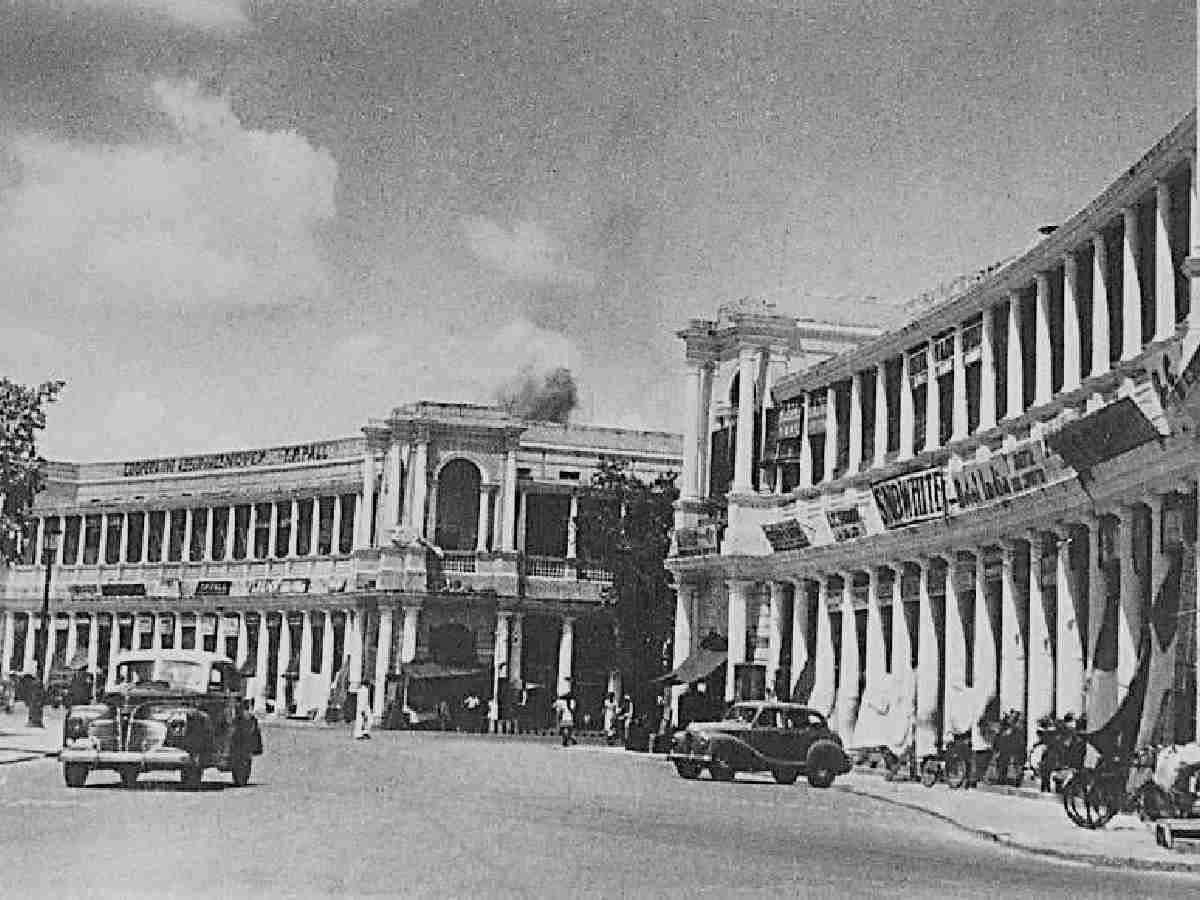
The Connaught Place Inner Circle in the 1950s
Every summer, Connaught Place remains one of Delhi’s busiest destinations. Less than a century ago, however, much of the market shut down for months as traders packed their goods and followed the British administration to Shimla.
Many traders in Delhi’s iconic shopping district still remember the days when most businesses shut for the summer. Before Independence, several Connaught Place establishments also operated branches in Shimla, often under the same names, including Gendamal Hemraj Departmental Store (in Regal Building), Kinsey Brothers (in Block ‘A’, near Wengers), Shimla Studio and Devichands’ Drapers, Tailors, and Outfitters. Even today, photographs taken at Kinsey and Shimla Studio can be found in family albums across Delhi.
Hill station transformed
Connaught Place and Shimla shared close ties because of the British administration. Much of the higher colonial administration in Delhi shifted from April to October to Shimla, which had been declared the summer capital of British India in 1864 by Viceroy Lord John Lawrence.
Lawrence chose the cool hills to escape the extreme heat of the plains. Every summer, hundreds of British officers, their families, clerks and senior Indian officials made the long journey to Shimla, transforming the small hill station into a bustling centre known as “Little England”. The British recreated elements of their homeland there, building churches, clubs, cottages and gardens.
“The Connaught Place looked empty. Shopkeepers found it better to follow their customers to Shimla rather than stay in a nearly closed market,” RP Puri, the legendary owner of Central News Agency, once told this writer.
This seasonal migration was practised mainly between 1933 and 1946. After Independence, when government offices began functioning permanently from Delhi, Connaught Place shopkeepers stopped relocating to Shimla each summer. Connaught Place gradually became a year-round commercial hub. Yet memories of those annual migrations still survive in the stories of old shopkeepers and their families.
Shifting schools
It was not only Connaught Place’s businesses that moved to Shimla. Schools did too, notably Union Academy School in Raja Bazaar, next to Connaught Place, and Harcourt Butler School on Mandir Marg. Most of their students were children of government employees, so entire schools relocated with their teachers and staff, allowing classes to continue uninterrupted while parents worked in the summer capital.
Established in 1917, Harcourt Butler School is regarded as the first government school in New Delhi. Named after Sir Spencer Harcourt Butler, a senior British official, it taught Urdu and Persian in its early years.
Partition profoundly affected the school. Dozens of students and several teachers left for Pakistan, while refugee families arriving from the newly created country enrolled their children at the school. Urdu and Persian gradually disappeared from the curriculum. For decades, the school served the children of government officials and elite families living in Connaught Place and Baba Kharak Singh Marg, then known as Irwin Road.
Former students such as Krishan Bhargav recall that when they attended the school in the 1960s, many teachers still spoke about the annual move to Shimla. Those stories survived as living memories of an earlier era.
Union Academy School was long regarded as the school of Delhi’s Bengali community. Originally established in Shimla as Bangali Boys School, it moved to Delhi in 1939. Even after relocating, the school continued returning to Shimla during the summer for several years. Its Raja Bazaar building was constructed by the renowned Delhi contractor Sardar Sobha Singh and still stands today.
Also Read: A walk through Delhi’s Japanese heritage
Former principal Manju Majumdar says old books and documents preserved in the school library still testify to the institution’s longstanding links with Shimla.
This shared summer rhythm between Delhi’s commercial heart and the Himalayan hill station remains a fascinating chapter in the city’s colonial history. Although air conditioning and modern infrastructure have transformed Delhi’s summers, the stories of Connaught Place and Shimla continue to fascinate historians, writers and local residents, recalling a time when the rhythm of the seasons shaped life in India’s Capital.
Elected to the Delhi Golf Club general committee, Mansher Singh says he wants to build…
A $780 million market built on pavements, where the pleasure of reading meets the price…
Supreme Court advocate Abhishek Pawar alleges women were denied washroom access for seven to eight…
Each day of closure costs shops in Khan Market and Connaught Place between Rs 60,000…
Delhi generates nearly 15,000 tonnes of waste daily, prompting the government to deploy 1,000 mechanical…
Delhi Police has issued an NOC for the Congress rally at Ramlila Maidan on November…

