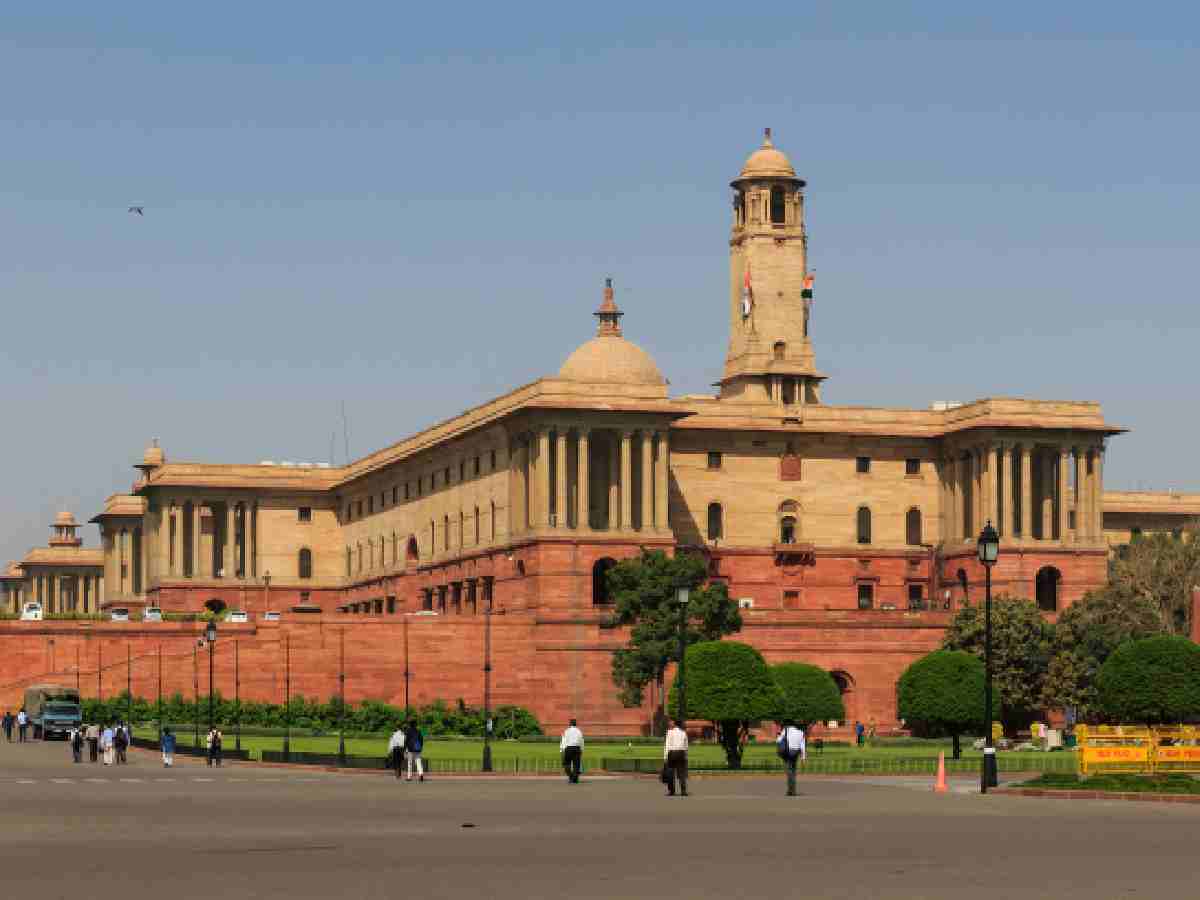
A view of North Block
When Union Finance Minister Nirmala Sitharaman presents the Union Budget for 2026–27 on February 1 in Parliament, it could mark the end of an era. It may well be the last Union Budget prepared in the majestic North Block, the iconic colonial-era structure overlooking the South Block on Raisina Hill.
In fact, even this Budget has not been entirely prepared within the walls of North Block. Several departments of the Ministry of Finance have already shifted to the new Common Central Secretariat (CCS) Building I—now known as Kartavya Bhawan—near the Central Vista. This transition, which began in late September 2025, is part of the government’s larger effort to modernise administrative infrastructure, promote digital and paperless workflows, and consolidate departments under one roof.
If one turns the pages of history, North Block emerges as a silent witness to some of the most defining moments in India’s fiscal journey. It was here that India’s first interim Budget was presented on February 2, 1946, by then Finance Minister Liaquat Ali Khan, who later became the first Prime Minister of Pakistan. At the time, Pandit Jawaharlal Nehru headed the Interim Government, which included members from both the Congress and the Muslim League.
The preparation
Nestled at the heart of New Delhi’s Raisina Hill, the North Block stands as a powerful symbol of colonial-era architecture and post-Independence governance. Designed in the early 20th century by the renowned British architect Herbert Baker, the imposing structure became home to the Finance Ministry of independent India. Within these historic corridors, one of the country’s most secretive and consequential annual exercises has unfolded year after year—the preparation of the Union Budget.
The Union Budget, officially termed the Annual Financial Statement under Article 112 of the Indian Constitution, lays out the government’s fiscal policy by projecting revenues and expenditures for the financial year running from April 1 to March 31. Prepared by the Budget Division of the Department of Economic Affairs in the Ministry of Finance, the document influences everything from macroeconomic growth strategies to social welfare schemes.
Shrouded in secrecy
“The process is shrouded in secrecy, with North Block serving as the nerve centre, ensuring that no leaks compromise national economic interests. This tradition of confidentiality dates back decades, evolving from colonial budgeting practices into a highly sophisticated, multi-stage operation,” says a senior official of the Finance Ministry.
Budget preparation begins months in advance, usually around September, nearly six to seven months before the presentation in Parliament. Initial consultations are held with various ministries, states, and stakeholders, after which estimates are refined and negotiations intensify. As the process enters its final phase, activity becomes concentrated within the secure confines of North Block.
Key milestone
One key milestone is the Economic Survey, released a day before the Budget, which provides a comprehensive overview of the economy’s performance and challenges. Yet, the real drama unfolds in the last few weeks with the iconic Halwa Ceremony, a tradition that signals the beginning of the final stretch.
The Halwa Ceremony also marks the start of the much-talked-about “lock-in” period, a stringent security protocol designed to prevent any leaks. More than 100 officials associated with drafting and printing the Budget are sequestered in the basement of North Block and cut off from the outside world until the Finance Minister rises to present the Budget in Parliament. During this period—typically lasting 10 to 14 days—officials cannot leave the premises or contact their families, and all communication channels are closely monitored.
The basement houses a dedicated government printing press where the Budget documents are produced. This was not always the case. Until 1950, printing was done at Rashtrapati Bhavan, and later at Minto Road, before being permanently shifted to North Block in 1980 to enhance security.
Beyond logistics
North Block’s role goes far beyond logistics. Its architecture—with expansive halls, thick walls, and secure vaults—facilitates the isolation necessary for this exercise. Herbert Baker’s design, marked by red sandstone facades and domed structures, evokes permanence and authority, mirroring the Budget’s long-term impact on the nation’s economy. Despite the Finance Ministry’s relocation to newer buildings, Budget printing continues at North Block because of its time-tested security infrastructure.
On Budget day, the Finance Minister—carrying the traditional bahi-khata, reintroduced in 2019—presents the document in the Lok Sabha. This is followed by intense debates, voting on demands for grants, and eventual parliamentary approval. Over the decades, this meticulously refined process has reinforced North Block’s central place in India’s fiscal narrative.
Herbert Baker’s imprint
In essence, the preparation of the Union Budget within Herbert Baker’s North Block is a blend of tradition, secrecy, and precision. From Budget circulars to the halwa ritual, it reflects India’s evolving economic aspirations, safeguarded within walls that have witnessed the country’s journey from colonial rule to global prominence.
However, the curtains are now set to fall. With both the Finance and Home Ministries slated to fully vacate North Block in the near future, the next Union Budget is likely to be prepared entirely at the Ministry’s new headquarters. The decades-old association between the Union Budget and North Block is drawing to a close, marking the end of one of independent India’s most enduring administrative traditions.
The Supreme Court deferred pleas on Delhi protests and metro and train service curbs to…
A plea in the Supreme Court challenges restrictions on protests at Delhi’s Jantar Mantar and…
Delhi recorded an AQI of 138 in the moderate category on Tuesday, with the minimum…
A 29-year-old driver was allegedly beaten to death by nightclub bouncers in Delhi following a…
Delhi HC to hear pleas seeking regulation of protests in the capital on Tuesday, with…
From a Sikh family in Tilak Nagar performing Shastar Puja to a Malayali household inscribing…

