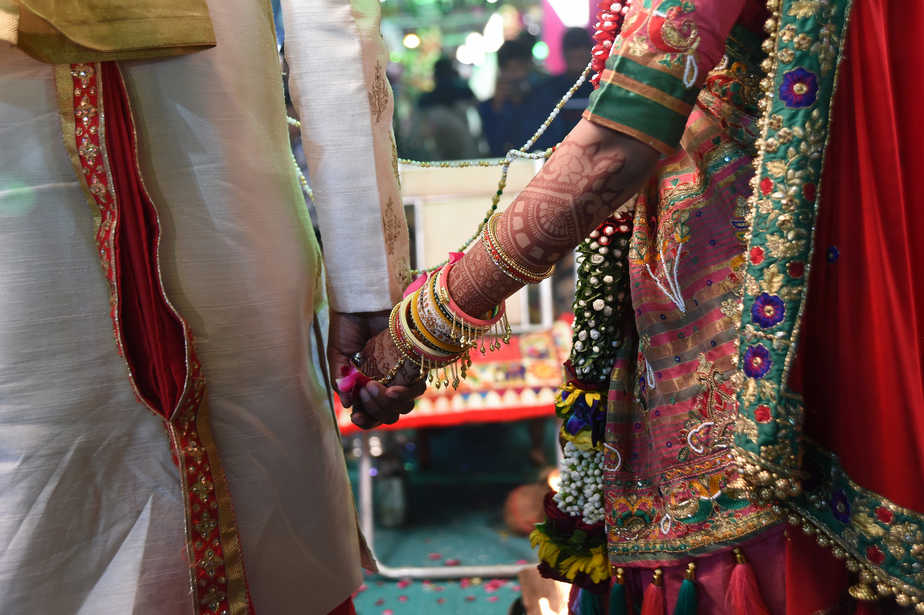
At his son’s recent wedding, businessman Jitender Singh Sahani introduced a friend to his wife with a familiar line: “Aye ve Rawalpindi waal ne” (He’s also from Rawalpindi). Sahani’s elders migrated to Delhi during Partition, and although generations have passed, the sense of belonging to their erstwhile city remains strong. When arranging marriages, Sahani and many like him seek matches from the same caste and, ideally, the same region of West Punjab.
In the bustling lanes of West Delhi’s Punjabi-dominated neighbourhoods—Rajouri Garden, Punjabi Bagh, Ramesh Nagar and Patel Nagar—the same sentiment surfaces every marriage season. One often hears: “Ladka ya ladki Lahore-Rawalpindi side se ho to accha rehga” (It’s better if the boy or girl is from the Lahore–Rawalpindi side).
Shaped by displacement
Among Delhi’s upper-middle-class Punjabi Khatri families who migrated as refugees in 1947, this preference for what they call “West Punjab refugee families” has endured with remarkable resilience. Even in 2025—nearly eight decades after Partition—the impulse to marry within this circle remains deeply rooted.
These families trace their lineage largely to Khatri and Arora clans, historically mercantile communities concentrated in Lahore, Rawalpindi, Multan, Lyallpur (now Faisalabad), Gujranwala, Sialkot and Jhelum.
Before Partition, Khatris served as the urban trading and administrative elite across western Punjab, while Aroras played similar roles in the canal-colony towns. When the Radcliffe Line cut across Punjab, almost the entire Khatri–Arora population of West Punjab moved eastwards, leaving behind flourishing businesses, havelis and ancestral shrines. They reached Delhi with little material wealth but strong social bonds, high literacy and a business acumen that helped them rebuild within a generation.
For Punjabi Hindu refugee families, two criteria have traditionally mattered for a matrimonial match — same caste and shared West Punjab origins.
According to noted author and astrologer Pandit J.P. Sharma ‘Laldhagewale’, “Punjabi refugee families—whether in Delhi or elsewhere—first match the horoscopes of the prospective bride and groom. If that hurdle is crossed, they look specifically for families originally from Lahore, Multan, Rawalpindi, Jhang and nearby cities.”
East Delhi-based businessman Manoj Sehgal says his family lived in Gujranwala for generations.
“Can we forget our roots so easily? Not at all. When we look for matches for our children, we ensure they share similar roots. My parents found brides for both my brother and me from West Pakistan. My brother and I are continuing the same tradition,” he says.
Lahori tehzeeb
Why does this preference endure in families that otherwise embrace modern lifestyles?
First, cultural continuity. Families from Lahore and Rawalpindi still take pride in what they call “Lahori tehzeeb”—a distinct cultural refinement, language, and robust food culture, especially their love for meat.
Also Read: A century of quiet faith: the free church at Jantar Mantar
Second, a prestige hierarchy persists within Punjabi society. Pre-Partition Lahore was the cultural and economic heart of undivided Punjab. Families who owned homes on Mall Road, taught at DAV College or ran wholesale businesses in Shah Almi Gate still command symbolic capital in matrimonial negotiations. A Multan-origin family may be wealthy today, but many Lahore–Rawalpindi families still label them “Multani”—coded as “less polished”. Conversely, families from smaller West Punjab towns often seek upward mobility by aligning with Lahori or Rawalpindi families.
Income Tax consultant SK Gambhir, whose family migrated from Multan, rejects this hierarchy. “Our Multani community in Delhi is proud of our roots. We are vegetarians, unlike many other West Punjab families. We certainly marry within our Multani community. We don’t discriminate against anyone,” he says.
Yet the strongest reason remains emotional: the desire to keep the memory of Partition alive through shared lineage. Every time a Delhi-born girl marries a boy whose grandmother also hid in a Mozang gurdwara in August 1947, Partition becomes a story of continuity rather than rupture.
This preference is not absolute. Love marriages and inter-community alliances do occur, but they tend to be exceptions that require explanation. When a Rajouri Garden boy married a girl from a Jalandhar-based Khatri family in 2022, his family reassured relatives: “The girl is very accomplished—and anyway, East Punjab and West Punjab are the same now.” The defensiveness was hard to miss.
This attachment to shared origins is mirrored across the border as well. If Punjabi Hindu refugees in India hold such preferences, Mohajirs—Muslims who migrated to Pakistan from Uttar Pradesh, Delhi and Bihar—follow similar patterns when arranging marriages. According to Islamabad-based senior journalist Hamza Habib, “Mohajir families from Delhi, Meerut, Moradabad, Banaras and other UP–Bihari cities prefer matches from the same background.” Habib is a nephew of historian Dr Irfan Habib. In 2004, Altaf Hussain, the Mohajir leader in Pakistan, told this writer in an interview: “We UP-wallahs only marry within UP-wallas in Karachi.”
Delhi HC will hear a PIL on Oct 16 seeking to allow peaceful protests at…
DU has approved a ₹5,889 crore plan to build and reconstruct hostels, creating residential accommodation…
Delhi LG said the capital’s development priorities are interconnected, stressing that PPPs must be chosen…
Delhi HC sought the Centre's stand on pleas to regulate protests, with traders and lawyers…
CJP founder Abhijeet Dipke warned of nationwide protests if Jantar Mantar is permanently closed to…
Delhi has made Aadhaar mandatory for power subsidies as allocation reached Rs 4,037 crore in…


