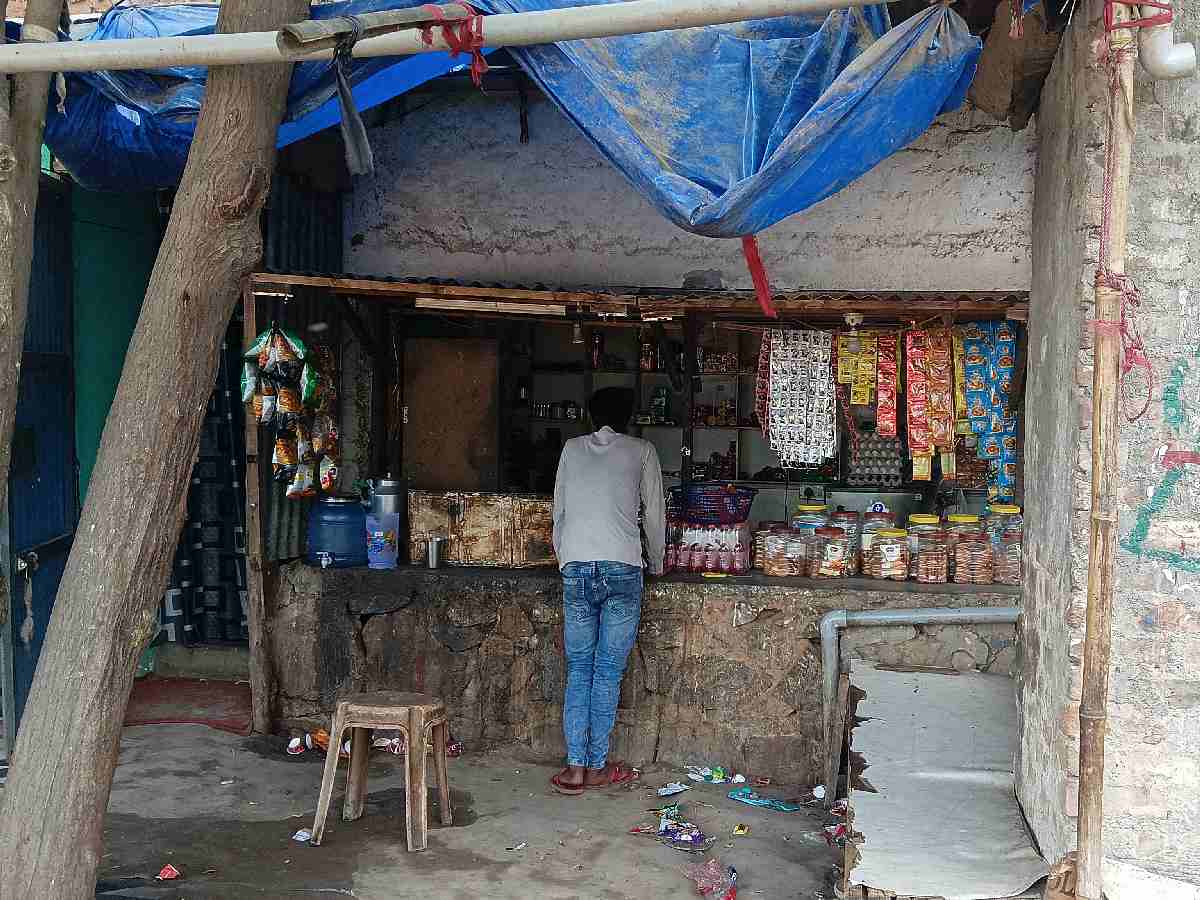
The local tea stall at the Jai Hind Camp slum cluster where almost all residents returned to West Bengal to vote, in swathes they determine beyond usual
Returning from Cooch Behar after about a week, Firdous, 33, found that he was now without a job. Working as a ragpicker, he resides in a pucca building in one of largest migrant slum clusters, Jai Hind Camp, near the more developed side of Vasant Kunj, Delhi. Many, like Firdous, have taken to working as ragpickers, collecting and selling scrap for paltry sums to make a living for themselves and their families.
However, even the process of participating in elections comes at a cost in these slum clusters, where people from Assam and West Bengal have lived for the past few decades. Every fifth year normally means returning to their state in the hope of making their voice heard. Unfortunately, this practice of participating in the democratic process has led to many losing work and income.
“I normally go door to door collecting scrap and garbage. I have a few houses I used to frequent; however, when I was away, I provided them with replacements. But when I returned after the elections, the ones I used to work for would not take me back, since the person I had suggested had been visiting them regularly,” said Firdous.
Now, he walks around the settlement, asking residents for work. “I had also suggested to some of them that I could help with their garbage, but most people are fairly unwilling to share their earnings. I did not think that I would face so much trouble just for returning to vote,” he said.
No support for family
His troubles are compounded by the loss of his livelihood, leaving his situation precarious, especially as he supports a family.
A father of two, he has been left with no choice but to look elsewhere for work. In the past week, he has taken up a few odd jobs within the settlement, mostly helping set up generators. Earlier in 2025, residents of Jai Hind Camp had fought with the Delhi government to restore their electricity supply. However, even after a year, it has not been restored, though this has created a small opportunity for Firdous.
“I never thought that I would be glad there was no electricity here. I make a living by arranging diesel and setting up the common generator. While it is not daily work, it is enough,” he said. Through his work as a ragpicker, he would earn around Rs 600 a day by selling scrap. “Most of it I would send home, but I would still have enough to live comfortably. But now, I have to carefully manage my finances since I have earned only Rs 1,000 in the past week, and the work is not regular,” he said.
The situation is similar for many women in the settlement, whose primary source of income is domestic work in posh societies in and around Vasant Vihar. Pooja, a single mother raising two children, also faced a cut in her earnings. She earns around Rs 12,000 a month by working in two households near the settlement.
Difficult to run household
“My husband died about a year ago. I have been trying to provide for my two children as best as I can, but it is difficult,” she said.
After her husband’s death, she could not go to work for nearly a week. “But the finances started drying up, and I had to return to work.”
While she had resumed her routine, the elections meant she had to travel again. “I went home to vote in Bankura. But after returning, I found my salary had been cut. Instead of Rs 6,000 that I would normally get from one house, I received half,” she said.
With almost a full month ahead, Pooja hopes for some relief, as managing two children on Rs 9,000 is proving difficult. “Voting is my right, but being penalised for exercising it has shaken my confidence,” she said.
Relative stability
For some, however, local opportunities have provided relative stability. Anand Banik, a resident of Jai Hind Camp and a voter from Assam’s Baksa, has faced fewer difficulties.
Running a small electrical appliance shop and working as an electrician, he is familiar with the settlement’s electricity issues. “I sell everything from emergency lamps to lights. I have not faced financial difficulties as such, since electricity is a major issue here. I am also the only electrical appliance seller in the area,” he said.
Also Read: Delhi plans fast-track regularisation of 1,511 unauthorised colonies
Yet, Banik believes the situation could change if more residents do not return. “Many are yet to come back to Delhi. If they do not return, it will affect both the settlement and my business,” he said.
Jiarul, 37, claimed that only about 10% of residents had returned.
For many in these settlements, the choice between exercising their right to vote and securing their daily livelihood remains difficult. As they return to Delhi each election cycle, the uncertainty of finding work again continues to shape their lives as much as voting itself.
Elected to the Delhi Golf Club general committee, Mansher Singh says he wants to build…
A $780 million market built on pavements, where the pleasure of reading meets the price…
Supreme Court advocate Abhishek Pawar alleges women were denied washroom access for seven to eight…
Each day of closure costs shops in Khan Market and Connaught Place between Rs 60,000…
Delhi generates nearly 15,000 tonnes of waste daily, prompting the government to deploy 1,000 mechanical…
Delhi Police has issued an NOC for the Congress rally at Ramlila Maidan on November…



