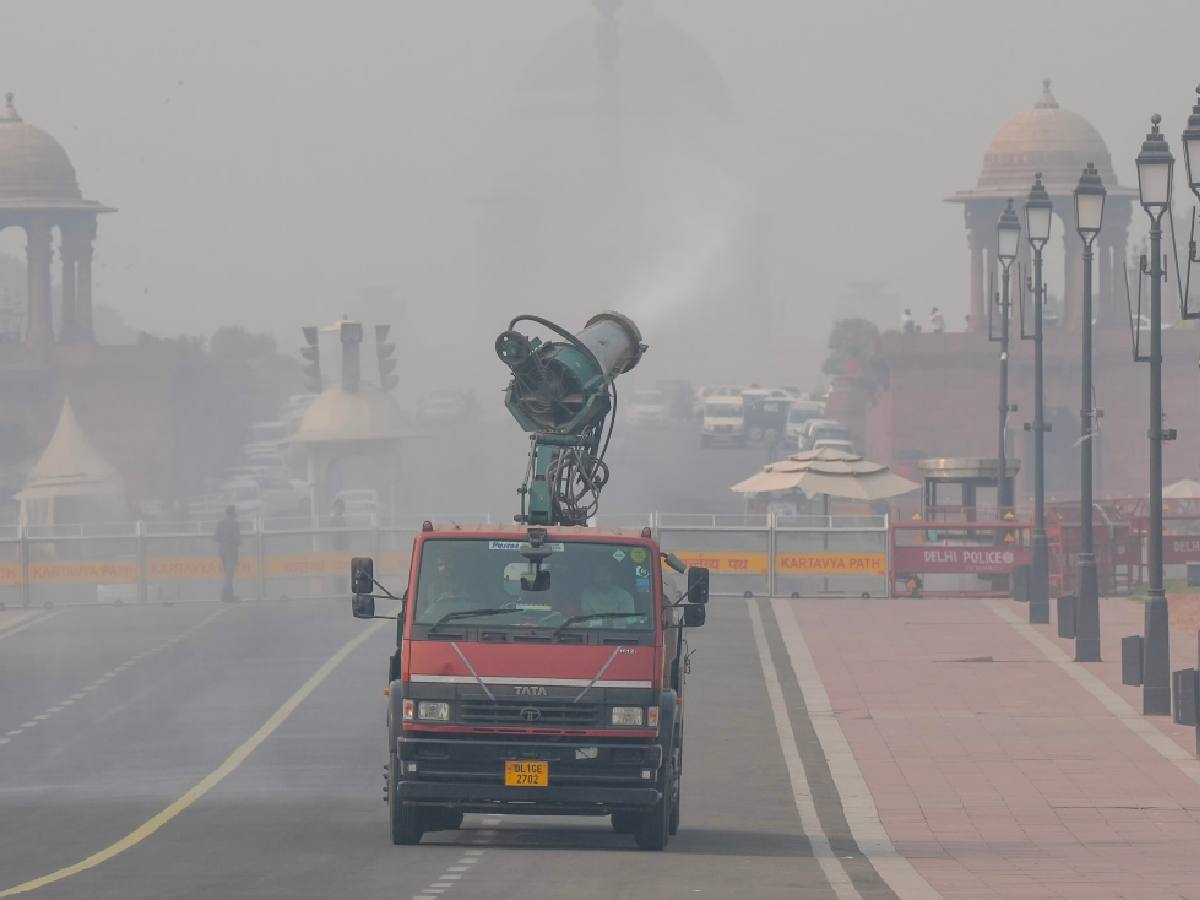
A decade-long analysis of air quality data shows that pollutants in Indian cities, including the national capital, follow sharply different seasonal patterns, underscoring the need to study each pollutant separately rather than relying on broad air quality trends.
A new public dashboard developed by research and advisory think tank Envirocatalysts compiles daily air quality records from the Central Pollution Control Board (CPCB) since 2015, enabling users to track long-term trends across pollutants such as particulate matter (PM2.5 and PM10), nitrogen dioxide (NO2), carbon monoxide (CO) and ozone (O3)
“To truly curb air pollution, we must track multiple pollutants across diverse timelines. The variations of each pollutant are the fingerprints that expose underlying sources and factors, allowing us to move beyond broad data toward targeted action,” said Sunil Dahiya, founder and lead analyst of Envirocatalysts, explaining that understanding the complicated seasonal patterns of each pollutant is necessary to study air pollution overall.
For example, a detailed analysis of the PM2.5 levels in Delhi from 2015 onwards shows a trend of spikes during the winter months, as in from October to February, with the level going down from March, following a seasonal pattern induced not necessarily by emission load reduction but by meteorological conditions dispersing the pollutants faster and farther. A similar trend can be seen for PM10.
However, when a pollutant like NO2 is considered, a pattern is seen where higher concentrations are observed during the summer months compared to winters.
NO2 shows relatively lower levels in the first few months of the year, similar to ozone.
The pollutant ozone shows a peak in the summer months, reaching a peak in May.
Dahiya said, “Studying the patterns through the dashboard, which compiles all the data in one place, in easy-to-understand visualisations, tries to bring complex data to all stakeholders to be able to contribute better in efforts to clean the air.”
According to the Indian National Ambient Air Quality Standards (NAAQS 2009) and World Health Organization (WHO) guidelines, the Indian standard for PM2.5 (fine particulate matter) is 60 µg/m³ (24-hour) and 40 µg/m³ annually. The WHO safe limit is 15 µg/m³ (24-hour) and 5 µg/m³ (annual).
Compared to this, an analysis of the data shows that Delhi recorded a monthly average of PM 2.5 between 153-240 µg/m³ in January from 2015-2026. The level remained between 171-230 µg/m³ for the month of December. This went down significantly in the middle of the year, when monsoon approaches.
The monthly average for July over the years remained around 30-66 µg/m³ and 25-59 µg/m³ for August.
For PM 10, the Indian standard is 100 µg/m³ (24-hour) and an annual level of 60 µg/m³; while the WHO standard is 45 µg/m³ (24-hour), and 15 µg/m³ (annual).
Similar to PM 2.5, PM 10 also shows a massive spike in winter months. The monthly average for January over the years remained around 240-446 µg/m³; and for December remained around 262- 396 µg/m³.
For July and August respectively, the monthly averages went down to 75-148 µg/m³ and 56-173 µg/m³.
However, when a pollutant like ozone is considered, the monthly average remained relatively low for January, 31-55 µg/m³, as compared to the WHO safe limit of 100 µg/m³. Ozone, however, sees a gradual spike in the summer months.
For April, the monthly average over the years remained around 67-122 µg/m³ and for May, it remained around 67-101 µg/m³.
When another pollutant like NO2 is considered, the monthly average for January remained around 40-64 µg/m³, as compared to the Indian standard of 80 µg/m³ (24-hour), and 40 µg/m³ (annual). The WHO standard is 25 µg/m³ (24-hour) and 10 µg/m³ (annual).
The monthly average, however, spikes to 47-108 µg/m³ for November over the years.
“Clearly, when you consider each pollutant individually, the trends over the months are different,” Dahiya said, adding that systematic reduction of air pollution can only happen when action is taken at source and emission load is reduced.
“We need to focus on this so that we do not depend on meteorological conditions to disperse the pollutants and the situation does not go bad as soon as the favourable meteorology turns unfavourable,” he added.
PM2.5 , CO and NO2 are emitted mostly from combustion sources such as transport, industry and power, while PM10 mostly comes from dust, construction etc.
Ozone is formed as a reaction of nitrogen oxides (emitted from combustion) and oxygen in presence of sunlight, leading to higher levels in summer.
Elected to the Delhi Golf Club general committee, Mansher Singh says he wants to build…
A $780 million market built on pavements, where the pleasure of reading meets the price…
Supreme Court advocate Abhishek Pawar alleges women were denied washroom access for seven to eight…
Each day of closure costs shops in Khan Market and Connaught Place between Rs 60,000…
Delhi generates nearly 15,000 tonnes of waste daily, prompting the government to deploy 1,000 mechanical…
Delhi Police has issued an NOC for the Congress rally at Ramlila Maidan on November…
