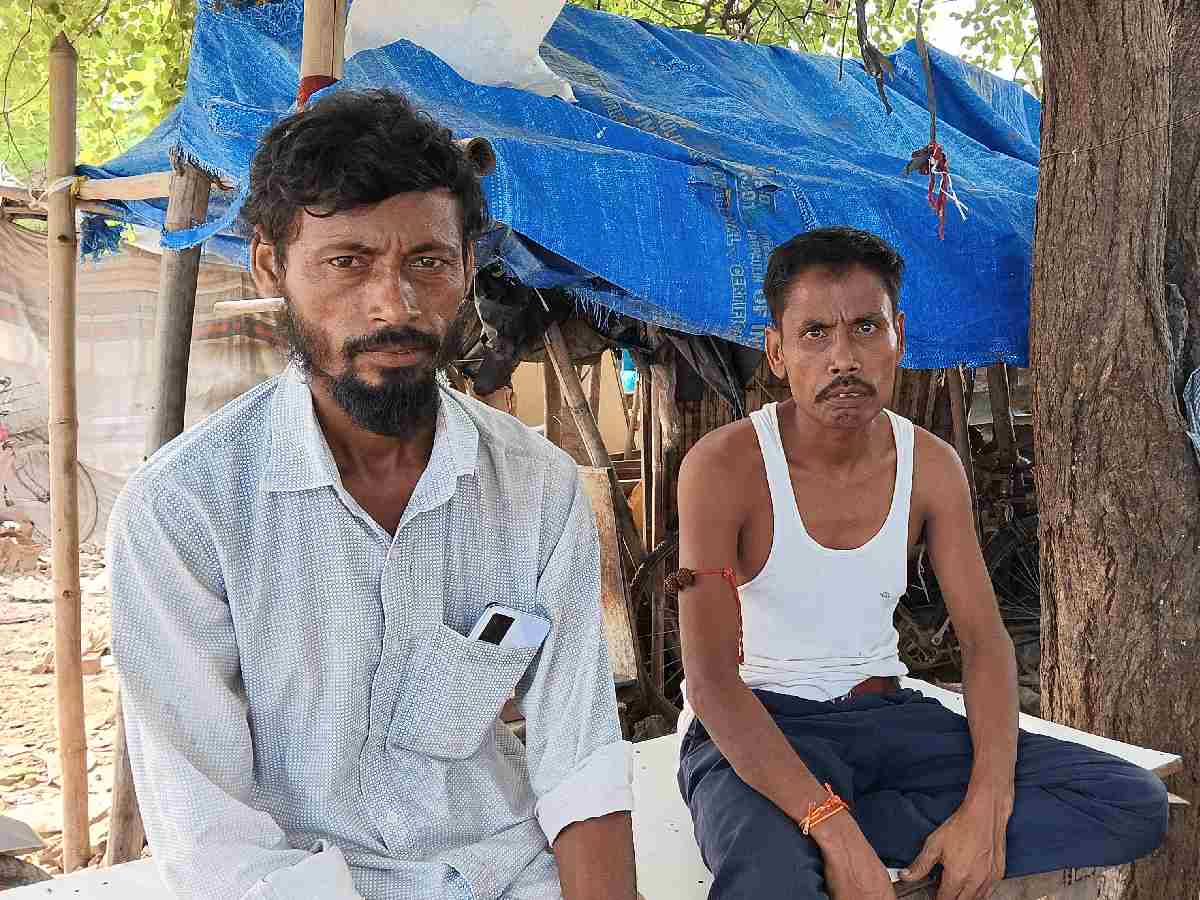
Beneath the glitz of Delhi’s malls and gated enclaves lies a world the city rarely sees. Jai Hind Camp, tucked away behind the wealth of Vasant Kunj in South Delhi, is home to over a thousand working-class families, many of them Bengali speakers, whose labour keeps the Capital running.
The settlement is almost hidden behind a mound of garbage piled outside its entrance. Inside, residents move through the rhythms of their day — one man empties his haul of rubbish while a woman queues before a Delhi Jal Board (DJB) tanker. It is the first water delivery in three days.
For weeks, the administration has tried to push them out, but residents have refused to leave. On July 8, the camp was plunged into darkness when BSES, backed by Delhi Police, cut the electricity supply. Since then, the community has endured powerlessness — in more ways than one — and a growing sense of alienation from a city they had come to see as home.
When police arrived that day, residents say they were branded “illegal Bangladeshi immigrants.” For many, the accusation carried an unmistakable ethnic undertone — targeting them for speaking Bengali and for their origins in West Bengal or Assam. That label has stuck, they claim, leaving them to grapple with an imposed identity that erases their own.
Officially listed as slum no. 701 by the Delhi Urban Shelter Improvement Board (DUSIB), Jai Hind Camp covers 18,400 square metres. Most residents say they hail from Cooch Behar in northern West Bengal, with others claiming to be from Assam and different districts in North Bengal. Yet in their struggle to prove their nationality, many feel stripped of any identity at all.
Also Read: Three generations of squash players to meet as Delhi hosts National Championships
Powerless and under pressure
For 20 years, 41-year-old Kanchan Barman has called the camp home. “They have started calling us Bangladeshis. They say this is not where we belong, but I have lived here since I was almost an adult. I do not know where else to go,” he says.
Since the power cut, families have been scraping by. Some believe the authorities are deliberately trying to make conditions unbearable so they leave voluntarily. “They are testing to see if we go on our own,” says 18-year-old Noor Zaman. “It has been a month without electricity. Some families are using generators or car batteries, but this only works because several households pool money. No one here can afford this alone.”
Until July, the camp’s power came from three communal meters — two at a temple and one at a mosque — which fed sub-meters across homes. The DJB once sent eight tankers of water daily; now, residents say, the supply is down to two or three on a good day, often with several days’ gap.
“They had stopped the supply completely for almost two weeks. We kept fighting and it has increased a bit,” says Morbina, a young mother from Cooch Behar. “Water, we can somehow arrange. But the lack of electricity is unbearable. Without fans or lights, it is suffocating. My baby has even started getting rashes,” she says, pointing to the child’s feet.
Most residents work for the Municipal Corporation of Delhi (MCD) via contractors, cleaning streets, collecting garbage, and maintaining public toilets. Others are employed at shopping centres or as domestic workers in the affluent neighbourhoods nearby.
Youth in the crosshairs
The hostility has not spared the camp’s children. At a nearby government boys’ school, five students — all Bengali-speaking residents of Jai Hind Camp — say they have been targeted by peers. They carry improvised weapons for self-defence: steel bangles, a razor blade, sewing scissors with a corkscrew, and now, a curved-blade knife.
Two weeks ago, one of them suffered a deep forehead wound after being attacked with a sharp object. “Almost a month and a half ago, one of us was hit on the nose with a hockey stick,” says a boy. The injury left his nose permanently bent to one side.
They believe the violence stems from ethnic prejudice. “The rumours about us being Bangladeshis reached them. They started calling us names, and then it got physical. We complained, but no one listened,” one student says.
Also read: Bill on school fee regulation leaves parents exposed to exploitation
A shifting political backdrop
On December 18, 2024, a former MLA claimed that Jai Hind Camp housed about 15,000 Rohingya refugees. Residents say this statement triggered harsher crackdowns, with more detentions and deportations by Delhi Police.
Since then, residents have decided to petition the Delhi High Court against BSES for cutting their electricity supply.
Meanwhile, officials confirm that Delhi Police have screened over 16,000 Bengali speakers since December 2024 to identify “illegal” Bangladeshi immigrants. The operation, they say, was launched following instructions from Lieutenant Governor Vinai Kumar Saxena’s office after a regime change in Bangladesh.
“During the screening process, suspects’ documents were thoroughly examined, and their credentials were verified with the home states they claimed to be from,” says an officer. Those found to be undocumented foreign nationals were handed over to the Foreigners Regional Registration Office (FRRO) for deportation.
After 12 years in theatre, the actor makes his international film debut with a role…
Protester alleges Delhi Police assaulted detainees, deleted phone videos, and detained minors during anti-CEC protest…
Shifting protests away from Jantar Mantar weakens democratic visibility and access to political power, an…
CM Rekha Gupta defends SIR and EC integrity, saying democracy can't be held hostage to…
AISA students march to Supreme Court over 'vote chori' claims against CEC, as police barricade…
DMRC extends closure of six central Delhi metro station gates until 5 pm citing security…
