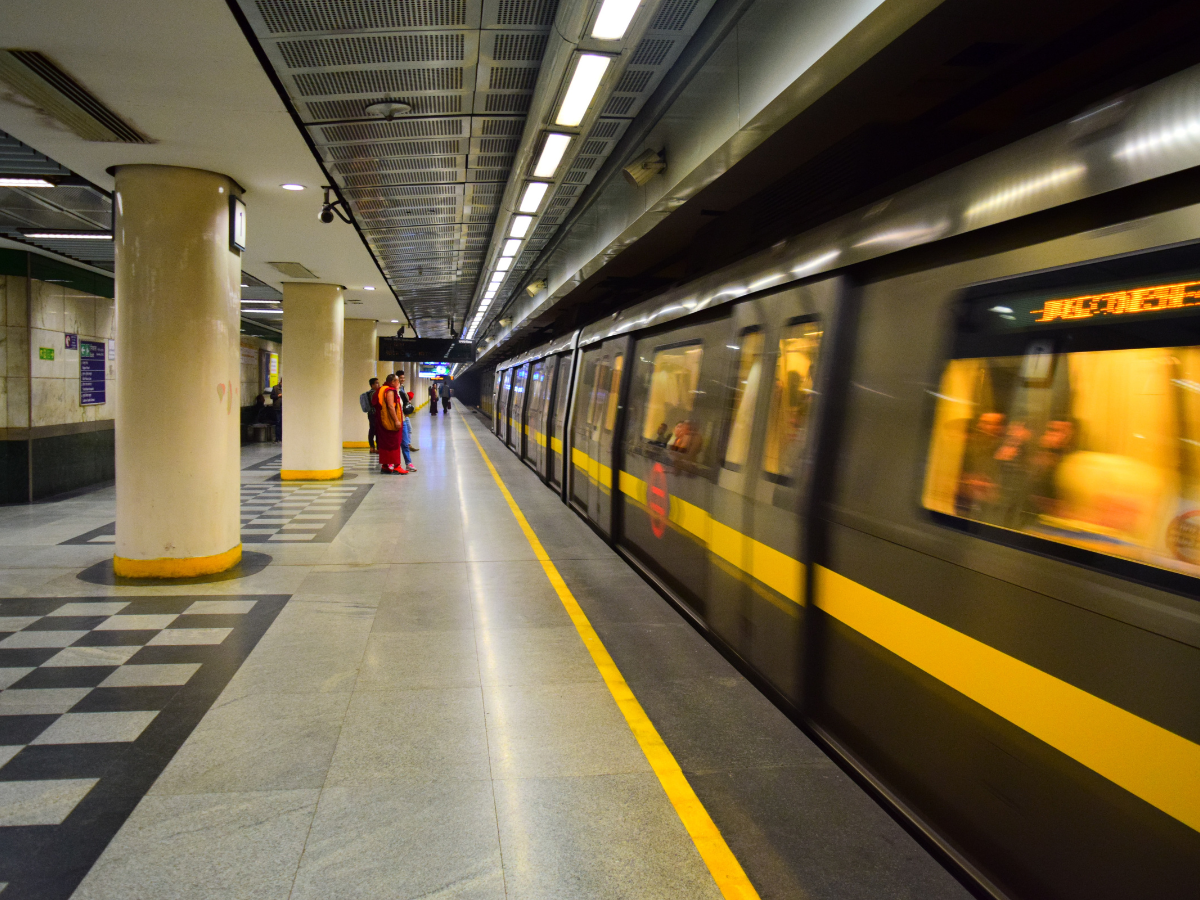
Delhi metro
The Union Cabinet on Wednesday gave the green light to two new corridors of Delhi Metro’s Phase-IV project — extending from Lajpat Nagar to Saket G-Block and Inderlok to Indraprastha — aiming to bolster metro connectivity in the national capital.
As per an official statement, the total estimated cost for these two corridors stands at Rs 8,399 crore, to be funded by the Centre, Delhi government, and international financing agencies.
Chaired by Prime Minister Narendra Modi, the Cabinet approved the new corridors, set to be operational in stages by March 2026.
During a press briefing post the cabinet meeting, Union Minister Anurag Thakur highlighted that with these new additions, the national capital region’s Metro network will stretch to approximately 450 km, compared to the existing 427 km.
Of the total expenditure, Thakur outlined that the Government of India will contribute Rs 1,547 crore, the Delhi government Rs 1,987 crore, JICA will provide Rs 4,309 crore as a loan, internal accruals of DMRC will contribute Rs 333 crore, and Rs 195 crore will be through PPP.
Upon completion, these lines are expected to serve around 2.5 lakh commuters. Presently, approximately 65-70 lakh people utilize the Delhi Metro network.
The statement elaborated that the combined length of these two lines will be 20.762 km. The Inderlok-Indraprastha corridor, an extension of the Green Line, will offer interchange facilities with the Red, Yellow, Magenta, Violet, Blue Lines, and Airport Line. Meanwhile, the Lajpat Nagar-Saket G Block corridor will connect the Silver, Magenta, Pink, and Violet Lines.
The Lajpat Nagar-Saket G Block corridor will be entirely elevated, hosting eight stations. On the other hand, the Inderlok-Indraprastha corridor will comprise 11.349 km of underground lines and 1.028 km of elevated lines, accommodating 10 stations.
The government emphasized, “The Inderlok-Indraprastha Line will enhance connectivity to the Bahadurgarh region of Haryana, facilitating commuters to directly access Indraprastha and various other areas of central and east Delhi.”
Furthermore, eight new interchange stations are slated to be established on these corridors at Inderlok, Nabi Karim, New Delhi, Delhi Gate, Indraprastha, Lajpat Nagar, Chirag Dilli, and Saket G Block, significantly enhancing inter-connectivity across all operational lines of the Delhi Metro network.
Currently, Delhi Metro is actively progressing with the construction of a 65 km network as part of its fourth phase of expansion.
Presently, DMRC operates a network of 391 km comprising 286 stations, making it one of the rapidly expanding metro networks globally.
Delhi Metro Rail Corporation Limited (DMRC) has already initiated pre-bid activities and tender document preparations. (With inputs from PTI)
CAQM reviewed dust pollution in Delhi and enforced GRAP-1 rules after AQI fell to 'poor'.…
Over 1 lakh of 4.56 lakh Form 6 voter enrollment applications in Delhi have been…
NDMC cut water and power near Race Course Mosque during a demolition drive, affecting nearby…
BNSS caps custody at 24 hours and requires production before a Magistrate; force permitted only…
An SEM court reserved its order on extending the judicial custody of CJP leaders Saurav…
Delhi recorded its first 'poor' air day of the season on Wednesday as AQI hit…
