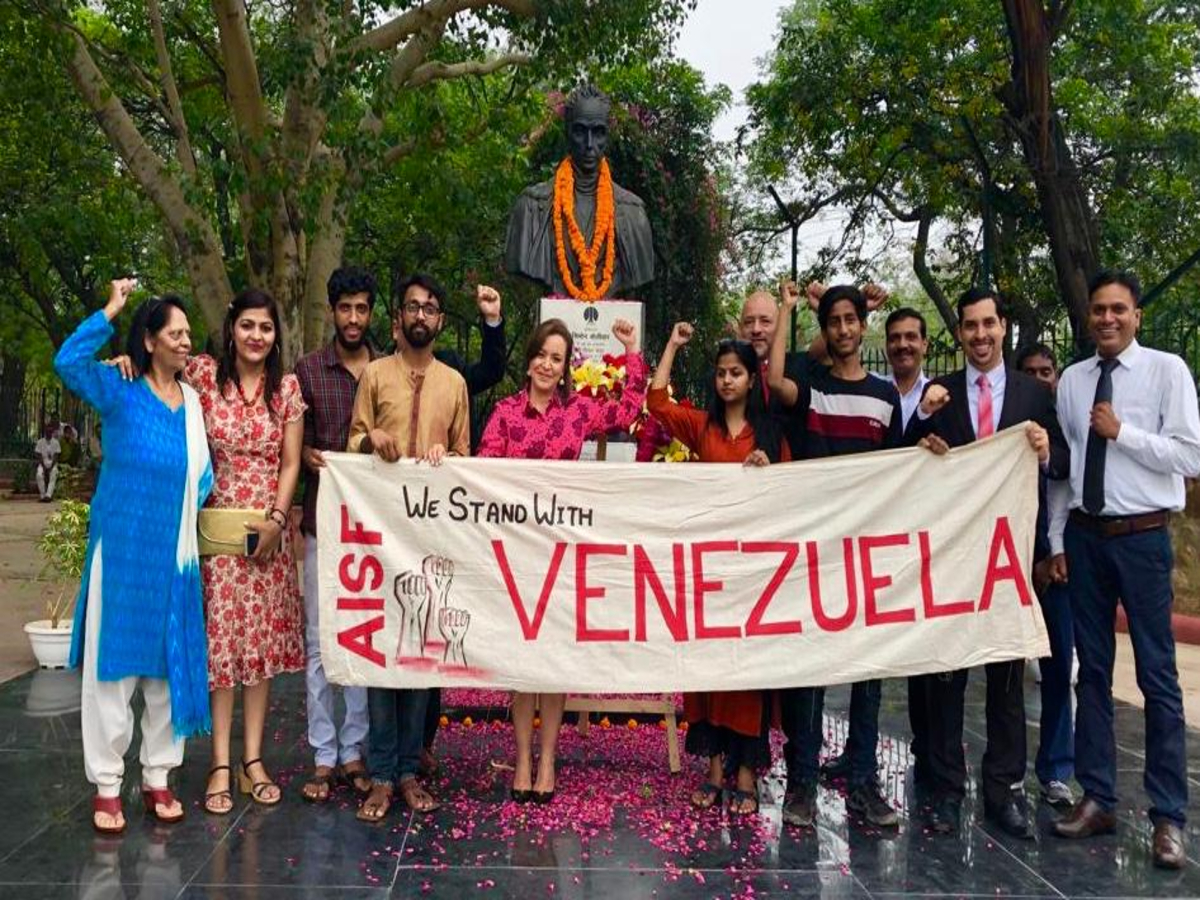
Venezuela envoy Godoy Coromoto pays homage to Simon Bolivar at Bolívar Marg in Delhi
Nicolás Maduro must have felt a sense of familiarity when he arrived in Delhi as Venezuela’s President in 2015. He had visited India earlier in 2005 in a private capacity, including a trip to the Prasanthi Nilayam ashram in Puttaparthi, Andhra Pradesh, to meet Sathya Sai Baba, and again in 2012 as Venezuela’s Foreign Minister. On his drive from Indira Gandhi International Airport to his hotel in Chanakyapuri, catching sight of a road named after Venezuela’s national hero Simón Bolívar would likely have stirred pleasant memories.
Simón Bolívar (1783–1830), the revolutionary leader known as El Libertador (The Liberator), freed Venezuela, Colombia, Ecuador, Peru and Bolivia from Spanish colonial rule. A proponent of Latin American unity, he went on to become a lasting symbol of resistance to imperial domination.
During his 2015 visit, Maduro met Prime Minister Narendra Modi, with the two leaders discussing ways to strengthen bilateral ties. He also held talks with other senior Indian officials.
Could not visit JNU
Unlike his predecessor, Hugo Chávez, Maduro was unable to address students at Jawaharlal Nehru University (JNU). Reports at the time suggested that he had wished to visit the university, but the programme was cancelled at the last minute for reasons that were never made public.
By contrast, Chávez’s visit to JNU had been a resounding success. On March 4, 2005, during his state visit to India, Chávez spoke to students about his socialist beliefs and Venezuela’s revolutionary movements. Despite light rain in the capital, thousands gathered to hear him. Professor Chaman Lal, who taught at JNU for many years, recalls it as possibly the largest gathering in the university’s history.
During Chávez’s impassioned speech, the crowd raised slogans such as “Red salute to Comrade Chávez” and “One solution, one revolution”. Ashok Kumar Pipl, a former student of JNU’s Spanish department, remembers that Professor Shamu Prasad Ganguly translated Chávez’s address from Spanish into English.
Also Read: From Madras Hotel to Annapurna Bhandar: another Delhi culinary legacy fades
Simón Bolívar Marg
The renaming of the road as Simón Bolívar Marg coincided with Chávez’s 2005 visit, symbolising the warmth of India–Venezuela relations at the time. Nearby landmarks include Bhagwan Mahavir Vanasthali Park and Sikkim House. Lined with dense tamarind, neem and peepal trees, the avenue reflects Bolívar’s revered stature in Venezuela—often compared to Mahatma Gandhi’s place in India.
The road stands as Delhi’s most visible symbol of Venezuela, honouring a foreign leader who fought for independence. A statue of Simón Bolívar has been installed here, surrounded by benches where passers-by often pause, though during winter’s biting cold the area can appear deserted. The American Embassy and the American Embassy School are also located close by.
Delhi honours several Latin American figures associated with liberation struggles through its street names. Benito Juárez Marg in south Delhi, near Dhaula Kuan and connected to Delhi University’s South Campus, commemorates Mexico’s former President Benito Juárez, a 19th-century icon of resistance to colonial rule. San Martín Marg in Chanakyapuri is named after Argentina’s General José de San Martín, a central figure in South America’s wars of independence.
Streets of Chanakyapuri
These streets in Chanakyapuri’s diplomatic enclave serve as quiet reminders of shared histories of anti-colonial resistance. Bolívar’s legacy, in particular, resonates with India’s own freedom struggle, creating symbolic bridges between continents. The echoes of Chávez’s enthusiastic reception at JNU and the diplomatic engagements of that period point to a phase of close India–Venezuela relations, rooted in ideological solidarity.
While political realities have shifted sharply in recent years—with Maduro’s recent capture by US forces under Operation Absolute Resolve marking a turbulent chapter—these landmarks in Delhi remain as testaments to enduring cultural and historical connections. The tree-shaded Simón Bolívar Marg continues to welcome visitors, evoking the spirit of unity Bolívar once envisioned for Latin America, a spirit India reflects in the naming of its public spaces.
Read More: Driven to exhaustion: the unseen lives of Delhi’s wedding-season drivers
At least 50 cases have already been reported this month; NCPCR guidelines mandate help desks,…
DMRC says zero reduction in train trips, attributes decline to security measures and public apprehension…
A Delhi court denied bail to a former DU professor accused of raping a student,…
Delhi Police charged seven dhaba workers in the fatal beating of a Manipuri musician who…
Seven Delhi STPs failed DPCC standards in September, dumping high levels of faecal coliform and…
AISA chief Neha Bora petitioned the Delhi HC against a police notice requiring a peace…


