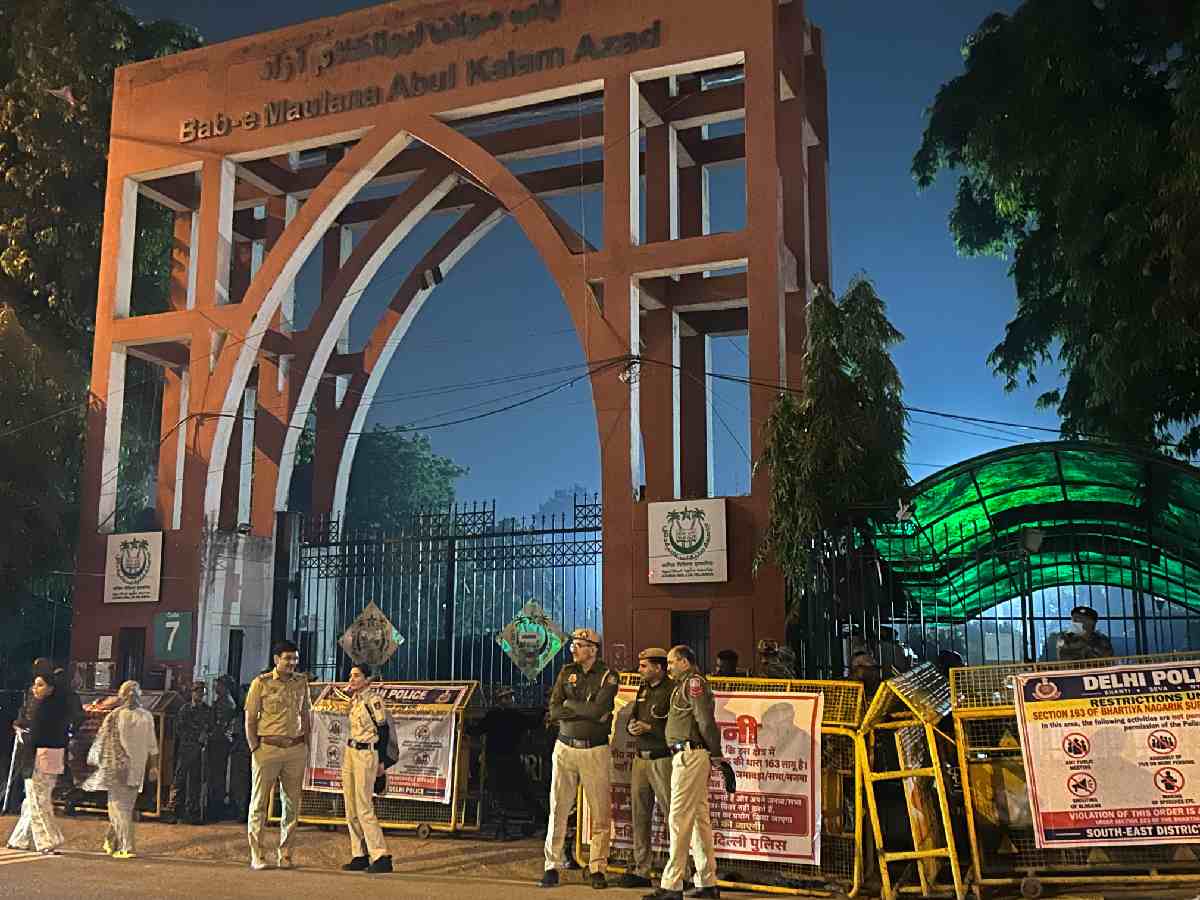
Students protesting at Jamia Millia Islamia for the restoration of an elected students’ union have alleged restrictions on food and drinking water, raised concerns over arrests and detentions, and expressed fears of disciplinary action.
The allegations come amid continuing protests despite the university’s October 26 announcement that students’ union elections would be held within 15 days of the approval of the union’s constitution. Students say the announcement does not provide a definite timeline for the polls.
Around 50 people were detained by police during the agitation on October 27. Police released 47 of them the same day, while three others—Niranjan KS, Arbaaz Mewati and Munna Qureshi—were arrested under Sections 126 and 170 of the Bharatiya Nagarik Suraksha Sanhita (BNSS).
Sections 126 and 170 of the BNSS are preventive legal provisions used by police and magistrates to maintain public peace and stop cognisable offences before they happen.
Also Read: From the Emergency to CAA: police at Delhi’s campuses
The three were produced before a Special Executive Magistrate (SEM) Court in Amar Colony on October 28 and sent to judicial custody for three days. The court granted bail to all three on October 28. However, they were not released until the afternoon of October 29 because bail formalities, such as “surety verification,” were not completed, protesting students told Patriot.
Two members of the National Students’ Union of India (NSUI), Faizan Ali Khan and Zeeshan Ahmad Khan, were detained on Wednesday, October 28. According to a Newslaundry report published on October 29, police produced the two before the SEM court which sent them to judicial custody for three days.
Students allege restrictions on food and water
Students participating in the agitation have alleged that security personnel prevented food and drinking water from reaching the protest site. They claimed that people bringing supplies faced restrictions and that some supplies were confiscated.
Abukaish Jilani, a student of the Hindi department, told Patriot, “Students who tried to bring food and water to the protest site have faced restrictions, and three of the students have been arrested and sent to Tihar.”
Police reportedly detained people who were supplying drinking water to protesters.
“Munna and Arbaaz were providing water and food when they got arrested,” said Michael (name changed), a student.
“I mean, first of all, this is so inhumane and unconstitutional, to not have access to basic food and water, and then sending students to Tihar to provide us drinking water is the end of Hitlerism.”
Also Read: Strike over, promises pending at JNU
Students have also alleged that water supply to washrooms was disrupted, adding to difficulties faced by those participating in the protest.
“Not only drinking water, but even in washrooms they stop water. You can imagine how cunning one can be to go to this extent. It is especially worse for the female students here. No one is being allowed to enter or leave the campus,” Michael added.
Classes have been shifted online, while police personnel and barricades have remained stationed around parts of the campus, according to students.
Detentions raise questions
The detention of Niranjan, Arbaaz and Munna has raised concerns among protesting students.
Students have questioned the circumstances of Niranjan, Arbaaz and Munna’s detention and disputed claims of police that the three were “outsiders”.
According to the protesting students, Niranjan and Arbaaz are Jamia alumni, while Munna is pursuing a certificate course in Yoga Studies at the university. The student added that Niranjan is also an activist with the All India Revolutionary Students Organisation (AIRSO) while Arbaaz is currently pursuing law at the University of Delhi.
The police diary states that Arbaaz and Munna had attempted to gather a crowd outside Gate No. 7 and enter the campus. At the same time, Niranjan was allegedly found jumping over the campus boundary wall and raising slogans.
Also Read: No BS-VI, no entry: what new anti-pollution curb could cost Delhi-NCR commuters
Students wear masks fearing identification
Some protesters have begun wearing masks during demonstrations and while speaking about developments on campus, fearing that they could be identified and subjected to disciplinary action.
Students have also alleged that journalists were prevented from speaking directly to protesters.
A reporter covering the agitation said authorities had stopped them from accessing students and recording their accounts.
The restrictions have made some students reluctant to speak openly to the media, raising concerns about access to information from inside the campus.
Hostel inspections spark concern
Students have also expressed concern over late-night hostel inspections, fearing that the administration could use them to identify protesters and initiate disciplinary proceedings.
Salim (name changed), a student of the History department, said the hostel warden inspected rooms late on Tuesday night.
“Students were concerned about room inspections carried out by the hostel warden late last night, because later they will take action against the students whose rooms were locked,” he said.
Some students also fear that the university could impose wider restrictions on campus, including a possible lockdown.
They referred to earlier protests in 2020, saying the university imposed restrictions and took disciplinary action against students then.
Also Read: Acid available freely in Delhi despite curbs, reveal ground visits
No definite date for union elections
The central demand of the agitation remains the restoration of the elected Jamia Millia Islamia Students’ Union, which students say is necessary to represent their concerns over academic matters, campus facilities and welfare.
On October 26, the university announced that it would hold elections within 15 days of the union’s constitution being approved.
The administration also announced the withdrawal of suspension and show-cause notices issued during the protest and said it would form a committee to examine the conduct of security personnel.
However, students have continued to demand a definite timeline for approving the constitution and conducting the elections.
With no deadline announced for the constitution’s approval, the election date remains uncertain.
The university administration has not responded to allegations of restrictions on food and drinking water, media access, and the recent arrests.
Central Secretariat and New Delhi stations will become 3-line interchange hubs via the expanded Magenta…
IMD issues red and orange alerts for thunderstorms, hail, and heavy winds across Delhi as…
Delhi HC refuses prayer access to Race Course mosque amid demolition risk, as Centre pledges…
Delhi HC asks Sourav Ganguly to specify timestamps in "Doosra" allegedly violating his personality and…
NDMC sets up an independent quality control wing and mandates third-party audits by top institutes…
Jamia’s 106th Foundation Day scaled back to flag hoisting amid student union poll protests and…
