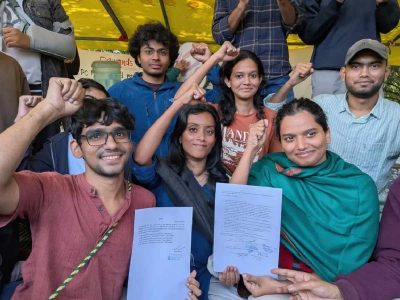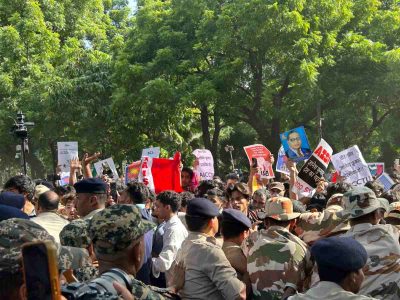
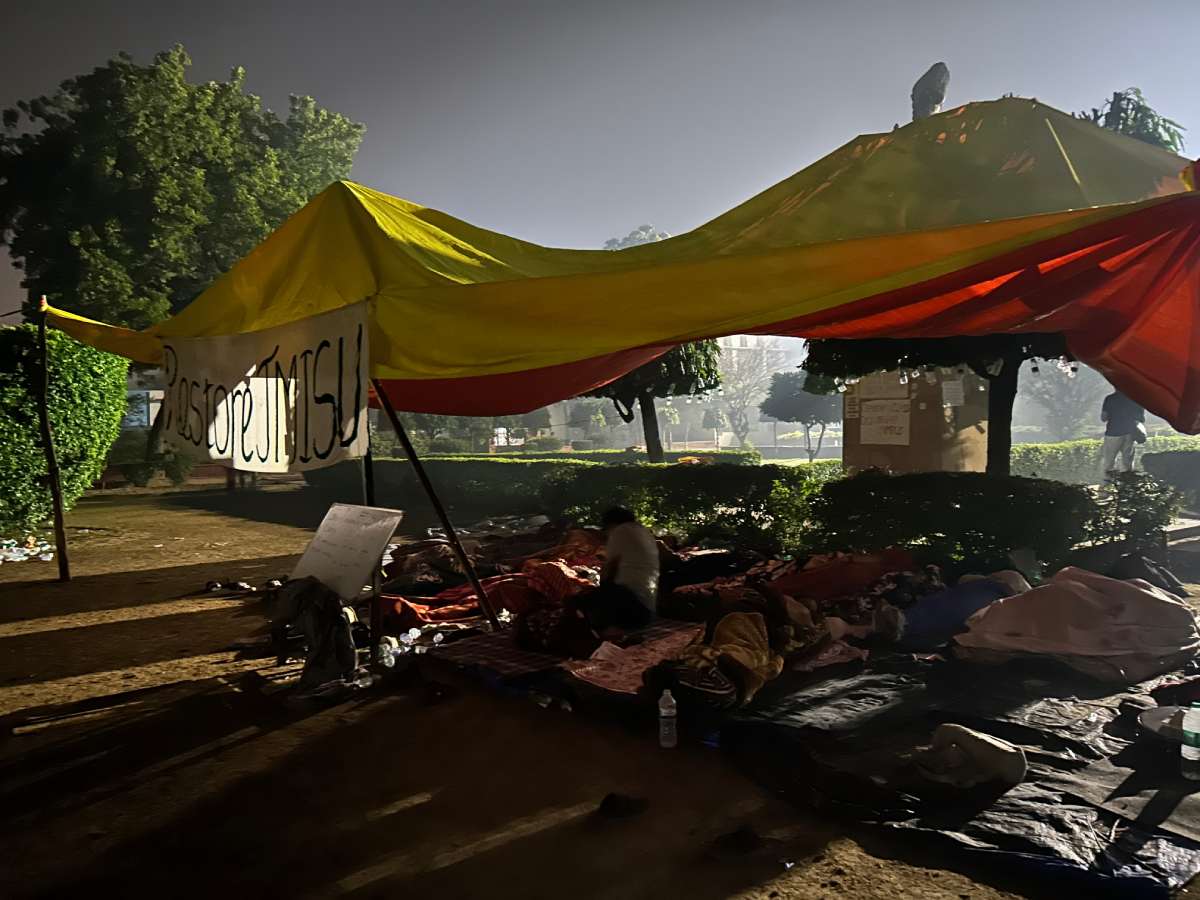
More than 200 Delhi Police personnel were deployed outside Jamia Millia Islamia during a student protest earlier this month. Inside the university, students were demanding the restoration of elected student union representation, while the administration faced pressure to restore normal academic activity.
The protest began on October 12 with an indefinite hunger strike. Tensions escalated on October 17, when protesters alleged that university security personnel removed students from the protest site and that police subsequently detained some of them. Ebin Basil, one of the students participating in the hunger strike, alleged that a police officer assaulted him.
The administration shifted classes online amid the confrontation. On October 26, it agreed to hold student union elections within 15 days of approving the union constitution, revoked protest-related suspensions and show-cause notices, and ordered an inquiry into security staff conduct.
The episode has brought renewed attention to the longstanding tension between campus protests and security operations, including the extent of police intervention and the authority responsible for it.
Also Read: Strike over, promises pending at JNU
At Jamia Millia Islamia, Jawaharlal Nehru University (JNU) and the University of Delhi (DU), police deployments have taken different forms over five decades. Some were planned arrangements for student elections, others followed political unrest, disputes with university administrations or incidents of violence. Their scale has ranged from local police teams to hundreds of personnel, including central armed police forces.
The 1970s
The Emergency, declared in June 1975, placed severe restrictions on political activity and civil liberties. Universities became important sites of student resistance, and JNU was among the campuses affected by police action.
On July 8, 1975, police raided JNU hostels while searching for student activists. Historical accounts report that police arrested around 60 students, while others were detained for questioning.
The raid disrupted ordinary campus life. Students living in the hostels faced uncertainty about who had been taken away and whether further arrests would follow. The case showed how university accommodation could become part of a wider political crackdown.
Police returned to JNU on September 25, 1975, during a student strike. Officers entered the campus looking for a student-union leader but detained another research scholar. The incident became another example of how a police operation could affect someone other than the person officers were reportedly seeking.
DU had already witnessed a major agitation over student representation. In 1972–73, students campaigned for direct elections to the Delhi University Students’ Union (DUSU). Under the earlier system, elected college representatives chose the union’s central office-bearers. The campaign continued for around 50 days and eventually led to direct elections.
Also Read: CPCB flags high pollution at Sahibabad, Shahdara drains
Confrontation of 1983
On May 11, 1983, police entered JNU during a confrontation involving students and the university administration. Students had been gheraoing the Vice-Chancellor and another senior university official during a dispute that had continued for two days.
The administration called the police. A lathi-charge followed, and arrests were made. Accounts of the incident also describe mounted police waiting nearby as the operation began.
A former student leader, recalling the protest, described how students chose to face arrest rather than respond with violence, “There were hundreds of police men but not a single stone was pelted by any student and the students stood in a queue to court arrest.”
The recollection offers a specific detail about how some students responded to the police intervention. Rather than disperse immediately, they chose to be arrested in an organised manner.
The administration’s position was different. The dispute involved the confinement of senior university officials, and the police action followed a complaint. The episode therefore became a conflict not only over student demands but also over the administration’s authority and the circumstances in which police could enter the campus.
The available historical record confirms the intervention and subsequent arrests.
DU and Mandal Commission agitation
In August 1990, the union government announced it would implement the Mandal Commission recommendations, providing reservations for Other Backward Classes in central government employment. The decision triggered widespread protests, with DU becoming a major centre of opposition.
Demonstrations spread across Delhi and other parts of the country. The agitation drew national attention in September 1990, when a student from DU’s Deshbandhu College attempted self-immolation at the AIIMS intersection.
The protests exposed deep divisions over caste, representation and access to government jobs. They also brought the police into repeated contact with student demonstrators as rallies moved across public roads and university areas.
Also Read: Before the lights: two Diwalis Delhi can never forget
The movement affected university life beyond the demonstrations themselves. DUSU elections were cancelled in 1991 amid continuing unrest, interrupting the union’s normal electoral process.
Unlike a dispute confined to one university building, the Mandal agitation was part of a national political movement. Police had to respond to gatherings at different locations, while university administrators faced pressure to maintain academic activity during a period of intense disagreement.
April 2000 action at Jamia
On April 9, 2000, an attempt to arrest two young men near Jamia Millia Islamia escalated into a major police operation. A fact-finding investigation by a civil-liberties group People’s Union for Democratic Rights reconstructed how an initial confrontation near the university stores spread towards the library and hostels.
The investigation reported that police first entered the library during the search and attempted to detain two students who, according to other students present, were not involved in the original incident. The confrontation then escalated as students tried to intervene and more officers arrived.
The investigation estimated that between 300 and 500 or more police personnel eventually reached the campus from at least 11 police stations and posts across South Delhi. According to an ex-student, the officers entered hostel buildings, broke open doors and detained students. The operation continued into the night and the early hours of April 10.
One of the most serious allegations concerned how students were treated inside their rooms. The fact-finding report recorded a student’s account of police entering his room while he and his roommate were preparing for an interview the next day. The report also recorded allegations that officers used communal slurs and targeted students during the operation.
Also Read: The Ashok: seven decades of Indian hospitality
The police version, as recorded in the report, was that officers had initially tried to arrest two accused men, faced resistance and stone-pelting, and acted to control the situation. Police denied entering the library and hostels, claims that the fact-finding team said conflicted with eyewitness accounts.
The university administration also came under scrutiny. The report said the hostel provost tried to stop the police from breaking through the hostel gates and was himself struck during the operation. The incident led to a magisterial inquiry and demands for action against the officers involved.
JNU’s fee protests
Security planning at DU became particularly visible during student-union elections in September 2010. Around 1,200 Delhi Police personnel were expected to be on election duty, with patrols, checkpoints and officers assigned to colleges and polling locations.
Recalling the incident, a police official said, “We had asked college authorities to ensure that no outsider is allowed inside the campus without proper ID cards.”
The deployment was planned around voting and counting. Its stated purpose was to prevent clashes, manage crowds and protect the electoral process, rather than respond to an already unfolding confrontation.
In February 2016, JNU became the focus of police action after a controversial campus event linked to protests over the execution of Afzal Guru. Delhi Police arrested student leaders, prompting demonstrations and a wider debate over student politics and freedom of expression.
Another major deployment followed on November 11, 2019, during protests against a revised hostel manual that included higher charges. Ahead of a planned student march, more than 120 CRPF personnel and a comparable number of Delhi Police officers guarded JNU’s gates and the Vice-Chancellor’s residence.
Also Read: Acid available freely in Delhi despite curbs, reveal ground visits
The reported deployment involved more than 240 personnel from the two forces. The immediate dispute concerned hostel fees and university rules, but the security arrangements themselves became part of the confrontation.
The issue was also raised in Parliament. A member of the Rajya Sabha K.K. Ragesh said students had been protesting against the fee increase and asked whether their constitutional rights to speech, association and assembly were being denied. The remarks reflected the wider debate over how universities should respond when students organise demonstrations against administrative decisions.
A month later, on December 15, 2019, Jamia became the site of another major police operation during protests against the Citizenship (Amendment) Act. Police used tear gas and entered university premises, including the library, amid disturbances around the campus.
Students inside the library described fear and confusion as officers approached. One student recalled, “We did not know what to do, so we latched the door, and everyone was looking at the door anxiously.”
Another student, who suffered fractures to both hands, described the police entering the room: “We were normally studying at the library when it happened; they didn’t warn us at all, and charged us with lathis.”
The students alleged that officers beat people who were studying or trying to escape the confrontation. Video footage later showed police personnel inside the library striking students with batons. Police initially denied entering the library and later said they were examining the footage.
The university’s Vice-Chancellor Najma Akhtar had said the police had not been permitted to enter the campus. The incident prompted complaints, fact-finding efforts and demands for an investigation into the use of force.
DU’s election security
On January 5, 2020, a masked mob attacked students and teachers at JNU, injuring members of the university community. The incident prompted scrutiny of campus security and the police response.
Delhi Police deployed personnel inside and outside the campus. JNU separately reported that 277 private security personnel were on duty around the clock. That figure referred to regular university security staff, not the additional police deployed after the attack.
The incident differed from routine protest management: students and teachers were attacked, and the immediate concern was their safety. It also highlighted the need for coordination between university security, administrators and police when violence occurs on campus.
In September 2023, approximately 500 security personnel were expected at DU’s North Campus for DUSU elections. The arrangements included local police, central paramilitary personnel and reserve staff, with additional checks and patrols around colleges, counting centres and strong rooms.
Also Read: No BS-VI, no entry: what new anti-pollution curb could cost Delhi-NCR commuters
The deployment followed a four-year gap since the last DUSU elections. Authorities said the arrangements were intended to protect polling and counting locations, manage crowds and prevent clashes.
DU faced another dispute over demonstrations in February 2026, when the university prohibited protests and public meetings on campus for one month, citing public-order concerns. Police subsequently imposed restrictions on assemblies in parts of North Campus. The restrictions became the subject of a legal challenge, bringing the regulation of campus demonstrations into sharper focus.
Institutional framework
Several institutions share responsibility for campus security. The Ministry of Home Affairs oversees Delhi Police at the Union government level and the central armed police forces. Delhi Police assesses public-order risks and determines operational requirements under the applicable legal framework.
University administrations manage campus access and internal security. They may seek police assistance when they believe students, staff or property face a threat. District authorities and authorised magistrates may also exercise powers under the law.