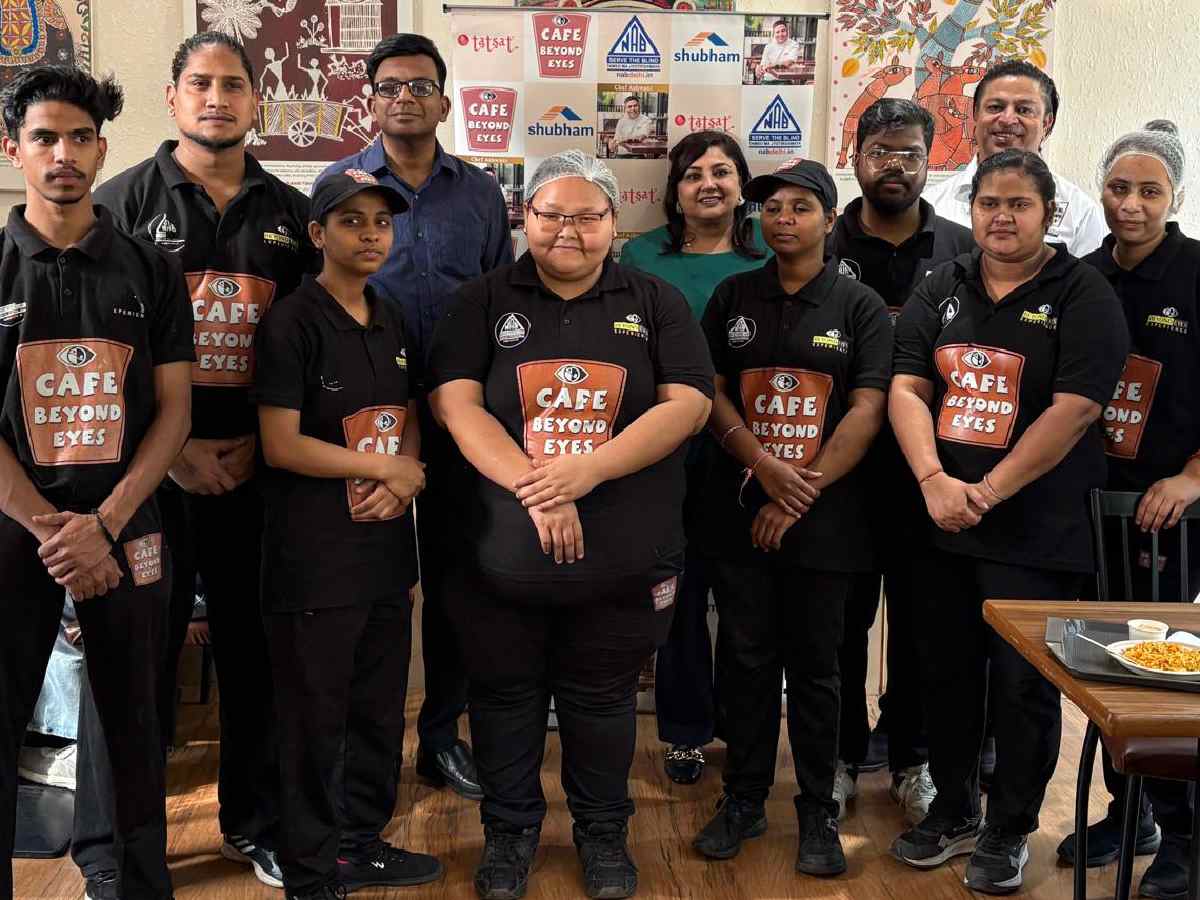
At the heart of the initiative is Chef Ashwani Kumar Singh, who has trained the first batch of visually impaired youth in professional culinary practices
Tucked into Sector 5 of Delhi’s RK Puram, Café Beyond Eyes is not just another addition to the capital’s café culture—it is a quiet assertion of dignity, resilience, and possibility. Operated entirely by visually impaired youth, the café builds on an earlier outlet in Dwarka and reimagines what inclusion can look like when skill meets opportunity.
Here, the clatter of utensils, the aroma of spices, and the rhythm of service replace sight as the primary tools of the trade. For the young trainees behind the counter, the café is more than a workplace—it is a gateway to independence.
Hands-on masterclass
At the heart of the initiative is chef Ashwani Kumar Singh, who has trained the first cohort of visually impaired youth in professional culinary practices. During a recent session, he led a hands-on masterclass that challenged conventional ideas of cooking as a visual art.
“Cooking is an art driven by passion, discipline, and sensory understanding rather than sight alone,” he said. “When we remove the dependence on vision, we discover how powerful the other senses truly are.”
Relying on touch
The training goes down to the most fundamental techniques—how to hold a knife, how to cut, and how to rely on touch rather than sight.
“The knife should not be too hard—it should be flexible. You have to cut through the edges and break ingredients with your fingers where needed,” he explained. “Whether it’s coriander, onion or potato, you guide the knife with awareness, not sight.”
For many trainees, this was their first exposure to structured culinary training.
Start from basics
“I ask them about ingredients and spices—whether they’ve tried these things at home. Often, they haven’t. So we start from the basics and build their confidence step by step,” he said.
The sessions emphasise touch, aroma, sound, and taste—skills often heightened among visually impaired individuals. From identifying ingredients through texture to judging doneness by sound, trainees are encouraged to trust their instincts and refine sensory precision.
Chef Ashwani also introduced them to the Vedic concept of tasir—the intrinsic heating or cooling nature of food—bringing together traditional knowledge and everyday cooking.
“This experience has made me a more mindful chef,” he reflected. “In great cooking, precision is not merely seen—it is felt.”
Larger mission
Café Beyond Eyes is as much about training as it is about service. The idea is to equip visually impaired youth with practical skills—kitchen work, basic operations, and customer interaction—that can translate into long-term employment.
“The initiative reflects the true spirit of inclusion, where individuals are empowered not by sympathy but by opportunity,” said Prashant Verma, general secretary, the National Association for the Blind (NAB).
Drawing on his involvement with the trainees, Verma noted how quickly they adapt. “When we understand cooking, we realise how important learning and teaching are. This has been a new experience—even for me,” he said.
He emphasised the role of sensory learning. “After sight, what remains is touch, smell, taste—and passion. All these qualities are there. We just have to nurture them.”
The training, he added, is deliberately practical. “They are being taught chopping, food preparation, and even how to measure ingredients using simple tools. These small techniques make their day-to-day work easier.”
Roles are assigned based on individual strengths. “Some are good with knife work, some with sautéing, some with mixing. We assign tasks according to their abilities, and they learn very fast,” he said.
Finding confidence
In one corner of the café, shelves display paintings and handmade items created by the trainees—quiet reminders that skill and creativity extend beyond the kitchen.
For many of the young women working here, the café has transformed not just their livelihoods but their sense of self.
“I lost my eyesight in an accident. I currently have 100% vision loss,” said Upasana Gupta. “Here at NAB, I did two to three months of training, and that’s when I developed a passion for working in cafés.”
She now handles multiple responsibilities with confidence. “I take orders, deliver them, and make sure everything goes to the right place,” she said. “Before this, I used to think I couldn’t do tray work or work in the kitchen. But today, tray work has become second nature to me. I handle billing and service on my own.”
The job, she says, has given her more than just skills. “Working here brings me a lot of joy. My family feels proud of me. I am able to support myself financially.”
Kamini Rai describes the experience as a turning point. “There is so much to learn here—how to interact with customers, how to engage with people coming from outside,” she said. “I had never experienced this kind of interaction before.”
“I know in my heart that I am one of a kind—someone with low vision doing this work,” she added. “If we truly believe in something—whether it’s learning or cooking—nothing can stop us.”
Deeply personal
For Lena Garg, who has been working at the café for eight months, the change has been deeply personal.
“I felt that I might not be able to do chopping or work in the kitchen earlier, but now I do almost everything in the café,” she said. “I feel so good about the changes that have happened to me after I started working here.”
Coming from Haryana, she now supports her family. “I am the primary breadwinner. My father suffered a heart attack and has been unable to work, so I manage our household expenses,” she said. “We are a family of five, and I am doing my best to keep us financially stable.”
The shift, she says, has also changed how she sees herself. “My family never imagined that I would be able to work and support them financially—and honestly, neither did I,” she said. “But with training and tools like Braille, I realised that we can work just like anyone else.”
“The staff here is very supportive. I always had a dream of working—and now I am living it,” added Lena, who has 90% vision loss.
Café to cart
Building on this momentum, NAB is now looking to take the model beyond a single space. In collaboration with Tatsat Foundation, it plans to roll out a network of food carts aimed at creating employment for visually impaired individuals over the next few years, Verma said.
Chef Ashwani, who is involved in the training, said the menu has been designed with both practicality and appeal in mind. “It has to be simple enough to execute consistently, but also something people enjoy eating,” he said, adding that the offerings combine familiar comfort food with Indian staples and follow standardised processes suited to the trainees.
The idea, according to organisers, is to move into neighbourhoods and everyday food spaces—making both employment and visibility more widespread.
Quiet shift
At the café, the change is already visible. Trainees move through the kitchen with confidence—measuring, stirring, plating—guided not by sight but by skill.
What might seem like a limitation at first reveals itself as an adaptation, even a strength.
At least 50 cases have already been reported this month; NCPCR guidelines mandate help desks,…
DMRC says zero reduction in train trips, attributes decline to security measures and public apprehension…
A Delhi court denied bail to a former DU professor accused of raping a student,…
Delhi Police charged seven dhaba workers in the fatal beating of a Manipuri musician who…
Seven Delhi STPs failed DPCC standards in September, dumping high levels of faecal coliform and…
AISA chief Neha Bora petitioned the Delhi HC against a police notice requiring a peace…



