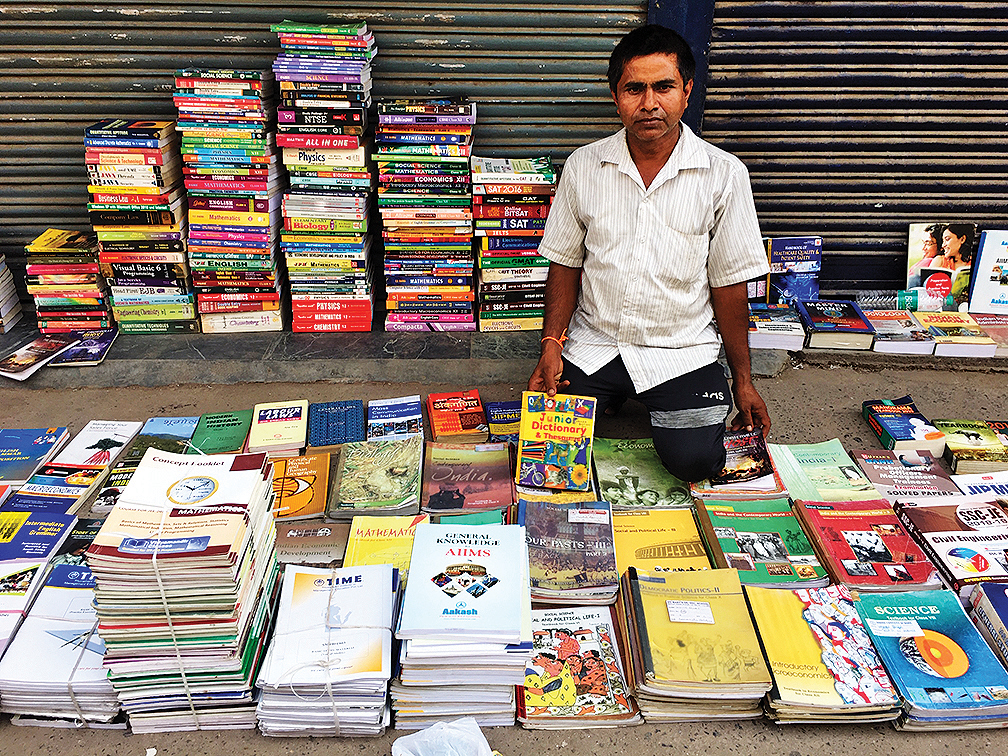
The Sunday old book market on Daryaganj’s pavements — popularly called Kitab Bazaar — was an exceptional occurrence in Delhi’s city life. All kinds of used books, rare, out-of-print or common, academic, textbooks, novels, coffee-table books, memoirs, specialised or generic books — books of all hues, description and genres were available at rock bottom prices.
A sort of recycling of knowledge took place every Sunday. The books read by previous generations that shaped their worldview was available to Gen Next at throwaway prices. It was an organic literary connection between the past and the present.
But on Sunday, 11 August, the streets of Daryaganj — literally meaning ‘market by the river’ — was devoid of books, booksellers and energy; it felt like the passing of an era, as people ambled along listlessly on the streets. The Delhi High Court ordered MCD to close the book market as it causes congestion in the area.
Last weekend, Chandni Chowk and Daryaganj bore a gloomy look despite Eid festivities, as debilitating police restrictions were in place to secure the area for the upcoming Independence Day celebrations.
Asked to comment on the court order, Bharati Chaturvedi, founder-director of the Chintan Environmental Research and Action Group, an organisation that focuses on issues of urban poverty, consumption, and sustainable livelihoods for those working in the informal sector in India, says bluntly, “It’s cruel and scar on the city to stop the book market as it a hallmark of Delhi.”
She explains that lakhs of people who love reading will be “deprived of the largest and biggest and most inclusive book store in the world run by the people. It’s such an extraordinary thing—very few cities in the world have an outdoor book bazaar like this.” Apart from providing livelihood to thousands of people, Chaturvedi says, it “unites us to the parts of the city we otherwise don’t go to, opens our eyes to books that we otherwise would not know of.”
A few of the booksellers have shifted to either Ansari Road—the hub of publishing in Delhi —or Nai Sadak, between Chawri Bazaar and the main Chandi Chowk market, about a kilometre from Daryaganj.
One of them is Rakesh Kumar Mishra, 60, originally from Bihar, who has been selling novels and international periodicals — like The New Yorker for Rs 100–for more than two decades. Before him, his brother did it for 20 years.
He has now set up a small stall in Nai Sadak, as selling old books is his only vocation. Six days of the week, he collects books from kabadiwalas, old book dealers, books donated by people like Chaturvedi, libraries and news agencies. On Sunday, he sells what he has. He laments, “I’m prevented from selling books. Kahan ka kanoon hai yeh? (What kind of law is this?)”
Mishra never learned the English language, but after years of dealing with books, he knows the names of authors and the titles of books by heart. He displays about 1,500 books and periodicals at a given time and remembers the name and title of each one of them.
Though the practice is to fish out a book of your choice from the big dusty pile and be surprised, if you ask Mishra for a random title, like Lucky Jim by Kingsley Amis, he responds confidently: “I have it. It’s in the pile,” or “In store, will get it next week.” Or suggests another stall in case he doesn’t have it. “Try Ramlal’s (his cousin’s) shop.”
Each of the booksellers is a unique character. Like many monsoons ago, when Delhi journalist Charu Soni was combing through a stack of bestsellers, “An anthology of Jan Koch-anowski, some say the greatest Slav poet ever, randomly came to my notice. I bought it from a man with a white beard who reminded me of Kochanowski himself,” she recalls.
Mishra used to earn Rs 3,000 every Sunday. Forced to shift to Nai Sadak, he found his earnings plummeting to just Rs 500. “It’s a question of life and death — our livelihood.” he says.
Concurs Jhabbar Singh, 49, who sell textbooks. “I don’t know what the future has in store for us. The authorities (MCD) says that we will be allowed to put up our stall on Ansari Road starting next week.”
Shyam Sundar, 53, has been selling engineering and medical books for more than 20 years, and is more than disappointed — he feels his livelihood is being snatched away by officials. “They treat us like beggars. But we perform an important function selling cheap books to poor students. I sometimes sell a book for a pittance if I see a student in need. Many have become doctors and engineers reading books from my stall. They come back with gifts,” he says in Hindi, showing a watch gifted by a student who went on to become an engineer and works in a multinational firm in Gurgaon.
Kitab Bazaar ensured that all segments of society could afford quality literature, in that sense making knowledge more accessible. Many bibliophiles regularly came here for the ‘surprise element’. “Where else can one sift through books with a carefree abandon of a drifter? And what will happen to the random aspect of my special quest?” asks Soni.
The quest that she mentions is when destiny, in unforeseen ways, connects a reader to a writer that leads to creation of a lifelong literary relationship. The writer of this piece formed a special bond with Graham Greene half a century after his demise on reading a pack of 12 of his novels purchased for merely Rs 500 from Kitab Bazaar.
The footpath second-hand book bazaar at Daryaganj, as Soni describes it, “is where I would go, looking to meet poets.” Not just that, “The pleasure lies in the fact that it was not a bookshop but a chaotic cosmos like Shah Jahan’s city. It was a measure of the old city’s cosmopolitanism.”
At least 50 cases have already been reported this month; NCPCR guidelines mandate help desks,…
DMRC says zero reduction in train trips, attributes decline to security measures and public apprehension…
A Delhi court denied bail to a former DU professor accused of raping a student,…
Delhi Police charged seven dhaba workers in the fatal beating of a Manipuri musician who…
Seven Delhi STPs failed DPCC standards in September, dumping high levels of faecal coliform and…
AISA chief Neha Bora petitioned the Delhi HC against a police notice requiring a peace…


