The Netflix documentary Inside Bill’s Brain shines light on how Bill Gates goes about solving some of the most pressing challenges facing the world today. It is less about Gates as the brain behind Microsoft and more about the world of solving complex problems in which he is a prominent figure. Gates, as a philanthropist, has been leading efforts to tackle the problems of sanitation, preventable diseases, energy, particularly in the Global South.
There’s no fixed template for solving problems but, from Gates’ work, one can distill a few common characteristics of successful projects fronted by billionaire capitalists.
First, filtering out the causes of big, complex problems is not easy. Problem-solvers like Gates are adept in data analysis and meticulous in considering as many relevant measures as possible to arrive at a decision. But since even their brain is computationally constrained, they take the help of artificial intelligence to locate hidden patterns and relationships in data by sifting through thousands, sometimes millions, of variables.
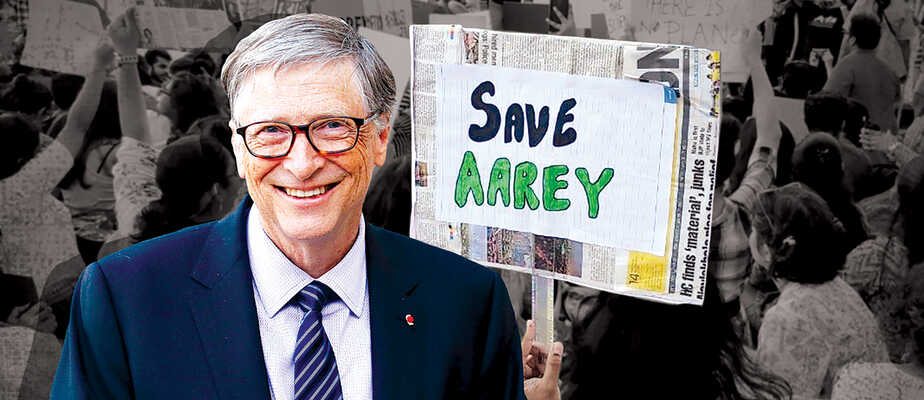
Take the example of the activists in Mumbai who are protesting against the plan to cut down around 2,700 trees in the Aarey forest to make space for a metro car shed. In response to a social media campaign by the activists, Ashwini Bhide, managing director of the Mumbai Metro Rail Corporation, defended the project. She claimed that the Mumbai Metro 3 line, for which the car shed is needed, “will carry 17 lakh passengers every day and thereby take 6.5 lakh vehicle trips off the road which will reduce 2.61 lakh tonnes of CO2 pollution every year.”
“If the same amount of pollution is to be reduced just by planting trees, Mumbai would need more than two crore trees for which there is no space in the city”.
Bhide further explained that a project for the greater public good can be executed by considering all variables and arriving at a decision that is cost and resource-efficient. Such optimisation involves maximising an objective function. In this case, it means reducing the carbon footprint and relieving Mumbai of vehicular traffic congestion.
It wouldn’t have taken AI much computational effort to rebut the arguments of the activists. By considering geographical, demographic, infrastructural, and congestion variables as well as the physical, monetary and environmental constraints, AI would have optimized the location for the metro car shed, arriving at the proposed spot or not far away. AI can aid problem-solving at scales which are beyond human capability.
Like Bhide, Gates knows this very well. It is a problem of optimisation, especially of resources. Gates thrives working under resource constraints. In the prototyping stage of the projects he invests in, he allows the freedom to design the most ambitious and non-implementable solutions that encourage the partners to think outside the box. He then has a few rounds trimming down the excess, considering all possible constraints and funneling the most practical and effective solutions. Since for-profit organisations focus on profit maximization, the billionaire’s solutions are often effective than those of the idealists.
The second characteristic is the ability to adapt to changes. Gates does attempt to solve multiple problems but their outcomes may vary due to unforeseeable events. Such disruptions as terrorism, government and economic instability can’t be easily factored in by humans, or for that matter AI. For all its promise, AI still performs poorly in predicting or factoring in such disruptions. But the lack of predictability is compensated for by the ability of people like Gates to adapt to changes. They employ the many tools at their disposal to achieve their goals in spite of setbacks. That is what keeps them going. Unlike politicians who can declare “all is good” in eight languages, they know they are susceptible to failure and need to work harder to achieve success.
The third characteristic common to all of Gates’ projects is the ability to foresee the disruptive power of technology. Gates seeks comfort in science and technology in all his endeavours. Nuclear plants, satellite maps, internet, mobile phones and AI are some of the tools that enable him to solve problems at scale.
His wife, Melinda Gates, too realises the transformational capabilities of technology. In an essay titled “Mobile phones are most powerful in the hands of the poorest women”, she details firsthand experience of how technology aids connectivity, which in turn uplifts the poorest of women around the world. Melinda Gates characterises connectivity as a solution to marginalisation, a point completely missed by the activists who prevented Facebook from offering free internet in rural India. Many a time, the optimum solution lies outside the realm of the moral high ground, and we need the help of people and technology that can figure out such solutions.
Finally, it is important to have a great team of problem-solvers. Gates relies on doers, including scientists, doctors, engineers, as well as a network of grasroot workers that can be mobilised to achieve a specific goal. He seldom relies on climate policy advisors, energy activists, sanitation experts, opinion writers and such who take a shot at the same problems but through empathy. Most of Gates’s team members have skin in the game, are goal-oriented and can get things done.
In our hyper-connected era, philanthropists like Gates coupled with AI may well make urban activism irrelevant.
www.newslaundry.com
MCD plans to deploy new auto-tippers across east and northeast wards by October 15 to…
Students say owners charge extra for electricity and gas, hold back deposits and demand cash,…
Gurugram police are tracking the driver of a sports car seen dangerously drifting on Golf…
Families struggle to identify victims of a fatal Greater Noida bus fire that killed nine,…
Delhi plans to build police posts at 50 subways and flyovers to enhance safety, with…
MCD amassed over ₹80 crore in unpaid parking dues over three years amid stalled site…
