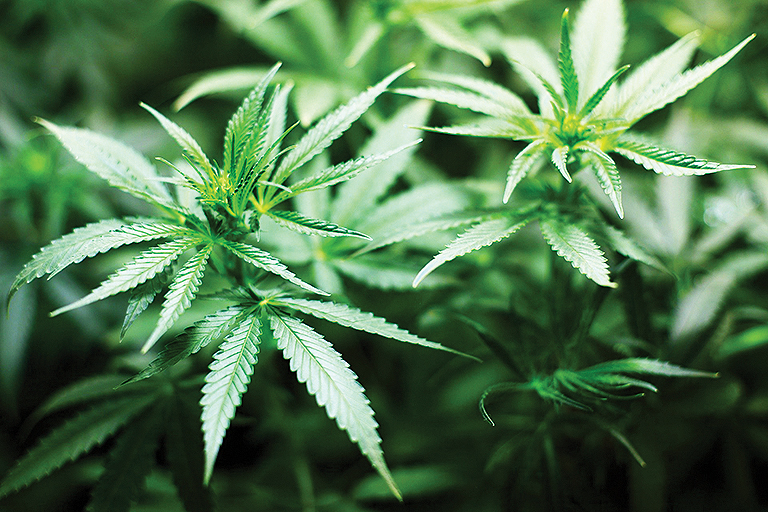
Bangalore-based NGO The Great Legalisation Movement is challenging the criminalisation and prohibition of cannabis (bhang) use in India. Its petition in the Delhi High Court specifically challenges the constitutionality of certain provisions of the Narcotics Drugs and Psychotropic Substances Act (NDPS), 1985, as well as the Narcotic Drugs and Psychotropic Rules, 1985, that restrict and criminalise the medical use of cannabis as well as industrial hemp and all peripheral activities related to it.
A 170-page document describes in detail how cannabis can be used to fight cancer, reduce nausea and for increasing the appetite of HIV patients. It addresses the agrarian crisis currently plaguing India and appeals to encourage the growth of industrial hemp industry, arguing that hemp can be used as a substitute for plastic, as well as for making everything from clothes to paper products. It reads: “The treatment of cannabis at par with other harmful and lethal chemicals is arbitrary, unscientific, unreasonable and hence unconstitutional.”
Viki Vaurora, founder, The Great Legalisation Movement, told Newslaundry: “The primary thing that we are addressing is that cannabis shouldn’t even be there in the NDPS. It is an entheogen and a very sacred plant of India, and to club it along with other illegal toxic chemicals is a bad move. India didn’t conduct any kind of scientific review or the use of cannabis in the field of Ayurveda … all of this was overlooked just because India was a signatory to the Convention of Narcotics in 1961 and to the Convention of Psychotropic Substances in 197.”
Vaurora says the government has legalised alcohol and tobacco and promoted it to such an extent that certain parts of the economy run on alcohol consumption. “This is wrong,” he explains. When asked what prompted him to move the Delhi HC regarding the legalisation of cannabis, he says it was a product of repeated failures at engaging in dialogue with state authorities to discuss the issue.
In December 2017, his organisation approached the Prime Minister’s Office with a letter. The PMO cleared it within a month and the letter was sent to the Ministry of Health, which in turn forwarded it to the Central Drugs Research Organisation (CDRO), asking it to decide whether this drug can be legalised in India or not.
“The CDRO was given 30 days to respond,” Vaurora says. “But till today, after nearly 500 days of writing that letter, nothing has materialised. This is the kind of bureaucracy that we deal with.”
In 2014, Colorado and Washington became the first states in the US to legalise the recreational use of marijuana. In June 2018, Canada became the second country in the world to legalise the use of cannabis for personal consumption.
www.newslaundry.com
Stage I of GRAP was invoked later this year in Delhi due to govt's preventive…
DDA plans to resume tethered hot air balloon rides at Baanseera park from Nov 14,…
NDMC is consulting RWAs and traders on draft 2026 property tax bye-laws, seeking feedback on…
Delhi HC will hear AISA leader Neha Bora's plea against a police peace bond notice…
CJP leaders Saurav Das and Ashutosh Ranka withdrew their HC plea challenging the extension of…
A woman died after being stabbed while trying to save her son during a violent…
