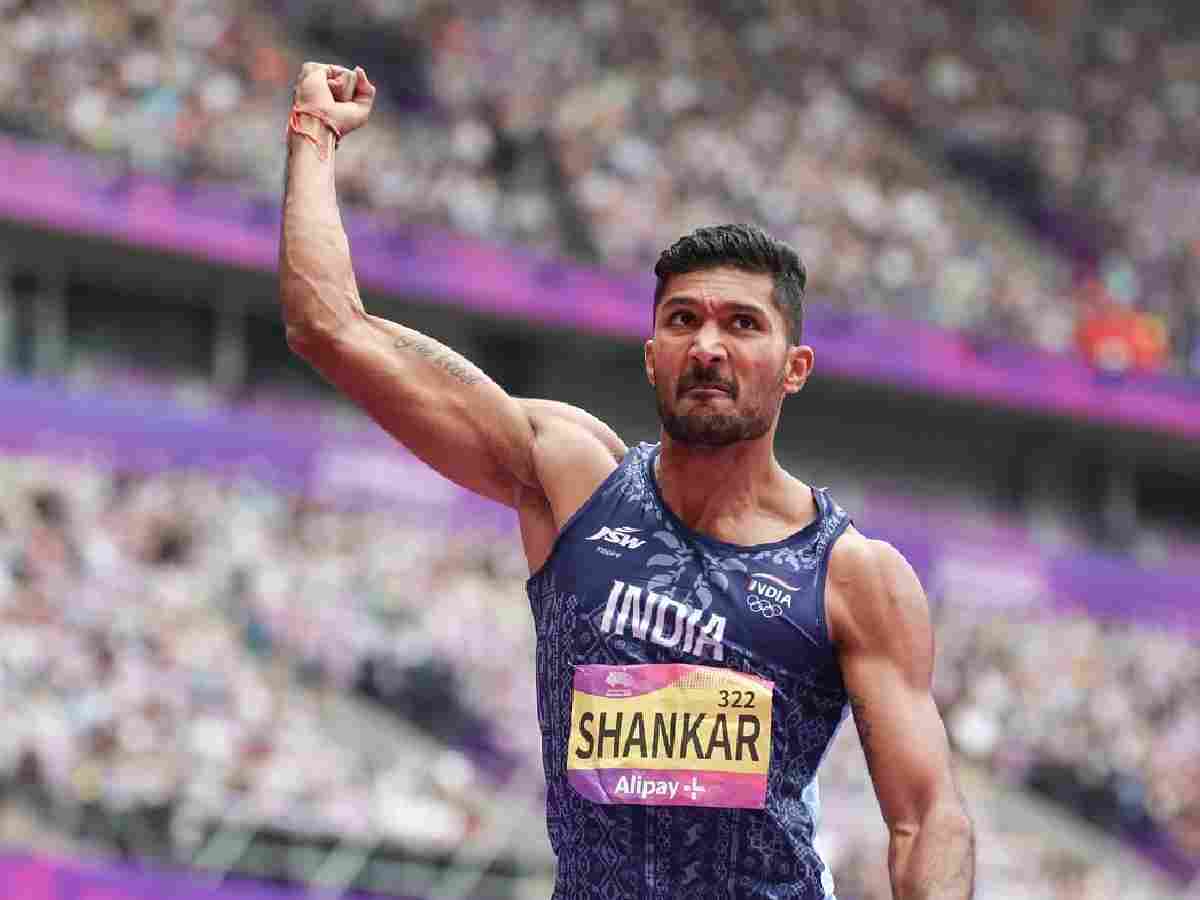
Tejaswin Shankar
Cricket was Tejaswin Shankar’s first love at school, but he eventually chose athletics — and, more specifically, the demanding discipline of decathlon. The decision has served him well. The 27-year-old has gone on to win several honours on the international stage, including a bronze medal at the recent Glasgow Commonwealth Games (CWG). Now, the six-foot-four-inch athlete has set his sights on gold at the Asian Games in Aichi-Nagoya, Japan, in September-October.
Shankar, an alumnus of New Delhi’s Sardar Patel Vidyalaya and Kansas University, where he is pursuing his second master’s degree and teaching biomechanics, broke the 8,000-point barrier in Indian athletics when he scored 8,057 points in the decathlon at the 29th National Senior Athletics Federation Competition in Ranchi in May.
The performance earned him qualification for Glasgow, where a knee injury affected his campaign. Unable to complete the standalone high-jump event, he nevertheless fought through the injury to clinch bronze in the gruelling 10-event decathlon.
A big fan of Virender Sehwag, Shankar spoke to Patriot in an exclusive interview about his career, ambitions and a range of other issues, including his ultimate goal of competing at the 2028 Los Angeles Olympics. He trains under renowned former American decathlete Kip Janvrin and was scheduled to resume training on August 10 after completing rehabilitation for his troublesome knee.
Excerpts:
Has the training started after the Commonwealth Games?
Since I came back [to Kankas University], for the last one week, I have been in rehab. But the plan is to resume training next week [August 10] onwards because that will put us exactly at the six-week mark [before the Asian Games begin on September 19].
How is the knee now?
It’s getting better. It was a flare-up of tendonitis. This is a very common injury among jumpers – high jumpers, long jumpers – [as well as those playing] basketball and volleyball. It is quite better now.
Is your training programme finalised until the start of the Asian Games?
My plan is to stay here in the US and train because in two weeks the university will start. So, I still have my university duties that I have to take care of as a student and also as a teacher. The Asian Games is still six weeks away. I’ll try to go to Japan a week before the Asian Games and take that week off to recover [from jetlag]. That will give me one week in Japan to get used to the conditions.
Most importantly for me, the long travel is what will be the biggest deterring factor, because a flight from here to Japan is about 15-16 hours. That’s going to be a very long travel day. But it’s nothing new because when I played in the Asian Indoor Championships this February in Tianjin, China, the whole point was to rehearse for the Asian Games. So, we wrote down the whole strategy of what flights to catch, [and] how to make sure that during the trip I’m able to recover better. All those things are ironed out.
Now, I just have to replicate that before the Asian Games. In Tianjin, the result was also good [he won the seven-event heptathlon gold with 5993 points – a national and Asian record]. So, if something like that happens in the Asian Games, it would be best for me.
Every four years, the Asian Games follow the Commonwealth Games with little gap. How would you overcome that?
In my experience of competing all these years, I have always said that physical recovery is easy. The body knows what to do with physical recovery. If you just take 8-10 hours of sleep, and you lead a stress-free life, or if you lead a stress-free week post your major competition, then the body knows what to do, as it’s the best machine in the world. The body knows exactly how to recover. So, if you’re eating well, if you’re sleeping well, and if you’re trying to stay as stress-free as you can, then there’s absolutely no problem. It’s definitely the emotional recovery which takes some time, and that’s why for me, this week [August 3-9] away from training was very important.
Will the decathlon competition at the Asian Games be tougher than at the Commonwealth Games?
I would say that it’s different, in the sense that if you look at the Asian Games rankings, there are three guys that are close within, and I’m ranked second. Obviously, there’s the Japanese athlete [world’s 34th ranked and Asian champion Yuma Maruyama, 8321 points] who is 200-some points better than me and the other Chinese guys. And then there’s me and a Chinese athlete [61st ranked Xiang Fei, 7815] who are very similar. And then there are a couple other guys who are in that ballpark.
So, I would say that the stiffness in competition was more at the Commonwealth Games because you had two Olympic medallists there and you had four or five athletes who had scored around 8,000-8,100 points. Based on that, the Commonwealth Games was more difficult. But in the Asian Games, you want to try and get the gold medal, right? So, it’s not about survival. It’s about trying to go for that gold. For that, there is stiff competition, because there are three or four or five guys who will try to reach the podium. So, I have to give my best in order to achieve that gold medal, which is what we will try and train for in the next six weeks.
At the Commonwealth Games, you were quite far from your personal best that you achieved in Ranchi in May. What was the reason? Was it the conditions, the competition, or was it the knee?
Well, I was within 90 points of my personal best. In Ranchi, I scored 8,057 points, and in the Commonwealth Games, I scored 7,976. So, that is within 90 points of my personal best. When you do 10 events, that’s like missing two bars, or maybe running 10 seconds slower. If you look at the whole decathlon, you can easily gain or lose 100 points by going up and down. So, that’s the positive, because if I can lose 100 points, I feel like I can also gain 100 points if there’s a swing [in my favour] in a couple of events. That puts me at around 8,100-some points, and if that happens, I feel like that’s a very, very competitive score for the Asian Games gold. That 100-point swing is very, very normal. But given the fact that I was more proud, that I had a knee flare-up, and given the conditions – the wind, and all those sorts of things – if I was still within 100 points of my personal best, that just shows that the tank is much bigger, and if I can put the whole series together, then I can score even bigger. Sometimes with 10 events, the chances of 10 things going wrong are much higher than the chances of one thing going wrong.
Will your coach Kip be with you at the Asian Games?
That’s something we have to figure out. I’ll have to ask him about his schedule because I haven’t really been to the track this week [August 3-9], and he was also travelling for the World Under-20 Championships in Eugene.
When he comes back, that’s when we will have a chat and see how it is possible for him to come, and if not, then what strategy or plan we can devise, so that I can give my best in that competition.
Would you prefer having him around at the Asian Games?
It definitely helps having familiar faces around when you are competing, or people who know your tendencies in the competition environment, what you do, what mistakes you make. It’s always good to have them. But what I have learnt in professional sports is that you can’t rely on that – that I’ll compete only if he’s there.
We’ve done a good job together over the last few years. For example, my wife [former sprinter Siddhi Hiray] is my travelling coach. She is able to come for most of my competitions. If, by chance, my coach is not able to come, she’s that link between communicating with him, or she’s giving me coaching cues, because she herself was an athlete. So, we have a small coaching tree, and I’m still able to get the cues that I need at every juncture in a competition.
And what do you think are your realistic chances at the Asian Games?
I definitely think I can fight for gold. So, it’s all about trying to execute on that given day. And if you had asked me about my realistic chances before the Commonwealth Games, I would have said I could finish fourth or fifth. I couldn’t even start after my knee flared up. I guess most times in sports, you have to try and be extremely positive and just hope that the result swings in your way. Having said that, everybody in that arena is putting in the same amount of effort, and everybody is working extremely hard. That’s why they are representing their countries at the Asian Games.
Therefore, at that level, you have to just give your best and see what happens. That excitement is also very important. And it’s also very important to take that stress. And that’s why these next six weeks become extremely important to know how to decompress the mind and the body, so that when you are again put in that position, you are able to handle all that extra stress and still be able to outperform your competitors.
Have you planned your calendar post the Asian Games?
The Asian Games will be my fourth and last competition for the year. I won’t have any other competitions planned after the Asian Games. And then we will go back into preparation phase for next season because, in track and field, especially in my event, the decathlon, you just cannot compete so often. This is because every time you do one decathlon, it takes a lot out of you physically – and obviously, emotionally.
On an average, every year, most good athletes tend to do not more than three or four decathlons. So, at that point, there’s nothing more to gain. Once we do the Asian Games, the plan will be to stop and get back into preparation, let the body recover, so that we can still go out and put out a better score next year and then try to qualify for the 2028 Olympics.
Each day of closure costs shops in Khan Market and Connaught Place between Rs 60,000…
Delhi generates nearly 15,000 tonnes of waste daily, prompting the government to deploy 1,000 mechanical…
Delhi Police has issued an NOC for the Congress rally at Ramlila Maidan on November…
CJP chief Abhijeet Dipke received conditional bail following his arrest for participating in a Connaught…
The DPCC has floated ₹104 crore tenders to test pilot pollution-control technologies across 40 key…
MCD pushes Bhalswa cleanup to Feb 2027 due to agency transition, leaving over 10 lakh…
