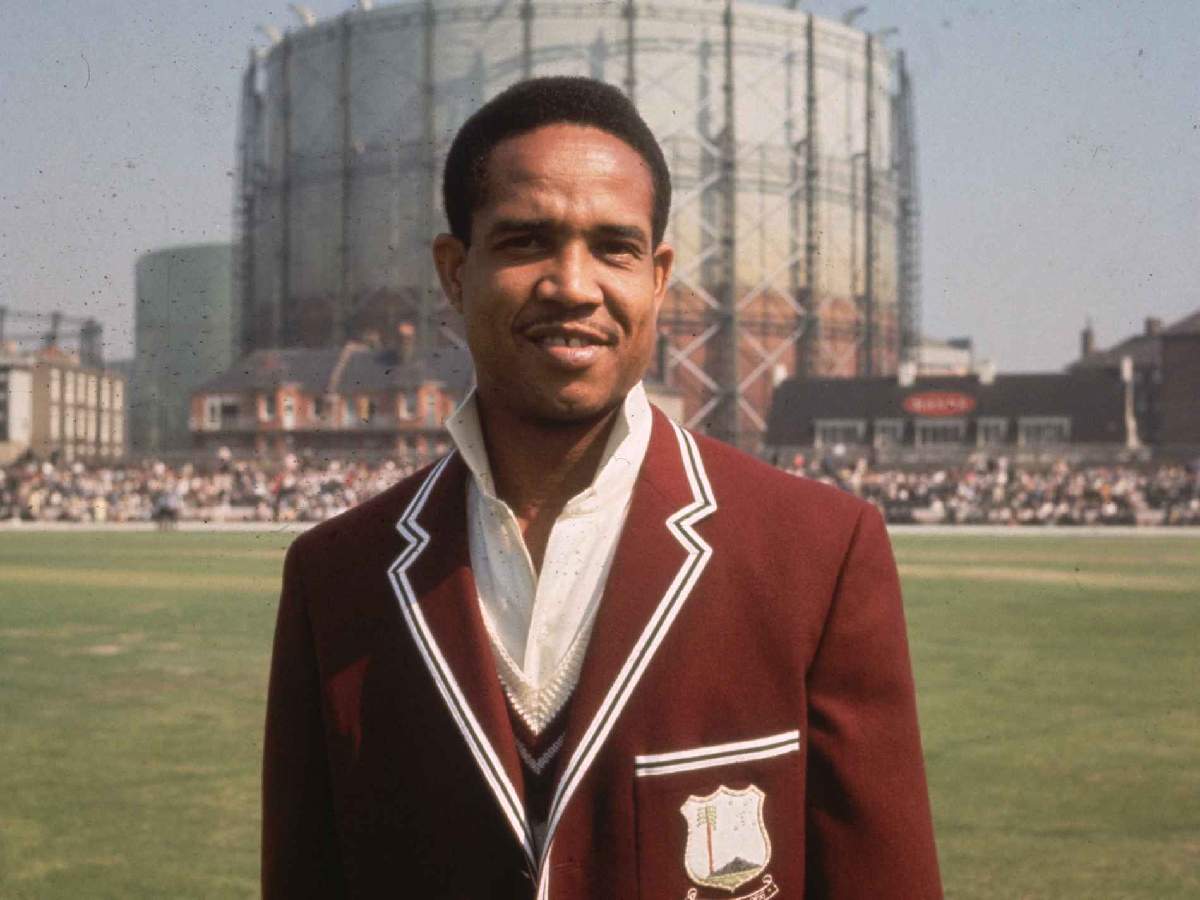
Sir Garfield St Aubrun Sobers
West Indies legend Sir Garfield St Aubrun Sobers, arguably the greatest all-rounder the world has ever seen, played 93 Test matches in his illustrious and eventful career. And the Barbadian, who passed away on July 17 aged 89, played only two first-class matches at Delhi’s historical Arun Jaitley Stadium, one of them being a Test match. The Test was played in February 1959, and the other game, a four-day encounter between the touring West Indians and a Prime Minister’s XI, was staged in December 1966.
However, some of those who either played in those games or witnessed them fondly remember watching Sobers in action. For former India captain Chandu Borde, the Delhi Test has a special place in his heart, as he scored his maiden century in that match, including some runs off Sobers’s left-arm bowling during his first-innings 109. And in 1966, Borde captained the Prime Minister’s XI, though the Indian was off-colour this time around.
Abbas Ali Baig, who scored a century on Test debut against England in July 1959, also played the 1966 game, and Sobers dismissed him in both innings.
Two other persons who went on to become household names as radio/TV commentators—Ravi Chaturvedi and Narottam Puri—watched the Delhi Test as students from the stands and were at the venue, almost eight years later, to witness the Prime Minister’s XI-West Indians tie. All four recalled both matches when Patriot reached out to them, though age and the passage of time have dimmed their memories a bit.
Rendezvous with Kotla
Sobers’s rendezvous with the Kotla as a cricketer was not memorable, though he visited the historical venue as a TV commentator during the 1996 World Cup and probably a couple of times more. He may have scored just 44 in the only innings he got the opportunity to bat in during the Kotla Test, but he ended the 1958-59 five-match series as the top run-scorer on either side. And he went wicketless in 24 overs in the first innings at the Kotla and didn’t get a bowl in the second as the match ended in a draw.
A left-handed batsman, Sobers amassed 557 runs in just eight innings at a brilliant average of 92.83 in that Test series. He hammered three centuries, with the top knock of 198 coming in the second Test in Kanpur. With the presence of tearaway fast bowlers Wes Hall and Roy Gilchrist in the team, Sobers wasn’t required to bowl a lot on Indian pitches. But the left-armer still ended up as the third-highest wicket-taker for the West Indies with 10 wickets, behind Hall (30 wickets) and Gilchrist (26).
When the West Indian legend returned to the Kotla in 1966, he led the team. But, again, he had an ordinary outing with both bat and ball. He scored 35 in the first innings before being hit wicket off left-arm spinner Bishan Singh Bedi and didn’t get to bat in the second as the four-day encounter ended in a draw. He took a solitary wicket in 22 overs the first time around and two, including that of captain Borde, in the second innings in 14 overs.
Borde vs Sobers
Borde was playing only his fourth Test in Delhi, having made his debut in the first match of that series in Bombay. Before coming to the Kotla, he had managed just 76 runs, including a half-century, in five innings. But Lady Luck smiled on him in Delhi, where he cracked 109, studded with 16 boundaries.
Also Read: “I am focused on winning T20 DPL for South Delhi,” says costliest buy Tejasvi Dahiya
“At the time, the Kotla ground was a very good wicket for batting also—a very solid, good batting track. Besides the century, I scored 96 in the second innings before being out hit wicket off Gilchrist. I hit the ball, but then, while turning, my bat dislodged the bails,” 92-year-old Borde told Patriot from his home in Pune.
Borde remembered Sobers as a brilliant cricketer. “He was a great cricketer. I feel he was the greatest all-rounder I have come across. I have not seen anyone better than him yet. And he was brilliant in the field—close-in fielding and in the outfield as well. He was a very jovial person,” he said. “On a personal note, we were good friends.”
Sobers dismisses Baig
Although Sobers didn’t have a memorable outing in the 1966 match, he accounted for Baig in both innings, besides dismissing Borde in the second. Today, Baig, all of 87, also doesn’t remember much of that game and was bemused to hear that he fell to Sobers twice after scoring 61 and 20 in the two innings.
“I don’t recall that game, but now that you have talked about it, a semblance of recognition is coming. It is surprising, particularly, that I got out to Garry in both innings,” Baig told Patriot from Singapore.
However, Baig, who played 10 Tests, remembered the time spent with Sobers. “We used to go out together and have a lot of fun. He was a fun-loving chap, an excellent chap. And, of course, a superb cricketer, absolutely out of this world because he could do anything—bowl slow and fast on any kind of wicket and bat on any kind of wicket and score hordes of runs. He was a very agile and fit person, and was extremely good on the field. Not many like him are likely to be born or have already been born. He was one and unique, absolutely,” he said.
Other ‘witnesses’
Renowned commentators Chaturvedi and Puri watched both matches that Sobers played in Delhi. Both were college students when they visited the Kotla for the 1959 Test—Chaturvedi was a final-year Master of Science student at Delhi University, while Puri was just 11.
“The first thing that struck me was that Sobers would judge the ball very quickly. He’d thrust his bat and pad forward, without a gap, and would play the ball gently. When he’d play a stroke, he wouldn’t use much of his body; he would just use his wrists, which would turn and send the ball to the boundary,” said 88-year-old Chaturvedi, who taught zoology at Delhi’s Zakir Husain College.
Chaturvedi remembers an anecdote from the Delhi Test. “There used to be a rest day during Test matches in those days. On the rest day of the Delhi match, the West Indies team went to watch the final of the Inter-College Tournament between St Stephen’s and Hindu College. Sometime later, when I mentioned it to Hall, who himself had watched the final, he said, ‘Oh, it was very competitive cricket,'” said Chaturvedi, who traces his ancestry to the Caribbean and went on to become friends with Sobers, Hall, and other legendary West Indies cricketers.
In the four-day match, Puri noticed a few things that are etched in his mind. “Three things stand out for me. One, Sobers’ entire demeanour—the way he went onto the field and how smart he looked. He looked like an athlete, a sportsman. So, that was impressive about him. Second, he was captain, so obviously, eyes were on him, and you got a view of his nature by that time, and everybody wanted to have a look at him. Third, he was very graceful while batting,” said 78-year-old Puri.
Puri remembers the 1966 game for another reason. That match was the first-ever cricket match in India to be telecast live. “I was a statistician in that match, and my father, Devraj Puri, was a commentator,” he recalled.
Police sources said authorities are considering recommending passport cancellation for those identified as being involved…
The Delhi High Court has asked the Delhi government and the MCD to submit a…
Seventeen Delhi Metro stations remained shut for the second day as security measures around the…
Delhi LG extends Delhi Police's preventive detention powers under the National Security Act till October…
Following a review of 95 services across 18 departments, the Delhi government has shortened processing…
Commuters advised to plan alternate routes as restrictions remain in force till further orders
