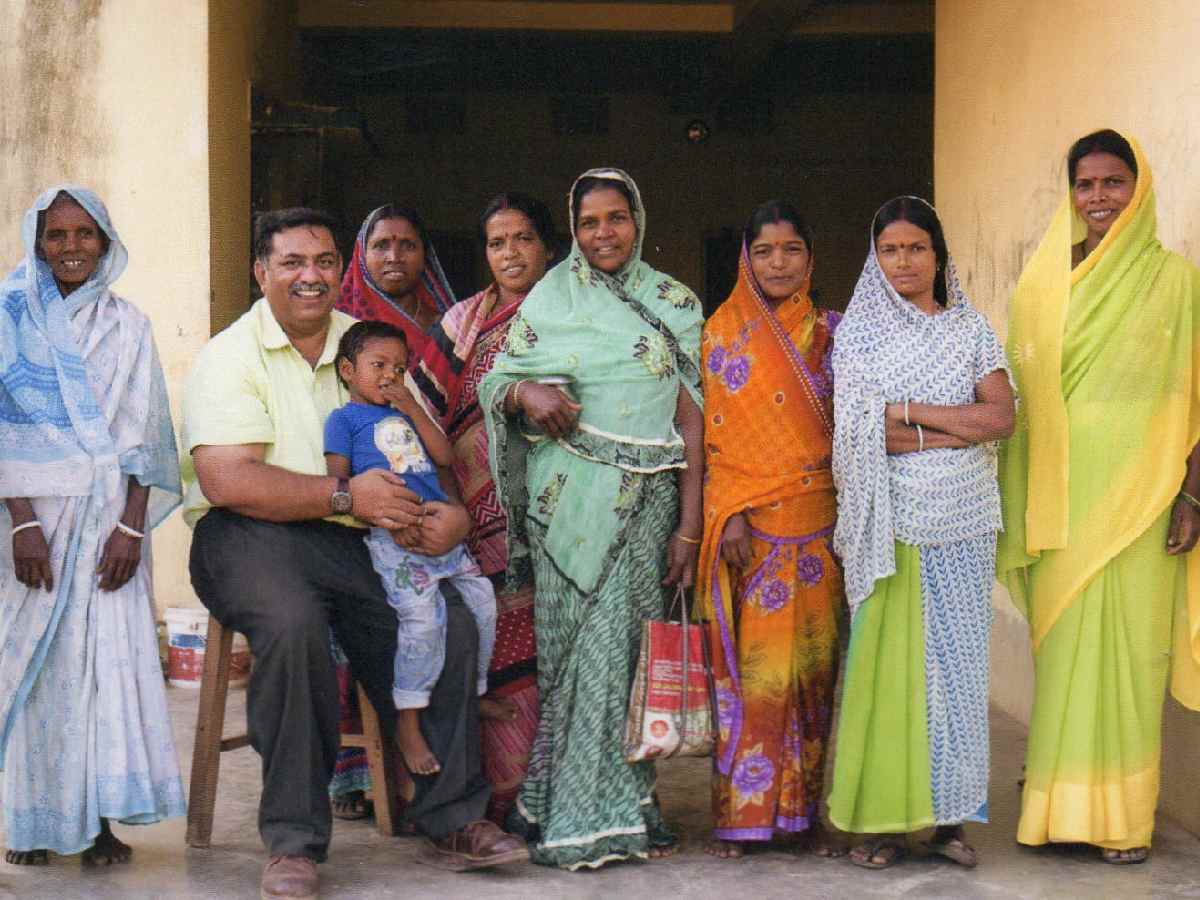
In the dusty villages of Bounsi and Dumka, a quiet transformation is underway. A new cluster of 85 rural women—many of them first-time earners—has received foot-pedal spinning machines and training in tussar silk yarn production, courtesy of Ecotasar, a social enterprise reshaping sustainable fashion from the forest floor up.
The move is part of the company’s larger ambition: to empower 2,000 women in Bihar, Jharkhand, and Assam by 2026 through dignified, home-based employment. The initiative was recently commemorated with a virtual event led by Day Kornbluth, President of West Elm—one of Ecotasar’s longest-standing international partners.
But this is no overnight success.
Also read: Shalimar Bagh: From a forgotten forest to a cultural gem
The beginning
In 2007, a quiet revolution in sustainable fashion was taking root in the rural heartlands of Bihar and Jharkhand. It began not with a grand business plan, but with the steady hands of adivasi women and the golden thread of tussar silk. At the centre of this transformation was Khitish Pandya, whose journey into rural enterprise was shaped as much by personal setbacks as by professional insight.
Pandya began his career in manufacturing. After earning an MBA from Xavier Institute of Management in Bhubaneswar, he launched a venture in Delhi focused on prefabricated housing and mobile sanitation units. But in 1998, an accident derailed his plans and forced the closure of the business the following year.
“I had to start over,” he says.
The search for meaningful work led him to consulting assignments and, eventually, to PRADAN—Professional Assistance for Development Action—a non-profit working to uplift rural communities since the early 1980s.
At the time, PRADAN had been working with women in Bhagalpur, one of India’s historic silk regions, helping them organise into collectives to spin tussar yarn. In 2004, they launched a producer-owned company called Masuta to manage yarn production. While the women had the skills, market access remained elusive—and Masuta struggled to cover its costs.
That’s when Pandya stepped in—not just as a consultant, but as a bridge between grassroots potential and market reality. “PRADAN was doing transformative work with women, but they weren’t equipped to turn it into a commercially viable model,” he says. “That’s where I came in.”
The choice of tussar silk, unlike many origin stories in fashion, wasn’t romanticised. It was strategic. “PRADAN chose tussar because it’s produced by some of the most marginalised communities in one of the most marginalised geographies,” he says. “It wasn’t about culture—it was about creating a viable livelihood.”
Laying the groundwork
PRADAN played a vital role in mobilising the first clusters of rural and adivasi women artisans. “They had built trust over time, which helped reduce resistance. Once production began, that’s when I stepped in—because PRADAN couldn’t make it commercially viable. I worked on creating the market linkages that transformed it into a sustainable model.”
Today, that model has grown to include more than 1,950 families.
Every product made by Ecotasar passes through a detailed, deeply manual supply chain that begins with tribal families who rear silkworms and produce the cocoons. “We buy those cocoons, treat them, and pass them to trained women who convert them into yarn using pedal-powered machines,” Pandya explains.
The yarn is then dyed in Bhagalpur, woven into fabric by weavers, inspected, mended, softened, and calendared. “Once finished, it’s shipped to Delhi or to our cut-and-sew unit in Manesar, depending on whether it’s a saree or a cushion cover.”
A decentralised workforce
Ecotasar does not follow a traditional employment model. Instead, Pandya describes a system rooted in flexibility and dignity. “We work directly with yarn producers. We provide raw material, and they get paid based on what they make. There’s no clock-in, clock-out. It’s all about empowering them to work from home, at their pace.”
How do they ensure quality control across such a dispersed network? “We do visit occasionally, but not frequently enough for ongoing supervision. Instead, we pay more for better quality. That’s all the incentive they need.”
The simplicity of the yarn-making process—akin to learning how to cycle—ensures that even the uneducated or illiterate can participate. “It’s eye-hand-leg coordination. If you can move with rhythm, you can make yarn.”
Also read: Boating relaunch at Purana Qila misses second deadline
Scaling sustainably
Seventy percent of Ecotasar’s revenue comes from exports, with the United States as the primary market, followed by the Netherlands, Germany, and Australia. “Almost all our exports are home textiles—cushion covers, throws, and curtain fabrics,” Pandya says.
Domestically, the brand has worked with FabIndia and Jaypore. “For us, volumes matter. The more we sell, the more yarn we need—meaning more livelihoods. While we’ve traditionally worked as a white-label B2B supplier, we’re now exploring our own B2C brand.”
Since its inception, Ecotasar has grown from a Rs 2.2 crore enterprise in 2007 to Rs 32 crore in FY 2024–25, achieving a compound annual growth rate of 21%. “Though we’re a social enterprise, we’ve always been profitable. You can’t create impact if you don’t survive the market.”
Impact on the ground
In regions where seasonal migration is the norm, the ability to earn from home is transformative. “Because of this income, families don’t need to migrate. Children can stay in school. Some families even send their kids to missionary-run boarding schools,” Pandya notes.
Others have used the money to build pucca houses or fund their daughters’ weddings.
At the design end, Ecotasar works with professionals from India’s premier design institutes like NIFT, NID, and IICD. But even here, collaboration with artisans is central. “We bear the costs of materials and compensate artisans for their time during the sampling process.”
And what about the company’s “carbon-neutral” claim?
“The cocoons are forest-grown, yarn is made on foot-pedal machines, and weaving is done on handlooms. While fossil fuels are used in dyeing and finishing, our footprint is a fraction compared to conventional textiles. No third-party certification yet, but our process speaks for itself.”
Office-friendly sarees and subtle summer lines
Ecotasar’s sarees are deliberately understated—suitable for office wear and Indian summers. “We use natural fibres in breathable blends like silk-linen or cotton-silk. Our production runs are small, so lab testing every line isn’t feasible, but we rely on textile traditions that are already tried and tested.”
To Pandya, “sustainability” isn’t just a feel-good term. “It’s primarily about economic sustainability. We constantly ask ourselves: does this strategy create wage opportunities for tribals, weavers, women artisans? If yes, then we’re on the right path.”
The path, however, isn’t without hurdles.
“Price sensitivity is a big issue—our handmade textiles can’t compete with machine-made ones. We overcome this by investing in good design. People will pay more for design they love.”
Climate change, too, poses a threat. “Erratic raw material supply affects availability and prices. We mitigate this by working with blends to stabilise costs.”
The road ahead
Growth is on the cards—but not at the cost of their mission. “Yes, we want to scale, but we avoid the lure of machine-made volume because it doesn’t create employment for the women we serve.”
Instead, Ecotasar is eyeing a franchise model. “We want to create a network of stores that stock only tussar silk—designed, produced, and sold within our existing ecosystem. That way, we connect with a niche audience who values both quality and ethics.”
What about state support?
“Government subsidies on equipment are helpful. But what we really need are retail spaces—urban platforms like Dilli Haat, leased long-term to brands like ours. Let MSMEs build a customer base and brand. Inverse rents based on performance could even incentivise success.”