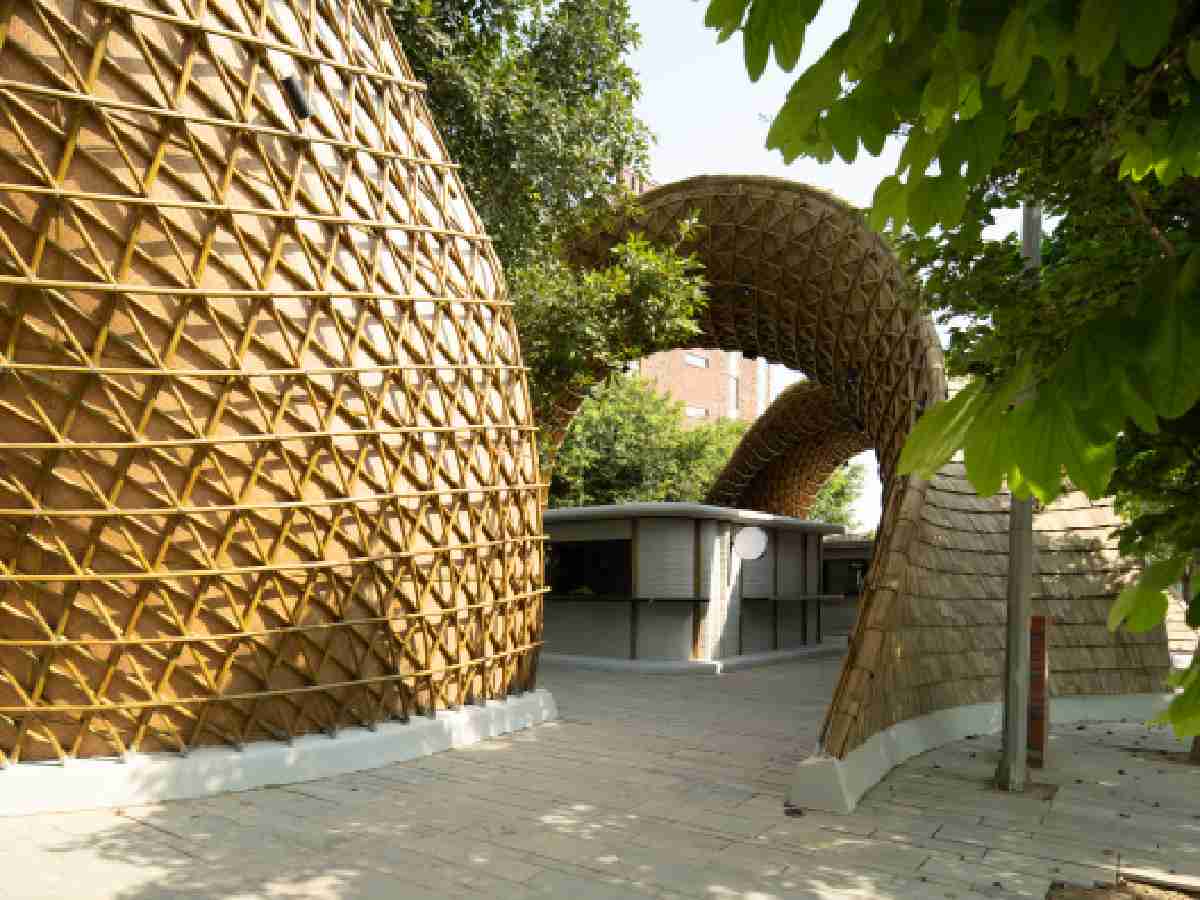
Beneath a canopy of trees at Ashoka University in Sonipat, bamboo twists and curves into shapes that feel almost alive. This is The Hungry Caterpillar, Apoorva Shroff’s audacious experiment in architecture, where natural materials meet cutting-edge technology. Here, bamboo canopies, 3D-printed kitchens, and furniture made from recycled plastic come together to create a space that feeds curiosity as much as it feeds students—a living classroom for sustainable design.
A metaphor in wood and weave
Spread across 650 square metres, the project draws its name from Eric Carle’s beloved children’s book, The Very Hungry Caterpillar. “It’s about curiosity, growth, and transformation. Just as the caterpillar never stops feeding, learning too must never stop,” Shroff explained. The design envelops students in a cocoon-like environment—safe, playful, and immersive—where every material tells a story of sustainability.
Nature and technology in harmony
The bamboo canopies, crafted by Jans Bamboo with structural support from London-based Atelier One, stretch up to 19 metres, their woven angles filtering dappled sunlight into the spaces below. Bamboo, long celebrated for its tensile strength, here becomes both structure and sculpture, shaping the way light and shadow move across the campus.
But the project goes beyond craft. Kitchens take the form of modular 3D-printed concrete shells by Micob Pvt. Ltd., reducing material waste and improving energy efficiency. Furniture by Placyle turns discarded plastic into functional seating, proving that sustainability can be both inventive and practical.
“We began with bamboo, but every choice had to be responsible,” Shroff said. “That led us to explore 3D printing and recycled plastic. Ashoka was open to experimentation, which made it possible.”
Lessons from Bali
The ethos behind the design stems from Shroff’s time in Bali, where she trained alongside learners ranging in age from 17 to 77. “The biggest takeaway was that you can learn at any age. We harvested bamboo, protected it, and built something tangible. It was eye-opening,” she recalled.
Yet bamboo presented challenges. “The hardest part is the lack of research. Everything becomes an experiment—testing strength, gluing, loading. It can be frustrating, but also rewarding,” she said.
Reimagining materials and methods
The Hungry Caterpillar demonstrates how unconventional choices can redefine construction. Bamboo replaces concrete as a structural element, recycled plastic is transformed into durable furniture, and 3D printing allows precision and reduced waste. Together, these elements create a circular, eco-conscious ecosystem where every component is intentional.
A campus landmark
Beyond its materials, the project is about place-making. “I went to an architecture college that was a concrete box with no character. If Ashoka’s students can sit here, under these shells, make memories, and remember it as their spot on campus, then it has served its purpose,” Shroff said.
The future of design
The Hungry Caterpillar is more than a food street—it is a manifesto for sustainable design in India. It shows that experimentation, curiosity, and respect for nature can converge to create spaces that are functional, beautiful, and meaningful. Shroff believes such approaches will shape the next generation of campuses, cities, and public spaces.
“Sustainability can be practical and innovative. Bamboo, recycled plastic, and 3D printing are not just alternatives—they are the future of design,” she said. For students, the project is a space to gather, eat, and learn. For architecture in India, it is a signal that imagination, material intelligence, and environmental responsibility can coexist—if designers are willing to rethink what a building can be.