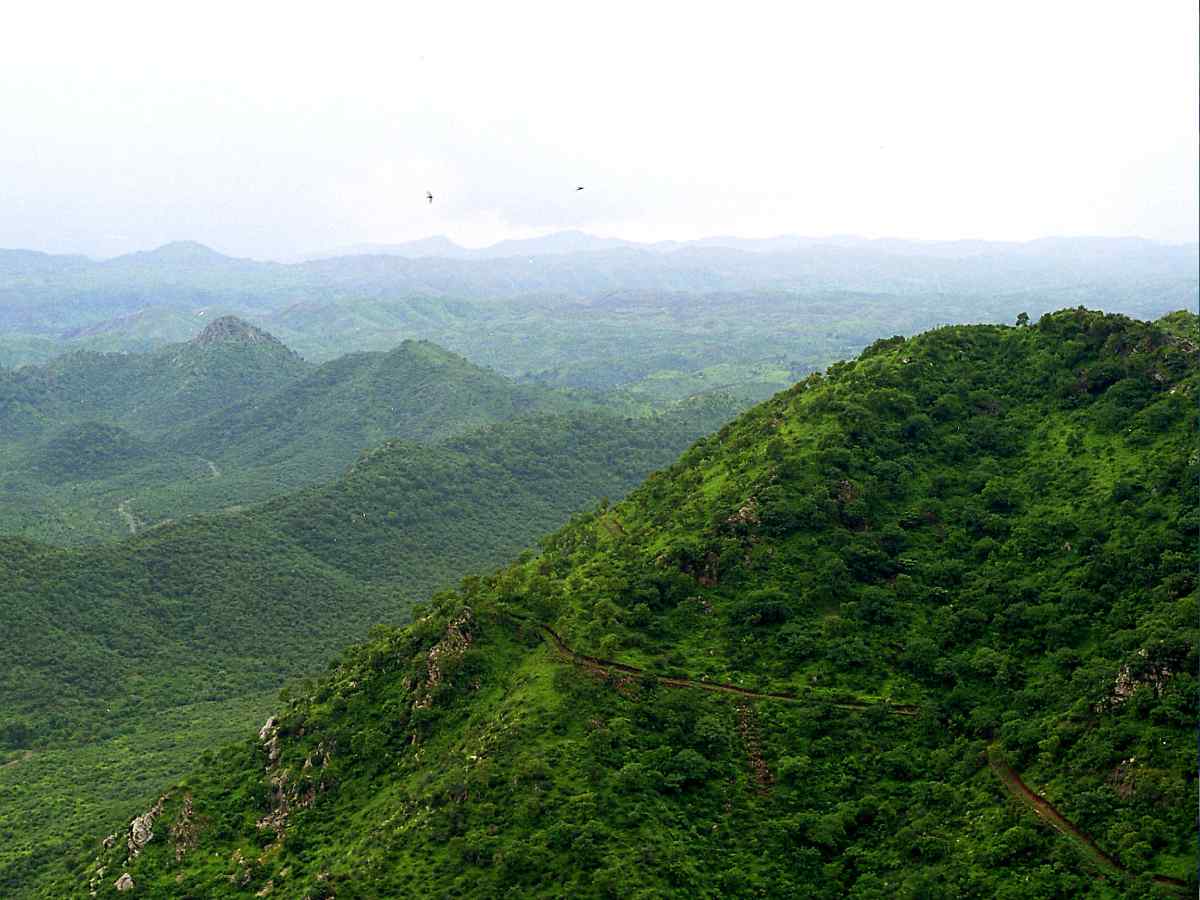
Aravalli hills: Amid a row over the definition of Aravalli hills approved by it, the Supreme Court has taken suo motu cognisance of the issue and is slated to hear the matter on Monday.
As per the cause list, a three-judge bench vacation of Chief Justice of India Surya Kant and Justices JK Maheshwari and Augustine George Masih is likely to hear the matter.
The case is titled as ‘In Re: Definition of Aravalli Hills and Ranges and Ancillary Issues’.
The top court on November 20 had accepted a uniform definition of the Aravalli hills and ranges and banned grant of fresh mining leases inside its areas spanning Delhi, Haryana, Rajasthan and Gujarat until experts’ reports are out.
The apex court had accepted the recommendations of a committee of MoEF&CC (Ministry of Environment, Forest and Climate Change) on the definition of Aravalli hills and ranges to protect the world’s oldest mountain system.
The committee recommended that “Aravalli Hill” will be defined as any landform in designated Aravalli districts with an elevation of 100 metres or more above its local relief and an “Aravalli Range” will be a collection of two or more such hills within 500 metres of each other.
The committee, while defining Aravalli hills, said, “Any landform located in the Aravalli districts, having an elevation of 100 metres or more from the local relief, shall be termed as Aravalli Hills… The entire landform lying within the area enclosed by such lowest contour, whether actual or extended notionally, together with the Hill, its supporting slopes and associated landforms irrespective of their gradient, shall be deemed to constitute part of the Aravalli Hills.”
The panel also defined Aravalli Range and said, “Two or more Aravalli Hills …, located within the proximity of 500m from each other, measured from the outermost point on the boundary of the lowest contour line on either side forms Aravalli Range. “The area between the two Aravalli hills is determined by first creating buffers with a width equal to the minimum distance between the lowest contour lines of both hills … The entire area of landforms falling between the lowest contour lines of these Hills as explained, along with associated features such as Hills, Hillocks, supporting slopes, etc., shall also be included as part of Aravalli Range.”
The SC delivered a 29-page judgement in the suo motu matter arising out of the long-running environmental litigation in TN Godavarman Thirumulpad case.
“We further accept the recommendations with regard to the prohibition of mining in core/inviolate areas with exception as carved out of the … committee’s report,” CJI Gavai, who authored the judgement, said.
Also Read: Delhi records dip in fire-related calls in 2025, but risk remains
The bench also accepted the recommendations for sustainable mining and the steps to be taken for preventing illegal mining in Aravali Hills and Ranges.
It also directed the authorities to identify permissible areas for “mining and ecologically sensitive, conservation-critical and restoration priority areas within the Aravalli landscape where mining shall be strictly prohibited or permitted only under exceptional and scientifically justified circumstances”.
“We further direct that till the MPSM (Management Plan for Sustainable Mining) is finalised by the MoEF&CC through ICFRE (Indian Council of Forestry Research and Education), no new mining leases should be granted,” it said.
The bench further directed that mining can be permitted if sustainable mining is allowed as per the MPSM which will be finalised by MoEF&CC in consultation with the ICFRE.
“In the meantime, the mining activities in the mines which are already in operation would be continued in strict compliance with the recommendations made by the Committee,” it said.
Calling the Aravallis a “green barrier” that prevents the eastward spread of the Thar desert and supports rich biodiversity, the court held that a clear, scientific definition was essential for ensuring environmental conservation, regulating land use, and determining permissible mining activities.