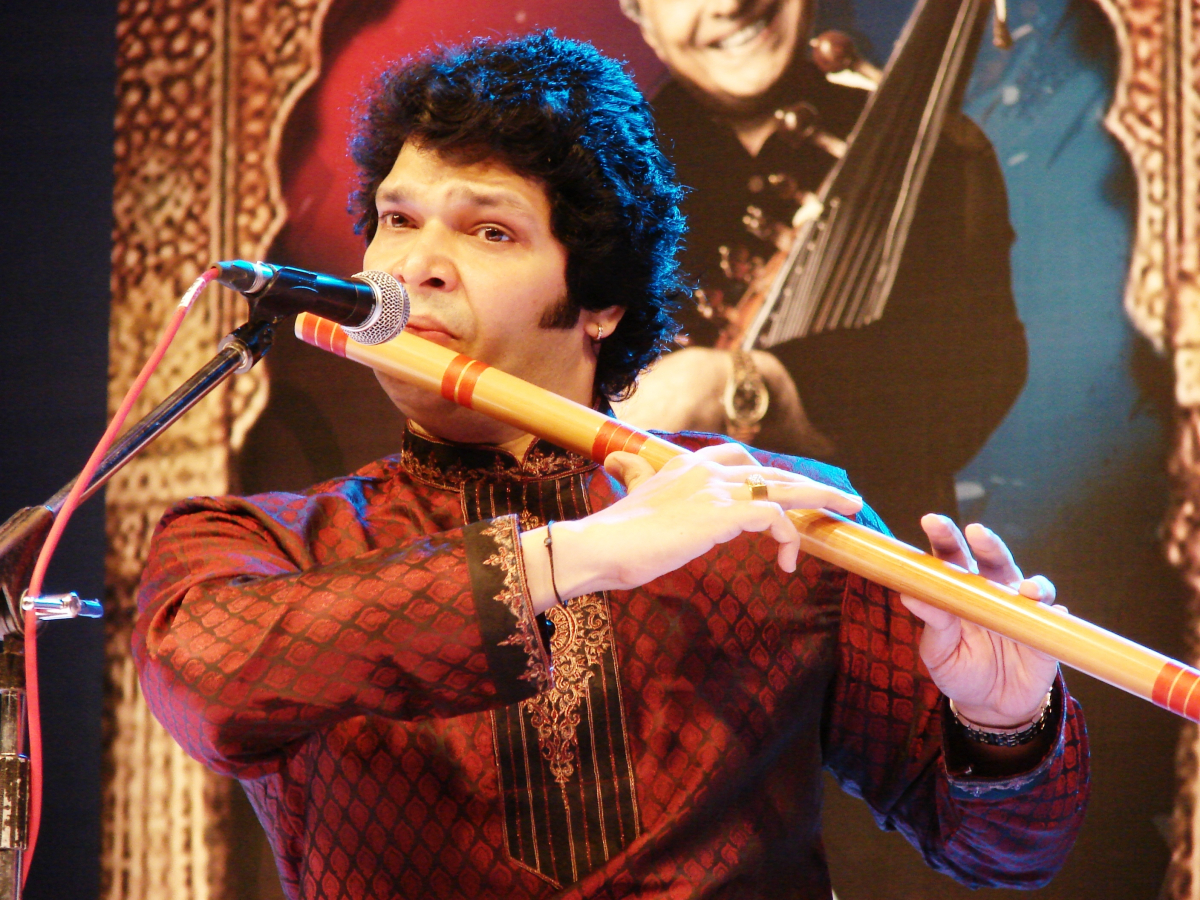
For Rakesh Chaurasia, music has always been both inheritance and exploration. As the disciple and nephew of legendary flutist Hariprasad Chaurasia, he grew up within one of India’s most revered classical traditions. Over the decades, he has shaped his own artistic voice while carrying forward that lineage, taking the bansuri from intimate classical gatherings to prestigious global stages. His journey has included international collaborations and two Grammy Awards for the album As We Speak, affirming the instrument’s place on the world stage.
Now, as he prepares to perform at Delhi’s historic Qutub Minar as part of Songs of the Stone, Chaurasia sees the moment as more than a concert. It is a dialogue between sound, space and history.
“I’ve been fortunate to perform on some wonderful stages across the world, but performing at Qutub Minar feels truly special,” he told Patriot. “With the city’s rich heritage, a dialogue between music and history can be best narrated through its monuments.”
Music in conversation with history
The idea took shape through conversations about the monument’s possibilities.
“When Simar, who is curating this Chapter of Songs of the Stone, and I began discussing the possibilities of performing at Qutub Minar, we realised the immense potential the space holds because of its rare architecture and the stories it carries from centuries past,” he said.
Standing before a structure that has endured for centuries brings a sense of humility, he reflected.
“When you stand before something that has existed for centuries, you instinctively feel humbled. It reminds you that while we as performers are temporary, art and heritage endure,” he said. “For Songs of the Stone, playing in a space like this feels almost symbolic, as if we are adding one more layer of sound to a monument that has silently witnessed so much history.”
The space, he explained, also transforms the emotional exchange between artist and listener.
“Space also deeply affects the emotionality of the audience,” he said. “Classical music is all about responding to the connection you feel with the people listening to you. It is never one-sided.”
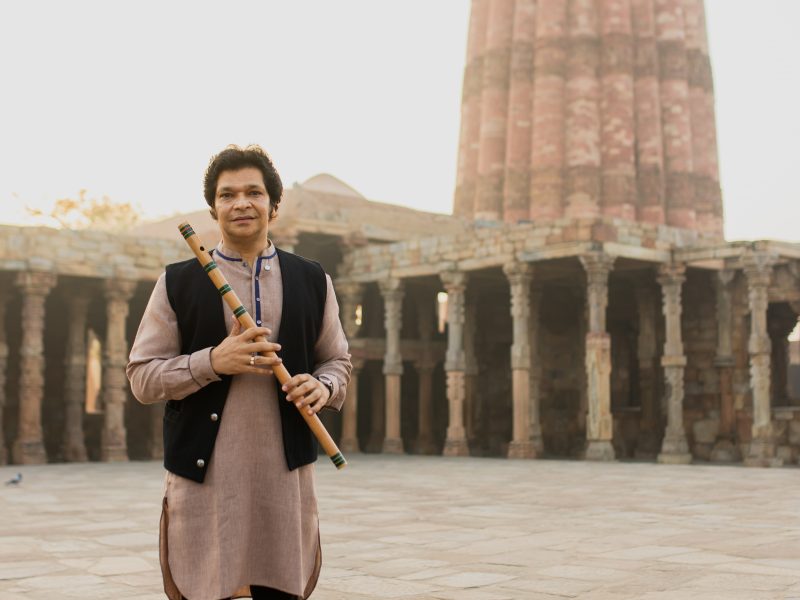
“In a space like Qutub, where awe is already heightened, and you are surrounded by such magnificence, that connection becomes even more energised,” he added. “The audience arrives with a certain openness, and as a performer, you can feel that. It creates a shared emotional current, something very powerful and difficult to recreate in a conventional concert hall.”
For Chaurasia, performing in such settings reconnects music to its natural origins.
“A space like Qutub Minar doesn’t just change the sound, it changes the feeling of the entire evening,” he said. “The flute is an instrument that naturally speaks to nature. It’s just breath flowing through bamboo, so it carries something very organic within it.”
The environment itself becomes part of the performance.
“When you perform in an open heritage space like this, where there is history, but also trees, open sky and birds, it feels complete. Sometimes even the birds respond to certain frequencies of the flute, and there is something incredibly special about that moment,” he added. “It reminds you that music is not separate from nature; it belongs to it.”
Also Read: Timeless tunes that link Punjabi weddings in Delhi and Lahore
Legacy, discipline and finding one’s own voice
Carrying forward a musical lineage of such magnitude comes with both honour and responsibility.
“Being the disciple and nephew of Hariprasad Chaurasia comes with immense pride, and yes, of course, responsibility,” he told Patriot. “He is one of the greatest legends of India, and when you carry that surname, people naturally expect a lot from you.”
Rather than feeling burdened, he embraced the expectations as motivation.
“But the pressure has always pushed me to go that extra mile, to practise harder, to think deeper, to respect the music even more,” he said.
His guru’s teachings extended far beyond technique.
“From Babu Ji, I have learnt that legacy is not about fame; it is about discipline, humility and honesty towards the raga. Those values guide me every single day,” he added.
At the same time, individuality remained essential.
“He has always encouraged me to find my own path,” Chaurasia said. “So while my foundation is rooted in his teachings, my journey, my collaborations, my global exposure and my generation’s sensibility naturally shape my own musical identity.”
He sees tradition not as limitation but as foundation.
“For me, the raga is the foundation. It is sacred,” he said. “No matter how much experimentation I explore, the grammar of the raga must remain intact.”
Once rooted in that discipline, collaboration becomes a meaningful exchange.
“Through my performances in India, the US, Europe, or any part of the world, when I perform with immensely talented and gifted global artists through jugalbandis, orchestras or ensembles like RAF, there is so much we exchange through music,” he said. “Experimentation should enhance tradition, not dilute it.”
A universal instrument
The bansuri’s global appeal, he believes, lies in its simplicity and humanity.
“What’s beautiful about the flute is that it began as a folk instrument – something simple, earthy, close to the soil – and over time it evolved into a powerful classical voice,” he said.
That familiarity allows audiences everywhere to connect instinctively.
“Across the world, almost every culture has its own version of a wind instrument – whether it’s the bansuri in India, the shakuhachi in Japan or other wooden wind instruments in the West,” he explained. “There is a familiarity in the sound of air passing through wood.”
Even when listeners are unfamiliar with ragas, the emotional connection remains immediate.
“So when I perform internationally, audiences may not understand the structure of a raga, but they immediately connect to the tone of the instrument. There is something very human about it,” he said. “The bansuri feels both rooted and universal at the same time, and that’s why it travels so beautifully across cultures.”
Initiatives like Songs of the Stone, he added, play a vital role in expanding that connection.
“Initiatives like Songs of the Stone are very important because they reframe how younger audiences encounter Indian music,” he said. “Instead of seeing classical music as a rigid or technical genre, they experience its full spectrum, especially when it sits alongside fusion, global sounds or familiar musical textures.”
Such experiences can leave lasting impressions.
“Young listeners may first connect to a certain texture or rhythm that feels familiar, and from there, they begin to explore the deeper layers of the raga. It opens a door,” he said.
“I hope our audiences are able to carry a small piece of that evening in their hearts and also leave with a renewed curiosity… about the cultural, emotional and historical layers that shape it,” he added. “If the evening prompts them to think differently or feel more deeply, that is the real impact. Perhaps that’s all we need in our fast-paced lives.”
Recognition, collaboration and remembrance
Despite global recognition, Chaurasia remains grounded in the core values of Indian classical music.
“For me, awards like the Grammys are a beautiful acknowledgment but they are not the benchmark by which I measure my music,” he told Patriot. “In Indian classical music, the true benchmark has always been riyaaz, depth of understanding and surrendering to the raga.”
Recognition helps bring wider visibility, but does not define artistic intent.
“Recognition on a global platform certainly helps bring our tradition to wider audiences, and for that, I am grateful,” he said. “But it does not and should not alter the core intention behind creation. Awards may celebrate a moment; the parampara sustains a lifetime.”
His Grammy-winning collaboration with tabla maestro Zakir Hussain remains deeply meaningful.
“My Grammy came alongside the legendary Zakir Hussain ji, and sharing that journey with him was a blessing,” he said.
His absence continues to be felt.
“His presence was not just musical, it was deeply reassuring, guiding and inspiring. Not having him around leaves a void that is both personal and artistic,” Chaurasia said. “His wisdom extended beyond rhythm; it touched the philosophy of performance, humility and spontaneity. When you sat with him, you didn’t just perform, you evolved.”
Yet his influence continues to guide him.
“The guidance of a maestro like him continues to resonate in every collaborative space I enter,” he added. “In that sense, he is never truly absent; he lives on in the taal, in the dialogue and in the courage to explore.”
His international collaborations, including those with Béla Fleck and Edgar Meyer, have further expanded his musical horizons.
“Collaborating with Béla Fleck and Edgar Meyer was an extraordinary experience,” he said. “When artistes from different traditions meet with sincerity and respect, something very organic happens.”
Listening, he emphasised, becomes central.
“When maestros come together, listening becomes more important than playing,” he said. “The music unfolds in the moment, guided by trust, sensitivity and a shared surrender to sound.”
The future of music and the breath within it
As technology evolves, Chaurasia believes the essence of music remains deeply human.
“AI can replicate tone, patterns and perhaps even stylistic elements but it cannot replicate lived experience, surrender or breath-awareness,” he said. “I see AI less as a threat and more as a reminder of what makes human musicianship unique. Technology may be a tool but the soul of music remains deeply human.”
Even after decades of performance, he continues to approach music with curiosity and humility.
“Inspiration comes from learning. I still consider myself a student,” he said. “Every raga reveals something new each time you approach it.”
He remains committed to both exploration and continuity.
“At present, I am deeply engaged in refining my repertoire, exploring nuanced interpretations of traditional ragas and nurturing the next generation of flautists,” he added.
Watching younger musicians, including his own son, carry forward the tradition brings him quiet fulfilment.
“If they remain rooted in discipline while exploring freely, the future of the bansuri is in very good hands,” he said.
For Chaurasia, the journey remains ongoing, guided by the simplest and most profound element of all: breath.
“The bansuri has infinite possibilities; I feel I have only begun to discover them,” he said. “As long as there is breath, there is music, and as long as there is music, there is something new to explore.”