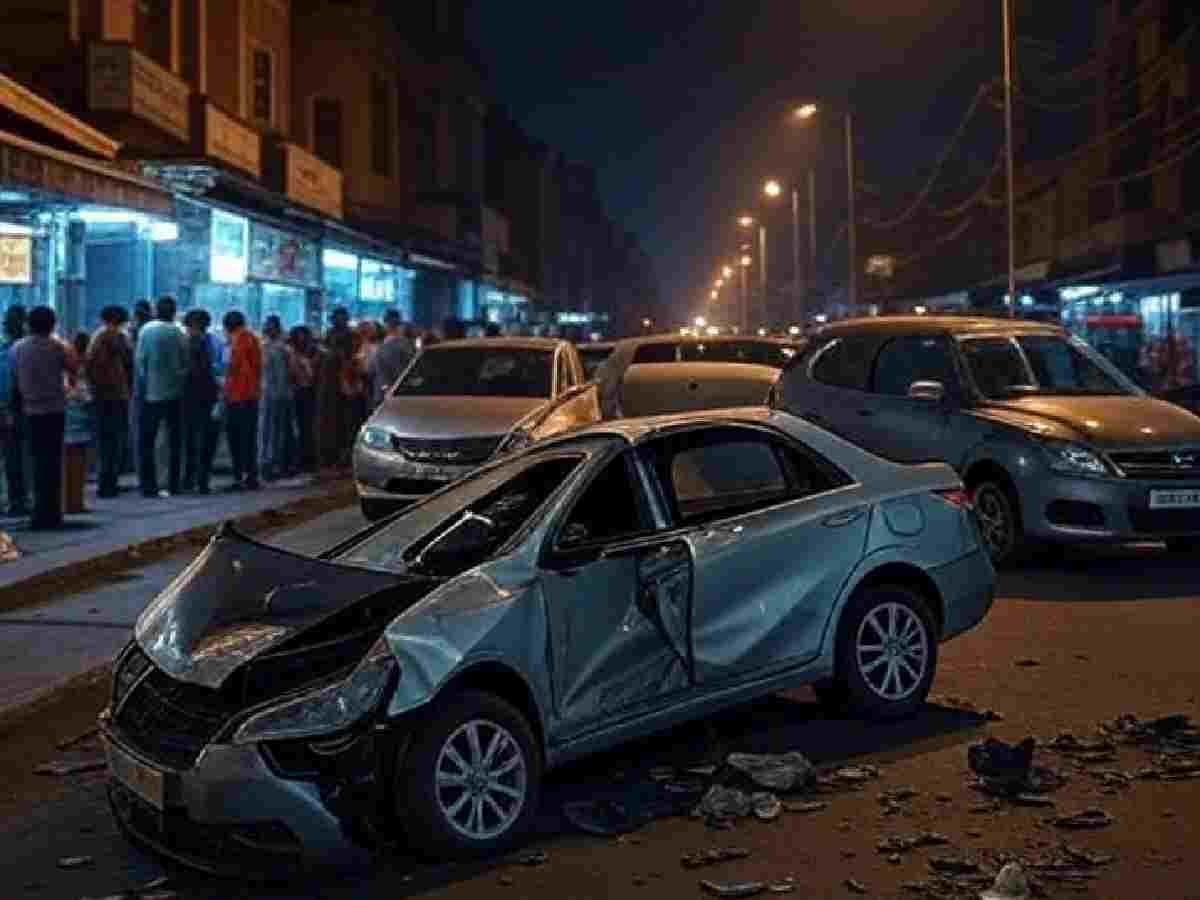
Delhi: Earlier in February, a heart-wrenching accident claimed the life of 23-year-old Sahil Dhaneshra, who was mowed down by a 17-year-old minor near Dwarka Sector 11. While the accused was granted bail to appear for his board examinations, Dhaneshra leaves behind a distraught mother who knows her son is never coming back.
However, the national capital holds many such stories — contending with a persistent infrastructural challenge when it comes to automobile fatalities.
According to recent data from the Delhi Traffic Police, 2025 emerged as the deadliest year for the city’s roads in seven years, with 1,617 lives lost across 1,578 fatal crashes. This represents an increase from 2024, when 1,551 deaths were recorded. Most striking is the concentration of these tragedies: just five road corridors account for around 28% of all fatal crashes in the capital, turning these high-speed arteries into some of the most perilous stretches in the country.
High-speed corridors, high fatality rates
The Ring Road and the Outer Ring Road are the undisputed heavyweights of Delhi’s traffic system, yet they also top the charts for fatalities. Together spanning nearly 90 km, these roads carry millions of vehicles daily, but their design — characterised by wide carriageways and long, uninterrupted flyover stretches — unintentionally facilitates lethal speeding.
In 2025, the Ring Road, also known as the Inner Ring Road, recorded 130 fatal crashes, the highest for any single stretch in the city. The Outer Ring Road followed with 113 fatal incidents. These corridors are particularly hazardous because they serve as transition points where high-speed transit meets dense urban activity, including metro stations and major bus terminals.
Pedestrians at greatest risk
The vulnerability of pedestrians is most visible on these two roads. Despite the presence of foot overbridges, the distance between safe crossings often forces pedestrians to risk crossing multi-lane traffic at grade.
In 2025, the Ring Road saw 50 pedestrian deaths, while the Outer Ring Road recorded 38. The mismatch between infrastructure designed for fast-moving steel and the reality of human foot traffic creates what safety experts describe as a “forgivingness gap” in road design.
Exit corridors turn deadly
Beyond the internal loops, Delhi’s major exit and entry corridors contribute significantly to the death toll. GT Karnal Road, which connects North Delhi to Haryana and Punjab, recorded 95 fatal crashes in 2025. The road serves as a vital commercial link, meaning heavy goods vehicles frequently share limited space with vulnerable two-wheelers and pedestrians.
Also Read: Jharkhand crash: Delhi airport remains the centre for most serious safety incidents
Similarly, Rohtak Road saw 64 fatalities, while Mathura Road recorded 31. These roads suffer from a hybrid identity crisis — officially urban streets, yet functioning as national highways. The lack of physical separation between heavy freight and local commuters leads to high-velocity collisions, many involving motorcycles or pedestrians who have little protection against the mass of a commercial lorry.
Rising severity of crashes
Analysis of 2025 data shows pedestrians remain the most vulnerable road users in Delhi, accounting for 649 deaths — up from 584 in 2024. Private cars were involved in the highest number of these pedestrian fatalities, followed by motorcycles and heavy goods vehicles.
Notably, accident severity has increased even as the total number of minor incidents fluctuates. While non-injury crashes dropped by more than 27% in 2025, the rise in fatalities suggests that crashes are becoming more violent and less survivable.
Dangerous driving and poor visibility
Driving behaviour continues to be a major hurdle. Authorities issued more than 22,000 fines for drink-driving and over 1,00,000 for speeding in 2025, yet these violations remain among the leading causes of death.
A particularly worrying trend is the 63% surge in triple riding on motorcycles, with more than 45,000 cases recorded.
Winter visibility also plays a lethal role on peripheral expressways. In December 2025, dense smog and fog reduced visibility to below 50 metres, leading to a doubling of fatalities on the Yamuna Expressway and a sharp spike on the Delhi–Mumbai Expressway.
Targeting ‘black spots’
The Delhi Traffic Police and the Public Works Department have identified 143 accident-prone “black spots” across the city for urgent intervention. These sites are being targeted for “forgiving infrastructure” projects, including crash cushions, improved hazard markings, and speed-calming measures such as speed breakers and redesigned roundabouts near schools and hospitals.
By shifting terminology from “accident” to “crash”, the administration acknowledges that these incidents are preventable through better engineering and stricter enforcement.
Technology-driven enforcement
The future of road safety in Delhi is increasingly data-driven. The city has integrated the Electronic Detailed Accident Report (e-DAR) system, a central repository that enables real-time analysis of crash patterns. This data feeds into the Intelligent Traffic Monitoring System (ITMS), which uses AI-enabled cameras to detect high-risk violations such as red-light jumping and speeding.
As of 2026, more than 47 AI cameras are operational, with plans to expand coverage across all major high-risk corridors identified in 2025 data.
Policy push and enforcement drive
Complementing these efforts is the New Delhi Road Safety Declaration, launched in February 2026. The initiative aims to reduce road deaths by 50% by 2030 through a “safe system” approach, focusing not only on enforcement but also on eliminating black spots through improved municipal engineering.
The government’s recently launched 100-day action plan includes repairing potholes, removing road obstructions, and ensuring central verges are properly maintained to prevent wrong-way driving.
To strengthen enforcement, the Delhi Traffic Police have launched a zero-tolerance campaign targeting five congested corridors — Madhuban Chowk, Rithala Metro Station, Shahbad Dairy, Badli Metro Station, and Sufiyabad Crossing. Following detailed traffic assessments, these locations were identified as hotspots for frequent violations and heavy peak-hour congestion.
The initiative includes deploying specialised teams and intensified camera surveillance to penalise red-light jumping, wrong-side driving, and improper parking.
Initial results from late January to early February 2026 show heightened enforcement activity, with more than 8,270 challans issued and 1,000 vehicles towed across the city. Key intersections such as Azadpur Chowk and Shalimar Bagh Chowk recorded thousands of fines, while operations at Bikaner Chowk in Karol Bagh alone resulted in more than 4,200 penalties to ease market-related gridlock.
This multi-pronged strategy — combining vehicle impoundment and rigorous on-ground monitoring — aims to enhance pedestrian safety and ensure smoother vehicular movement across Delhi’s most congested corridors.