
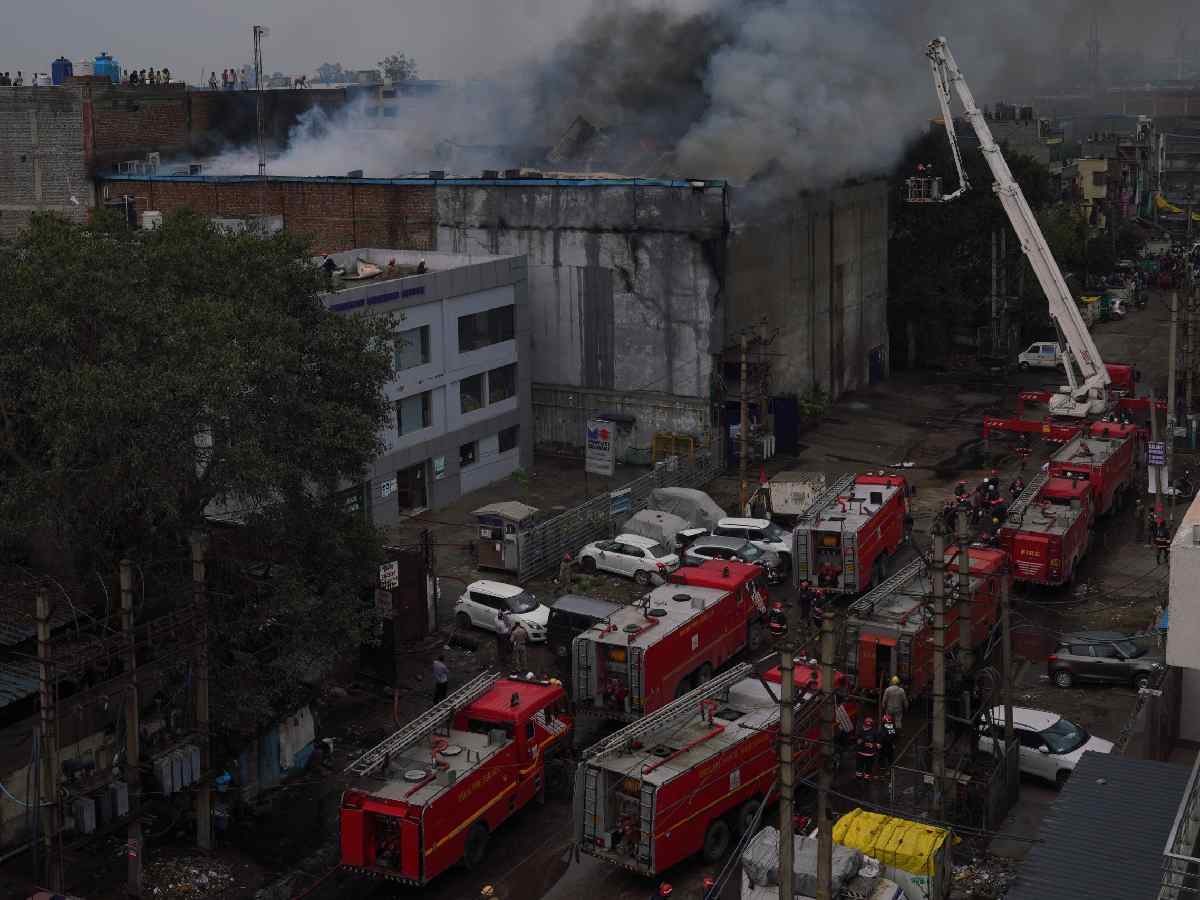
Central locking systems, thick iron grills at the back of the building, and a single staircase that served as the only internal escape route turned fatal when a massive fire tore through a residential building in Delhi early Sunday, leaving nine people dead.
The fire, suspected to have been triggered by an air-conditioner blast, broke out around 3.48 am in the four-storey building in Vivek Vihar Phase-I and rapidly engulfed flats on the upper floors on its rear side, trapping residents inside as smoke and flames spread through the structure.
With the electricity supply disrupted amid the fire, residents said centrally locked doors may have become difficult to open, while the lift became unusable. At the rear, thick iron grills and enclosed balconies further complicated the evacuation and rescue process, they added.
“There is one central staircase which serves as both the entry and the exit. The rear side gate was covered with a grill, which we had to cut using tools,” a firefighter involved in the operation said.
He added that to rescue around 15 people, the team deployed ladders from different sides and used a turntable ladder vehicle.
The building had parking space on the ground floor, eight flats above it with four each on the front and back sides, a lift adjacent to the staircase, servant quarters, and a narrow rear gate opening into a cramped back lane lined with adjoining structures and overhead wires.
Describing the rescue efforts, Sanjeev Rana, member of a non-profit disaster management team, said, “We received a call around 6 am. When we went upstairs with the fire department personnel, we first saw one charred body on the second floor, then five bodies on the next floor. After that, we moved to the top floor.”
On the top floor, three people had tried to save themselves but could not escape because the door leading to the rooftop had a central locking system, he said.
Those found dead on the fourth floor were identified as Nitin Jain (50), his wife Shailey Jain (48), and son Samyak Jain (25), police said.
“They could not get out. The bodies of the mother and son were found holding each other on the staircase leading to the roof. The sight was devastating,” Rana said.
Neighbours said Nitin was involved in the paper trade in Chawri Bazar and also owned a restaurant in Karkardooma. His younger son, Prasuk, aged around 22, survived as he had travelled to Ujjain with friends.
On the third-floor flat, five members of another family — Arvind Jain (60), his wife Anita Jain (58), their son Nishant Jain (35), daughter-in-law Anchal Jain (33), and their grandchild, Akash Jain — were found dead.
“Arvind and Anita were widely known in the locality because they maintained close ties with everyone,” a resident said, adding that their son Nishant worked as a chartered accountant in Connaught Place, while their daughter-in-law was employed in a private bank. The couple had a child after eight years of marriage, neighbours said.
They added that Arvind’s household comprised nine members, including his younger son Deepak, his wife Sonali, and their two sons aged four and five.
Sonali, Arvind’s daughter-in-law, said, “It is my son’s fifth birthday today. We had booked rooms in Manesar for the celebration and rushed back after hearing the news.”
“My sister-in-law, brother-in-law, and their baby were supposed to come yesterday, but there was a change of plan, and they decided to come today instead,” she lamented.
Meanwhile, on the second floor where the fire is suspected to have originated, a woman, identified as Shikha Jain (45), was found dead. Her husband Naveen Jain (48) suffered burn injuries while attempting to come down the staircase, residents said.
“Naveen came down using the stairs and got burnt. We rushed to the side of the building to rescue their two daughters, aged around 21 and 23, who were standing on the edge of the balcony. We spread mattresses below and used ladders to bring them down,” a resident said, adding that both sustained minor leg injuries because of the jump.
Another survivor, Silky, said that she, her husband, two children, and in-laws remained stranded on a front-side balcony on the top floor until firefighters reached them with a hydraulic ladder.
“We stayed on the balcony for a long time. If they had not rescued us within five minutes, we too would have died,” she said.
Eyewitnesses said the fire appeared on the rear side of the second floor before racing upwards to the third and fourth floors.
“The fire started on the second floor at the back. After that, it spread to the third and fourth floors. We live on the upper ground floor and ran downstairs immediately,” said Rakesh, another resident.
“I got a call saying a fire has broken out. We came down the stairs, but soon after we exited, the staircase got blocked. Glass started falling, and there was fire everywhere,” he added.
Rana from the disaster management team said several air-conditioners were installed in the house, and an AC blast may have triggered the fire.
“When we went upstairs, we saw two ACs even in the drawing room. If one blasted and furniture were nearby, that could have made the fire spread faster,” he said.
Neighbours said many homes in the locality had installed central locking systems for security against theft. They said such systems often depend on electricity, and if power fails during an emergency, occupants can get trapped inside unless manually unlocked.
“People put these things in place thinking they will be safe from thieves. But what about their own safety during disasters?” a neighbour asked.
Residents further said that iron grills and netting at the rear had been installed mainly to prevent theft and keep pigeons away.
Visuals from the site showed the exterior of the building’s rear side damaged in the fire. Walls and balconies were blackened with soot up to the roofline, several window openings were gutted, and some railings were warped by heat.
A long aluminium ladder, used to rescue the two women, was propped up to the upper floors.
The row of houses had balconies and rear facades enclosed with iron grills on multiple floors, creating cage-like structures. The narrow passage behind the buildings was lined with overhead wires and boundary walls.
“There are four flats in the front and four at the back, eight in total. There is a sprinkler system, and no such incident happened in the last eight years,” a resident said.
Twelve fire tenders were pressed into service. Police said the fire was brought under control after several hours, and an investigation is underway to ascertain the exact cause of the fire.