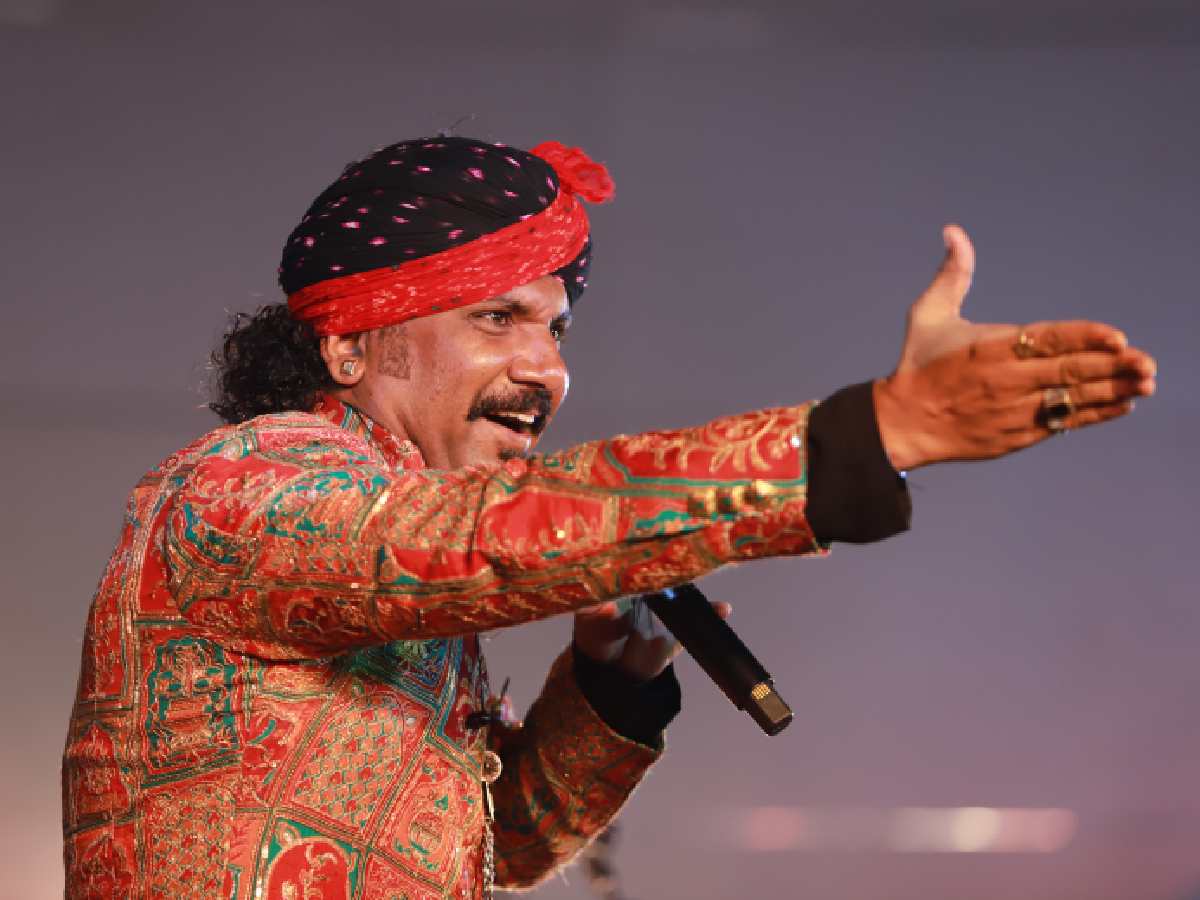
The voice of Rajasthan’s desert has travelled far beyond the dunes. From intimate folk gatherings to international festivals, film soundtracks and collaborations with some of India’s finest musicians, Kutle Khan has spent more than two decades carrying the rich traditions of Manganiyar music to audiences across the globe.
Yet, despite performing in more than 85 countries and sharing the stage with celebrated artists, the singer, composer and songwriter remains deeply rooted in the musical heritage he inherited as a child.
“I still consider myself a student of music first. Rajasthani folk is my root and identity; classical music taught me the discipline and structure of notes (sur), and Sufi music gave my singing spiritual depth. I also play about 10 instruments; all of this is the result of regular riyaaz (practice),” he says.
For Khan, folk, classical and Sufi are not separate musical worlds but interconnected traditions.
“To me, styles aren’t separate boxes but different expressions of the same tradition. When the devotion (saadhna) is honest and the emotion is true, moving between folk, classical and Sufi becomes natural. Ultimately, my goal is for music to come from the heart and reach the heart.”
Music inherited, not learned
Born into a Manganiyar family in Rajasthan, Khan’s musical journey began at home. His father, Ustad Jethu Khan, recognised his talent early and started training him when he was just eight years old. Music soon became more than a passion; it became his life’s calling.
“My family always supported me; I learned music only from my father,” he says.
Leaving school after Class IV, Khan devoted himself entirely to music. Years later, he formed The Kutle Khan Project, blending Rajasthan’s traditional sounds with contemporary arrangements while preserving the essence of folk music.
His breakthrough came in 2013 with Coke Studio @ MTV, where his performance of Khari Khari introduced him to a national audience. Since then, he has returned to the platform multiple times, most recently with Ae Ajnabee, a collaboration with Aditya Rikhari and Ravator for Coke Studio Bharat.
“I have performed three times on Coke Studio, and Ae Ajnabee is my latest track with Aditya Rikhari and Ravator. Audiences have given so much love to all three songs.”
Keeping tradition alive through experimentation
While deeply committed to preserving folk traditions, Khan believes experimentation is essential if the music is to remain relevant to younger generations.
“I fully respect the sentiments of purists because folk music is tied to our roots. My attempt has never been to change its soul, but to make it accessible to more people. Rajasthani folk is my foundation; its soil, its fragrance and its simplicity remain at the centre.”
Rather than viewing contemporary production or electronic sounds as a threat, he sees them as opportunities to widen folk music’s reach.
“Including Western and contemporary sounds isn’t adulteration to me; it’s a dialogue between tradition and the present. Today’s listeners hear all kinds of music. If we want to keep folk alive and relevant, we must connect it with the language of modern times.”
He believes innovation strengthens rather than weakens tradition.
“Music is like a flowing river; if it stops, it stagnates. To ensure it reaches new generations, adding new colours while preserving tradition is essential.”
Taking Rajasthan to the world
Few Indian folk musicians have travelled as extensively as Khan. Having performed in more than 85 countries, he has seen audiences from different cultures respond to music that transcends language.
“The greatest strength of folk music is its truth and its soul. It isn’t bound by one language or country. The emotions within Rajasthani folk — love, devotion, separation, joy and pain — are universal human experiences.”
He says international audiences are often fascinated not only by the music but also by Rajasthan’s unique instruments and traditions.
“International audiences always show a deep interest in knowing about the folk instruments and folk music. They are very responsive to our music.”
Representing India abroad remains one of the greatest honours of his career.
“Along with the music, we promote Rajasthan’s attire, language and culture. I have performed in over 85 countries and received great respect everywhere. However, when I perform in India, it generates a different level of energy.”
Among his overseas performances, one remains especially memorable.
“My performance in Canada remains the best moment of my international career.”
Learning from masters
Khan’s versatility has enabled him to collaborate with some of India’s most respected musicians, including AR Rahman, Midival Punditz, Karsh Kale and Ranjit Barot.
One of his most recognised film projects was Param Sundari from Mimi, to which he contributed vocals, morsing and khartal for Rahman’s composition.
“There is so much to learn from the legend Rahman saab. Discipline in music and making a track are what I learnt while recording Param Sundari.”
For Khan, collaborations are opportunities to grow creatively.
“Collaborating with artists from different cultures opens more opportunities to create something new and fresh. These experiments enrich the experience.”
Reflecting on his work with musicians from diverse backgrounds, he says every partnership expands his artistic horizons.
“Every artist brings their own world. Working with artists like Karsh Kale or Ranjit Barot, I realised that when different cultures and sounds meet, something is born that isn’t possible alone. It’s a creative dialogue where we push each other’s boundaries and build a bridge between tradition and modernity.”
His association with producer Ravator has been equally rewarding.
“I always try to do something new. Ravator is a very good friend and a brother figure. It was a great experience to be a part of this iconic song for Gen Z.”
Singing for stories, not numbers
Despite singing for films and series such as Mimi, Action, Afwaah, Love Shaadi Drama, Dahaad, Sharmajee Ki Beti and Kadaisi Ulaga Por, Khan says he remains selective about the projects he accepts.
“Every project is a responsibility. My first criterion is honesty and a connection to the story. I look for space for the soul of folk music.”
He is not interested in chasing numbers.
“I don’t work just to increase the number of projects. I say yes only when the story, thought and music are in the same direction.”
One performance that remains especially close to his heart came during the International Indian Film Academy (IIFA) Awards in Jaipur, where he represented Rajasthan’s folk traditions before some of the country’s biggest film personalities.
“I wasn’t just representing Kutle Khan; I was representing all of Rajasthan.”
Celebrating the spirit of the monsoon
Khan was recently in Delhi as one of the featured performers at Baarish: Season 2, Chapter 1, Excurators’ immersive celebration of the monsoon that brought together music, storytelling and culture.
Sharing the stage with Midival Punditz, Malini Awasthi and Pavithra Chari, he became part of an evening that explored the many moods of rain through folk, electronic and contemporary musical traditions.
The event resonated deeply with the singer, who says the monsoon has always occupied a cherished place in Rajasthan’s musical imagination despite the state’s arid landscape.
“The monsoon season is also very important in Rajasthan’s musical culture, as we get less rain in the desert. Many songs have been written and composed for this pleasant weather.”
Performing before Delhi audiences is always a special experience, he says.
“Delhi has all types of music lovers. They always love our music.”
Asked to sum up his affection for the capital, Khan smiles and simply says, “Delhi is love.”
A mission beyond music
For Khan, the future of folk music depends on both preserving tradition and creating opportunities for artists who dedicate their lives to it.
“I think every form of music has its own audience. Good riyaaz and spreading folk music are important, and my fellow folk artists and I are doing our best to preserve it.”
He believes governments and cultural institutions should invest more in traditional musicians through training schools, financial support and mentorship for younger artists.
His own journey continues with several upcoming releases that build on the same philosophy that has guided his career.
“I am very excited about my upcoming projects. Several albums based on folk music are ready, where I’ve blended Rajasthani tradition with contemporary sounds. My focus remains on keeping our roots strong while making folk music relevant and vibrant for future generations.”
For Kutle Khan, preserving tradition has never meant resisting change. Instead, it means allowing the music of Rajasthan’s deserts to travel freely across generations, cultures and continents, without ever losing the soul from which it was born.