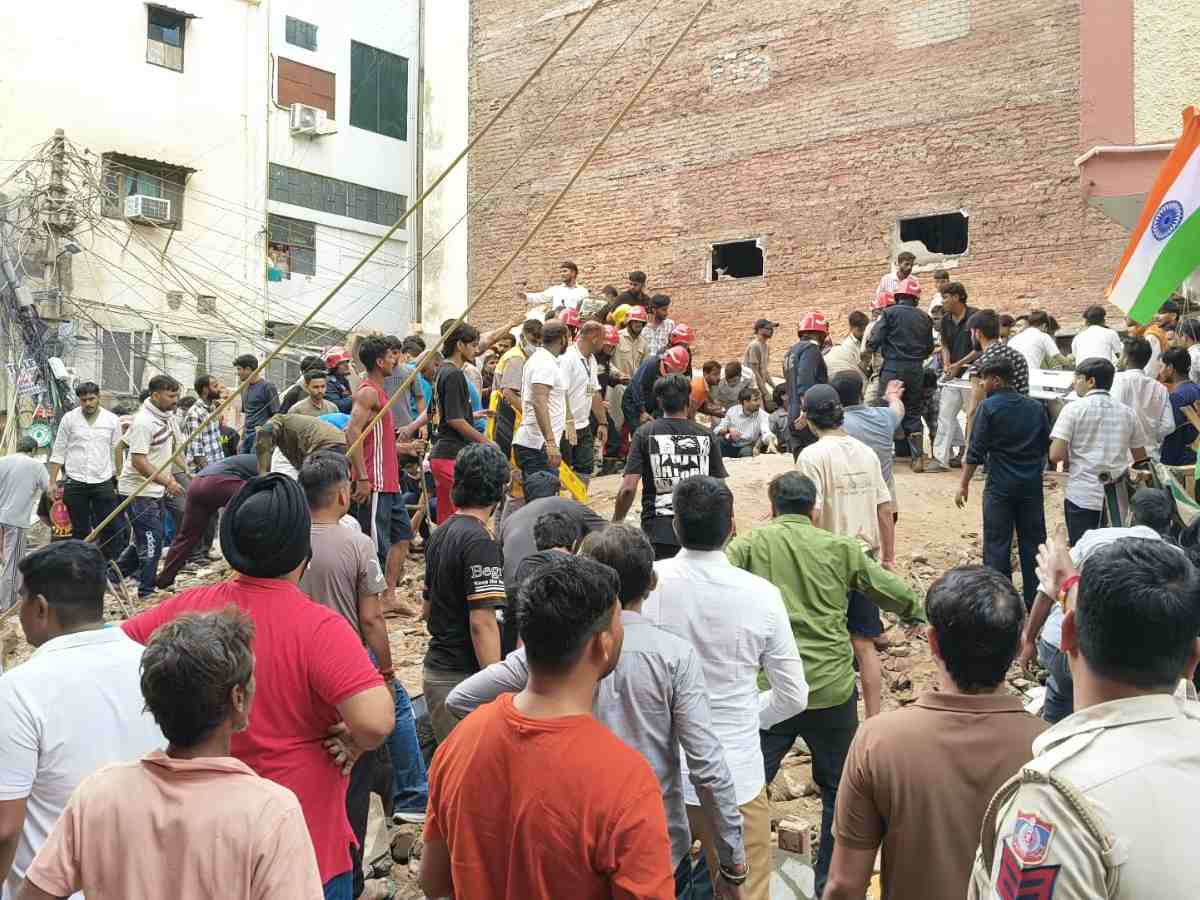
Over the years, several incidents across Delhi have resulted in deaths at dilapidated buildings or on land earmarked for in situ development by private contractors. In most of these cases, civic bodies such as the Municipal Corporation of Delhi (MCD) and the Delhi Jal Board (DJB) were at the centre of the proceedings. A review of 25 judgments shows that in several instances, officials faced only departmental action, most commonly temporary suspension.
In 2025, multiple cases were heard in which major questions regarding the functioning of the civic bodies were asked.
In a decision on November 19, 2025, the Delhi High Court addressed an illegal construction at Ganj Meer Khan in Turkman Gate. A resident had filed a petition requesting court’s intervention to stop the unauthorised work. The proceedings revealed delays in how the MCD handled the violation.
Although the MCD had formally issued a demolition order in early July 2025, it took only partial action nearly three months later. “Perusal of the documents handed over by learned counsel appearing for MCD shows that a Demolition Order was passed on 9th July, 2025… action was taken by the MCD on 26th September, 2025,” as per the order.
The court further held that the municipal body was bound to take action against other unauthorised constructions.
‘MCD bound to act’
“Accordingly, the MCD is held bound to take requisite action against the unauthorised construction existing in the property in question. Further, in case of any ongoing unauthorised construction, the same shall be stopped forthwith by the concerned officials of the MCD, with the assistance of the local police,” the court noted.
Dismissing the individual’s plea as the petitioner had no direct personal right affected and had already lost a similar suit in a lower court, the High Court ordered the MCD to complete the demolition of the unauthorised building without further delay. The court also noted that the petitioner’s own residence lacked an approved building plan and was being used to run an illegal spare parts business and asked the MCD to take appropriate action against unauthorised constructions by the petitioner as well.
Public-private oversight is not new to the Capital. The DJB and Tata Power Delhi Distribution Limited (TPDDL) came under scrutiny after a nine-year-old child drowned in Burari.
9-year-old’s death
A ruling from November 18, 2024, stated that the deceased’s parents approached the court after their son fell into an open, rainwater-filled pit on a vacant plot owned by the DJB.
Investigations revealed supervisory lapses, including broken boundary walls left unfixed and hazards left entirely exposed to nearby residents. Citing official inquiry reports, the court highlighted the extent of officer negligence. “…Mr. Sher Singh Executive Engineer (SW-VII), Estate Manager did not discharge his duty properly and could not supervise the said land and could not watch the broken boundary wall and his this negligent work caused the death of a child of age 9 years,” the judgement read.
“The SDM report also highlights that the land was initially enclosed by a boundary wall, however, this wall had been damaged, allowing access to local children of the area. Additionally, the said report also reveals that a contractor had excavated a pit measuring approximately 15x15x15 feet, a few days before the incident.”
A significant portion of the hearing focused on shifting liability between public agencies, specifically the role of TPDDL. The court recorded that the petitioners had made no direct allegations against the discom.
The DJB claimed that physical possession of the plot had been handed over to the power utility in January 2015 to build a sub-station, and that the land had been properly enclosed at the time of transfer. However, the power utility rejected these assertions, clarifying that the petitioners had made no direct allegations against them, and that official revenue demarcations placed the accident site roughly 23 to 30 metres outside the land allocated to the discom.
The High Court resolved the liability dispute by confirming that the site where the hazard existed remained under the DJB’s primary ownership and control. Consequently, the court ordered the Delhi Jal Board to pay Rs 22,00,000 in compensation to the family, along with 6% annual interest from the date of the incident.
Illegal constructions in Zone ‘O’
The most recent cause for concern was raised over illegal constructions in Zone ‘O’, the designated Yamuna riverfront and floodplains area under the Master Plan for Delhi. Zone ‘O’ covers a vast 9,934-hectare expanse that includes riverbeds, long-standing Lal Dora villages, government plots, and approximately 91 unauthorised settlements housing 5 to 6 lakh residents. The High Court reiterated that Zone O is critical for regional ecological balance and that human habitation or residential developments within this floodplain are completely impermissible due to environmental risks, flood hazards and severe river pollution caused by untreated sewage discharge.
In an order dating back to May 23, 2026, the Delhi HC took note of fresh illegal construction occurring within the environmentally sensitive region. Examining photographic evidence in areas like Jagat Pur Village, Wazirabad Village, Ram Ghat, and New Aruna Nagar (Majnu Ka Tilla), the court observed that unauthorised structures were actively coming up right under the supervision of MCD engineers.
Taking a stern view of the alleged lapses, the court ordered the Commissioner of the MCD to file a comprehensive status report detailing the specific disciplinary and legal actions initiated against the responsible Executive Engineers, Assistant Engineers and Junior Engineers. The bench further directed that the names of the concerned Executive Engineers overseeing these specific Zone ‘O’ sectors be submitted to the court, mandating their personal appearance in subsequent proceedings alongside planned demolition reports.
On July 27, 2024, heavy rainfall caused severe flooding in the basement of the coaching centre. The building’s main sliding gates collapsed under sudden water pressure, allowing rainwater to surge into the basement, which was allegedly being operated as a library and exam hall. Most students managed to escape, but three lost their lives by drowning.
Death of civil services aspirants
The Central Bureau of Investigation (CBI) registered a case under Sections 105 and 106(1) of the Bharatiya Nyaya Sanhita, 2023, investigating criminal negligence and misuse of the property. The four co-owners — Parvinder Singh, Sarabjit Singh, Tajinder Singh Ajmani and Harvinder Singh — were arrested for leasing the premises for commercial use in contravention of the approved occupancy certificate.
On January 21, 2025, the Delhi High Court confirmed regular bail for the four co-owners. Justice Sanjeev Narula observed that the primary objective of bail is to ensure presence at trial rather than to serve a punitive purpose. The court noted that the lease agreement placed the responsibility on the lessee to obtain necessary local authority clearances and comply with municipal by-laws. Consequently, standard lease clauses alone could not establish ‘knowledge’ of the offence. The applicants voluntarily contributed a total of Rs 5 lakh to the Delhi State Legal Services Authority for the welfare of the deceased students’ families.
Across these cases, the sections invoked were broadly similar, with the accused charged under ‘death by negligence’ or ‘culpable homicide not amounting to murder’.
The Satya Niketan PG collapse has renewed scrutiny of Delhi’s structural safety regime. The Delhi High Court has refused to entertain an urgent listing for a petition challenging the demolition of structures near the collapsed building, in which the petitioners claimed more people were trapped under the basement’s debris.
Also Read: Satya Niketan collapse: Families recall last conversations with victims
Shubham Tyagi, a PG operator, moved the Patiala House court for anticipatory bail, which was denied. The court observed that he had a responsibility to be aware of the structural status of the buildings he had invested in.