To participate in the Cockroach Janta Party (CJP)-led student protest at Jantar Mantar was also to enter an extensive surveillance web.
The 36-day protest, organised over an alleged leak and other irregularities in the National Eligibility-cum-Entrance Test (Undergraduate), ended on July 25 after Dharmendra Pradhan resigned as the Union Education Minister and the Centre accepted CJP’s two other key demands – compensation for the families of those who had ended their lives after the cancellation of the May 3 exam and withdrawal of FIRs against peaceful protesters.
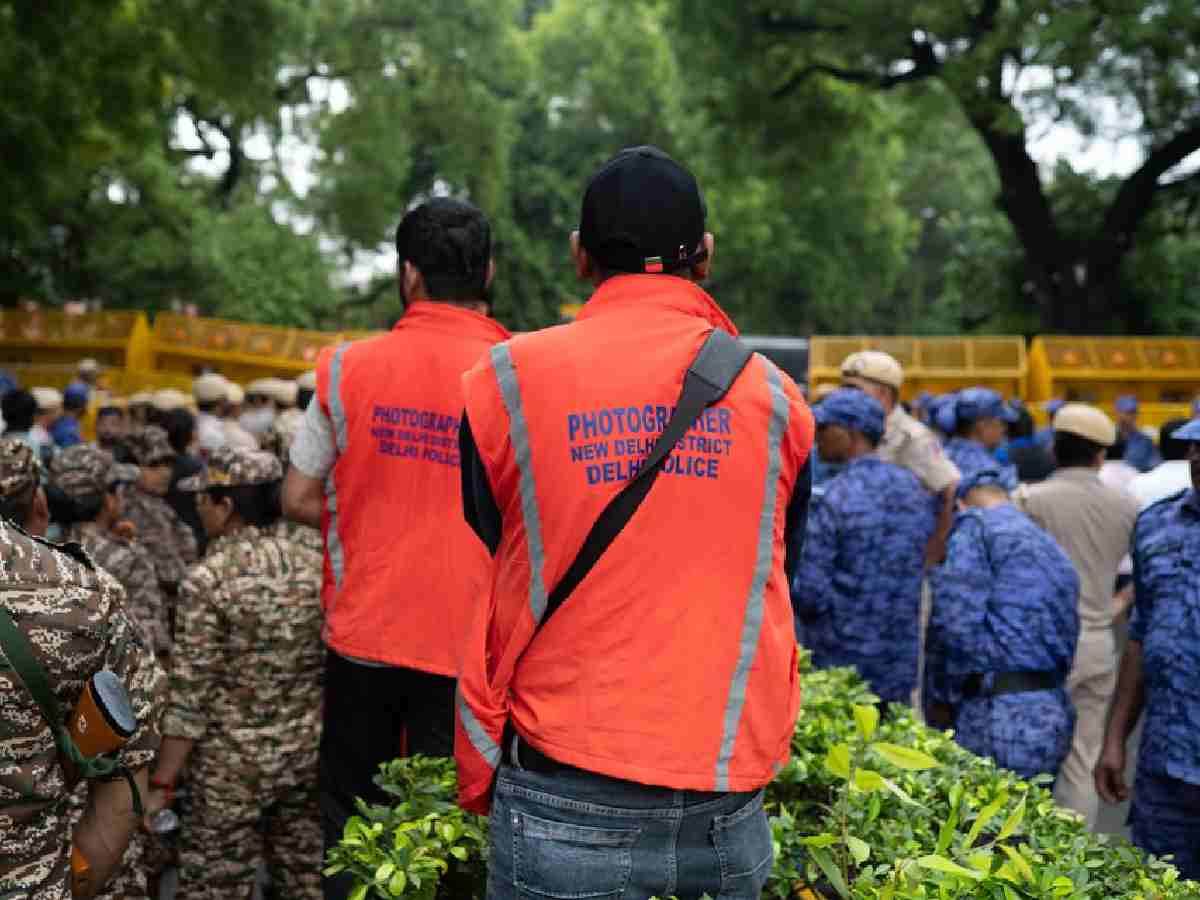
During the protest, facial recognition systems (FRS) scanned protesters, cameras recorded the gathering, drones mapped the site, and photographers contracted by the police documented those present.
According to a police report cited by several news organisations, investigators used CCTV footage, facial recognition and police databases to identify 2,873 people with criminal cases at or near the protest site. It added that 989 of those had been booked in serious criminal cases.
Of the 989, police said 101 had been booked in murder cases, 62 in attempt-to-murder cases, 284 in robbery and dacoity cases, 61 in rape cases, six under the Protection of Children from Sexual Offences Act, 25 in molestation cases, 229 under the Arms Act, 135 in snatching cases, 19 in kidnapping cases and 67 under the Narcotic Drugs and Psychotropic Substances Act.
The figures do not by themselves establish that those identified were convicted or involved in violence during the protest.
The police presented the operation as a preventive measure intended to stop miscreants from exploiting the demonstration and creating law and order problems.
The scale of the monitoring, however, raises a broader question: When surveillance designed to identify criminals is directed at a public demonstration, what effect does it have on citizens exercising their democratic right to protest?
That question formed the basis of a public interest litigation filed in the Delhi High Court on July 15, 2026, by former Jawaharlal Nehru University Students’ Union president Aishe Ghosh. The petition challenged the alleged continuous and indiscriminate surveillance of peaceful protesters at Jantar Mantar. The Centre has argued that the plea is infructuous as the protest has ended and the court has asked the petitioner to file a fresh plea on the larger issue of the surveillance framework during protests.
A protest was mapped
FRS units were positioned at key entry and exit points around the protest site and connected directly to a central police database.
The system was designed to flag wanted criminals, absconders, repeat offenders and registered ‘bad characters’. Officials maintain that the intended targets and that the operation was directed at anti-social elements.
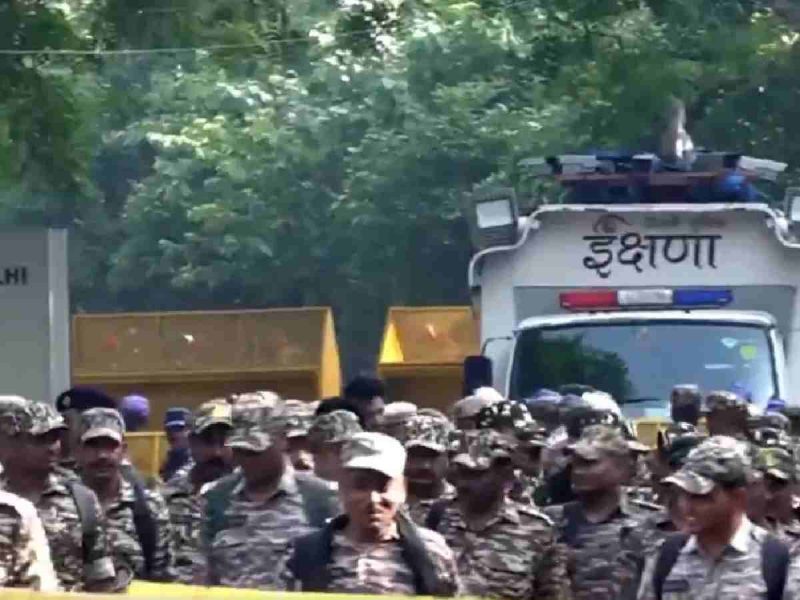
Two surveillance vehicles were stationed at the site. One was a Mobile Command and Control Vehicle used to monitor live CCTV feeds. The other was Ikshana, a specialised surveillance van introduced ahead of the 2023 G20 Summit.
Video streams from Jantar Mantar were processed using facial recognition software. The system marked detected faces with bounding boxes and compared them with images in existing police records.
A senior officer said, “The purpose was to check whether the system flags anyone matching the police’s database of criminals.”
The police have not publicly disclosed the size of the database used for the exercise, the software’s accuracy or the procedure followed after a possible match.
These faces were tagged in the Delhi Polices Criminal Dossier System, which is a web-based application developed and maintained by the Computer Centre of Crime & Railways.
The application enables drafting of dossiers on those booked in criminal cases, and updation of existing records. The database contains details of registered offenders classified under various parameters, such as name, aliases, physical features, modus operandi and criminal history, etc.
The human layer of surveillance
The monitoring did not rely solely on automated systems. Photographers and videographers were also hired to film the protest.
“The shifts sometimes went on for over 12 hours at a time,” said a cameraperson contracted by the Delhi Police, requesting anonymity.
“We have been told to document everything on camera, from the regular protesters to people who have been labelled as miscreants and those who act suspiciously,” the cameraperson said.
Multiple drone operators also documented and mapped the protest site.
“The footage will be used for archival purposes and also to track down miscreants,” another cameraperson said.
From protest site to control room
The surveillance operation at Jantar Mantar took place against the backdrop of the police’s expanding technological infrastructure under the ‘Safe City Project’.
In February 2026, Union Home Minister Amit Shah said the project would strengthen security in the national capital.
He unveiled an Integrated Command Control Communication and Computer Centre built at a cost of approximately Rs 857 crore.
“In the first phase of the programme to connect Delhi with 10,000 cameras, 2,100 cameras have already been connected live,” he had said.
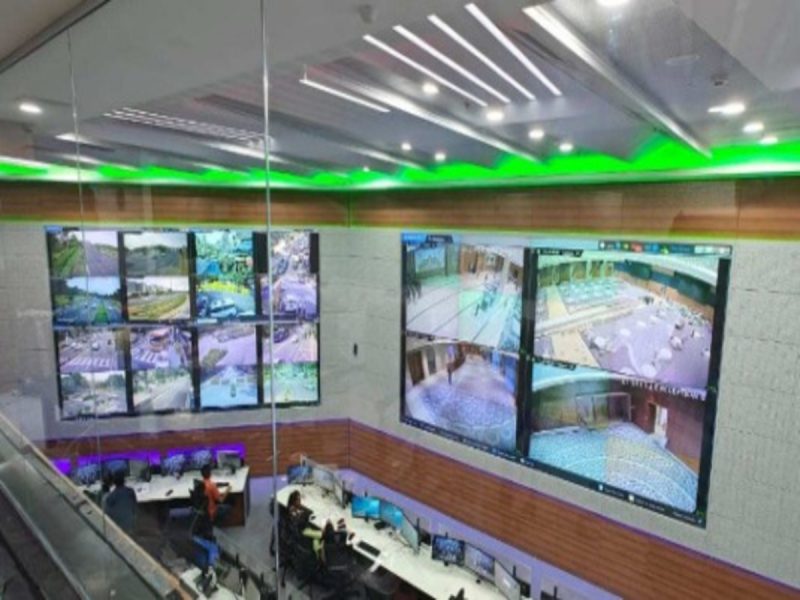
At the centre of this network is the control room at the police headquarters. Spread across 9,000 sq ft, it serves as a hub for monitoring public safety, traffic and emergency responses across Delhi.
A central double-height section accommodates large video screens displaying live footage and data from across the city. Operators use these feeds to monitor conditions and make operational decisions.
The facility is designed for continuous operations and coordination among multiple agencies. Panelling and glass partitions divide its functional areas while maintaining clear lines of sight and limiting noise. Neutral paint, false flooring concealing electrical cables and acoustic flooring reduce visual clutter and background noise. Ergonomic desks and chairs support personnel working extended shifts.
The control room provides the physical and technical infrastructure needed to bring together information collected through surveillance systems across Delhi.
Surveillance beyond faces
Facial recognition is part of the police’s broader use of automated surveillance tools. Vehicle movements are also monitored through Automatic Number Plate Recognition (ANPR) systems.
According to video analytics company Intozi, footage recorded by surveillance cameras across Delhi is processed and analysed through its proprietary software. Although introduced primarily for traffic management, the technology has also been used in police investigations.
An Intozi case study states that the system can recognise number plates on two-wheelers, autorickshaws and other vehicles, including those with custom-formatted plates. It is designed to operate at night and in low-visibility conditions.
Barricade-mounted devices scan registration plates and transmit the information to a central command-and-control dashboard. The details are then automatically cross-checked against databases and portals containing information on stolen or suspect vehicles, including the ZipNet, the National Informatics Centre and Goods and Services Tax portals.
When a possible match is detected, the platform generates alerts through on-screen pop-ups, audible signals and SMS or WhatsApp messages sent to officers on the ground.
The system can map a vehicle’s previous movements across checkpoints. It also provides customisable real-time alerts, manual hotlisting and compatibility with third-party cameras.
According to the company, these capabilities help the police trace suspect vehicles, investigate incidents, curb vehicle-related crime and improve operational efficiency.
From tracing children to monitoring protests
FRS technology was initially introduced under the Nirbhaya Fund to trace missing children and other missing persons, as well as identify unidentified bodies.
Its remit has since expanded. Delhi Police’s best practices document envisages using technology for surveillance and maintaining law and order.
“The facial recognition system is also useful in the surveillance and detection of suspects at crowded places like railway stations, bus terminals and large gatherings like sports events, public rallies, etc. It will also be used to identify and restore missing children, including those who are found after a long gap, as this system will also account for the ageing process of the child and the concomitant facial changes,” the document states.
Its use at a student protest illustrates this widening purpose.
A match is not proof
Facial recognition software analyses key features of a face captured in an image or video and converts them into a digital template. This template is compared with images in a target database.
A possible match is flagged when the similarity score crosses a predefined threshold.
In a 2022 response to a Right to Information application, Delhi Police said it considered a match “positive” if the system indicated an accuracy rate of 80% or above.
An automated match, however, does not constitute definitive proof of a person’s identity. Accuracy can vary according to camera angles, lighting, image resolution, facial coverings and the quality of the database.
Tests conducted by the US National Institute of Standards and Technology have also found varying error rates across demographic groups. Human verification, comprehensive audit trails and clearly defined technical thresholds are therefore considered essential safeguards.
The police have not publicly explained how possible matches generated at Jantar Mantar were verified by human operators.
A challenge to continuous monitoring
The petition by former JNUSU President Aishe Gosh frames these technological and procedural concerns into a constitutional challenge.
It has contested the police’s use of a permanent surveillance tower and facial recognition vehicles at Jantar Mantar, describing the monitoring of peaceful protesters as “continuous, indiscriminate and intrusive”.
The plea has argued that citizens were subjected to round-the-clock monitoring, photography and videography without any “disclosed statutory authority, procedural safeguards, or constitutionally permissible justification”.
According to the petition, the surveillance extended beyond public acts of protest to personal activities such as eating, resting and receiving medical care.
Ghosh has also alleged that police personnel threatened to send photographs and videos of participating students to their parents and educational institutions. The petition describes this as an “instrument of coercion and suppression of democratic dissent” that creates a “profound chilling effect” on free expression.
During the proceedings, the Centre defended videography at protests as a standard law-and-order measure undertaken in the “legitimate state interest”. Solicitor General Tushar Mehta described privacy objections at a public gathering as “ironic” and said the checks were “absolutely necessary”.
On July 27, the Centre told the Delhi High Court that the petition had become infructuous after the agitation ended. The court advised Ghosh to consider filing a broader petition seeking general guidelines governing surveillance at protests.
Ghosh’s counsel maintained that parts of the original petition remained unresolved, including the request for the destruction of personal data collected during the protest. The matter was listed for further hearing on July 28.
Supreme Court orders records preserved
Separately, on July 28, the Supreme Court restrained states from taking coercive action against protesting students without criminal antecedents. It also directed the release of arrested or detained protesters under 18 with no prior criminal record.
Hearing a batch of petitions alleging excessive police force during the demonstrations, the court said the allegations prima facie warranted an independent and impartial investigation. It allowed the police to register and investigate cases but barred coercive action against eligible students while the proceedings remained pending.
The court directed the authorities to preserve CCTV footage, drone and body-camera recordings, wireless communications and police control room records connected with the protests. It also said that personal and digital data of protesters must not be shared publicly.
The Supreme Court’s direction differs from the relief sought by Ghosh in the Delhi High Court. While Ghosh sought the destruction of personal data collected during the protest, the Supreme Court ordered its preservation as possible evidence while barring its public disclosure.
The protection from coercive action does not extend to people with criminal antecedents. This places greater importance on how such antecedents and facial recognition matches are identified and verified.
The Supreme Court sought responses from the authorities and listed the matter for August 3.
While the police portray these systems as a means of identifying miscreants without targeting ordinary protesters, the court proceedings raise a counter-question: Can that distinction survive when a public demonstration is subjected to continuous recording and database checks?