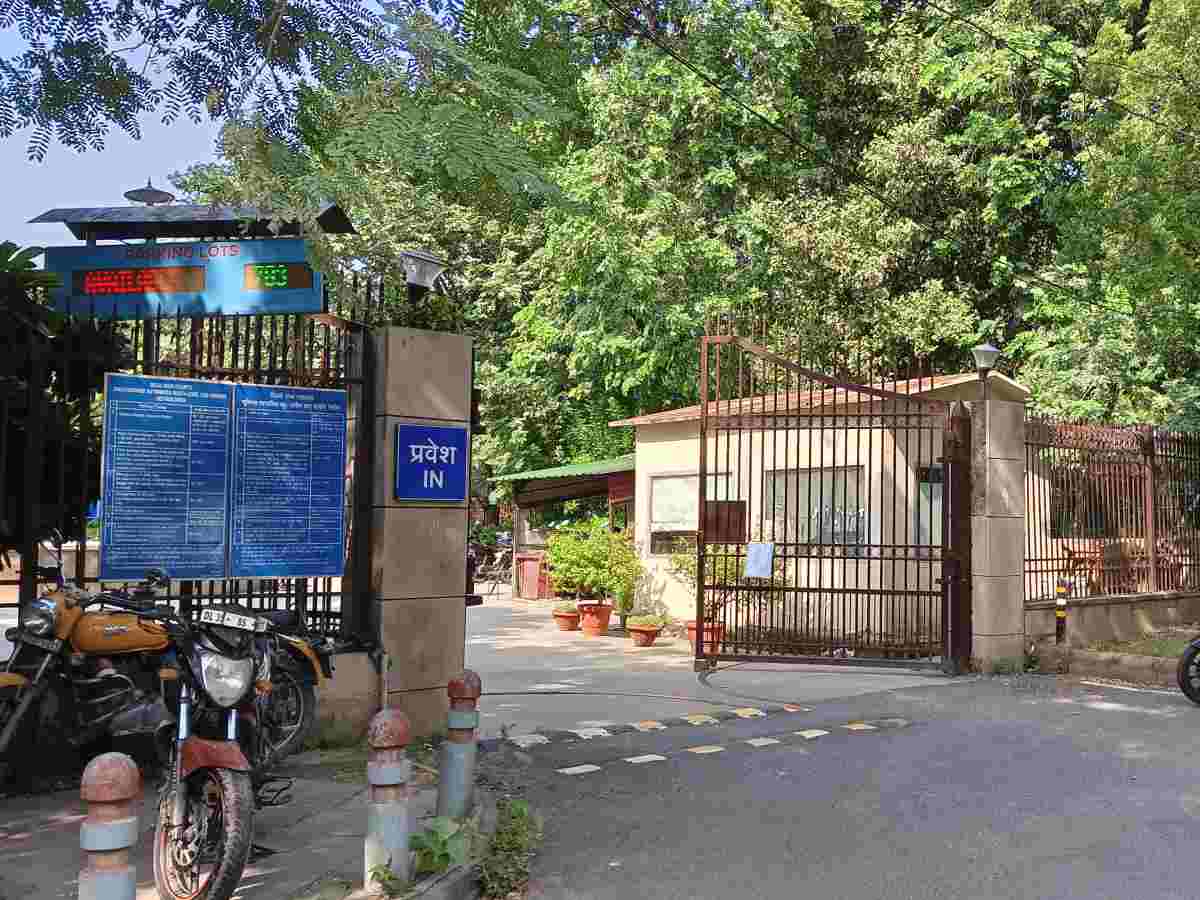
Litigants entering the Delhi High Court were stopped, frisked and asked to produce identity documents, while advocates and vehicles bearing Delhi High Court Bar Association (DHCBA) stickers passed without comparable checks during a visit by Patriot.
Security personnel at the complex said advocates were generally allowed to enter after showing their Bar identity cards. An officer stationed at the entrance to the underground car park said vehicles bearing DHCBA stickers did not have to be checked.
The practice appears to conflict with Delhi High Court directions requiring security personnel to check all people and vehicles entering court complexes.
Lawyers bypass frisking
The Delhi High Court complex has multiple entry and exit points manned by Delhi Police and other security personnel. The intensity of the checks, however, appeared to depend on who was entering.
At one entrance, a litigant was stopped while an advocate walked past without being frisked. The litigant stood with his arms outstretched and handed over his Aadhaar card. He was allowed through with his files after being asked which office he was visiting.
“We normally do not check advocates, especially if they are members of the Bar Association. They just show their Bar identity cards, and we let them through,” said a security staff member posted near the main entrance.
No comparable physical check of the advocate was observed.
Stickered vehicles pass unchecked
A similar pattern was observed at the entrance to the underground car park.
A Delhi Police officer posted there remained seated beside an under-vehicle inspection mirror as a car bearing a DHCBA sticker entered without being examined. Another car passed through about a minute later, but the officer did not move from his seat.
“Cars belonging to DHCBA members do not have to be checked. None of the entrances check them,” he said.
The sticker indicated that the vehicle was authorised to enter the complex. Court directions, however, separately require security personnel to check all authorised vehicles before allowing them inside.
Bomb threat renews concerns
The apparent disparity assumes greater significance after the Delhi High Court received a bomb threat by email on August 14, 2026.
The threat prompted searches and heightened security at the complex. Bomb disposal and dog squads examined the premises, but no explosive was found. The threat was later declared a hoax.
Nearly 15 years earlier, on September 7, 2011, a bomb exploded near Gate 5 of the High Court, killing 15 people and injuring 79. The attack led to an extensive review of security at the Delhi High Court and the Supreme Court.
Security at court complexes came under scrutiny again following a shootout inside a Rohini courtroom on September 24, 2021, in which three people were killed. Two gunmen had entered the court dressed as advocates.
A low-intensity explosion inside the Rohini court complex on December 9 that year further exposed weaknesses in the security arrangements.
Orders require checks for everyone
Following the Rohini shootout, the Delhi High Court initiated a suo motu case concerning security at court complexes across the Capital.
In an order dated November 24, 2021, a Division Bench of then Chief Justice DN Patel and Justice Jyoti Singh directed that all people entering the complexes be checked by security personnel. The order was uploaded on the court’s website on December 9.
The court ordered frisking at two checkpoints: The outer gates of each court complex and the entrances to buildings housing courtrooms. Women police personnel were to be deployed to check women advocates, employees and litigants.
The Delhi Police was directed to use updated metal-detection and baggage-scanning equipment. No baggage was to be allowed inside without being scanned.
The order also required round-the-clock monitoring through high-resolution closed-circuit television cameras. The Delhi Police Commissioner was directed to constitute an expert team to conduct security audits of the Delhi High Court and all district court complexes.
Police personnel were instructed to check every vehicle entering court premises. Only authorised vehicles bearing valid stickers were to be allowed inside.
The court also suggested installing automated gates similar to those used at Delhi Metro stations. Advocates were directed to cooperate with security personnel during checking, frisking and baggage scanning.
Bar representatives agreed to cooperate
In July 2023, the Delhi Police informed the High Court that representatives of the Bar associations had agreed not to obstruct security procedures.
A status report filed by the Deputy Commissioner of Police, Security (Courts), referred to a meeting attended by Bar representatives and senior officers from the security, district and traffic units.
According to the report, office-bearers of the Bar associations had agreed to cooperate with security personnel and ensure that advocates submitted themselves and their vehicles to checks at court entrances.
Advocates carrying litigants in their vehicles were required to drop them outside the complex so that they could pass through the designated security checks.
The report also said the Bar Council of Delhi had begun working on uniform smart-chip or QR code-enabled identity cards for advocates. The DHCBA was to work on similar identity cards and uniform vehicle stickers for entry into the High Court complex.
Security tightened after 2011 bombing
A 2013 Delhi High Court judgment recorded that, until 2003, entry to the premises had been unrestricted. Litigants were neither frisked nor required to produce proof of identity.
A gate-pass system was introduced in 2003, with passes issued on the recommendation of a lawyer.
Following the September 7, 2011, bombing, a high-level meeting presided over by the then Chief Justice of the Delhi High Court was held the next day. It was attended by five senior judges, a Joint Commissioner of Police, two Special Commissioners of Police and DHCBA representatives.
The meeting unanimously decided that no one should be allowed to enter the court premises without a photo entry pass.
A report cited in the 2013 judgment said the Central Reserve Police Force would take charge of the High Court’s internal security. It was also decided that around 49 closed-circuit television cameras would be installed and visitors would pass through a three-tier security arrangement.
The judgment recorded that entry passes were issued after litigants produced proof of identity, a requirement mentioned on court summonses.
Also Read: 15 years after Delhi HC blast, trial in main case continues
At the time, around 1,200 to 1,300 litigants visited the High Court each day. Of them, 25 to 30 arrived without identity documents. The Deputy Registrar (General Administration) would remain at the pass section and permit their entry after verification.
Different rules at the Supreme Court
The 2013 judgment also reproduced separate Supreme Court security circulars issued in 2007. Those circulars governed entry into the Supreme Court’s high-security zone and did not constitute Delhi High Court guidelines.
The Supreme Court circulars permitted only vehicles bearing approved, current parking stickers to enter. Each non-transferable sticker had to carry the vehicle’s registration number. Security personnel were also required to use an inspection mirror to check vehicles at the gates.
Advocates, registered clerks and court employees were required to display identity cards or visitors’ passes. Advocates wearing robes and displaying their identity cards were exempt from physical searches. Open files carried by advocates did not have to pass through X-ray scanners.
Those exemptions applied to the Supreme Court. The Delhi High Court’s 2021 order, by contrast, directed that all entrants be checked and all vehicles entering court complexes be examined.
According to Vice President, DHCBA, Sacchin Puri, security measures have been fairly hamfisted at the court’s premises. “The one thing that should be done is to put in place similar security measures as in the Supreme Court. At the HC, there’s barely any checking. Lawyers, especially older ones are permitted to walk inside the premises without the security checking them. A lot of them move around the metal detector as well. Now, they have stopped using the under hood reflectors for cars as well when they enter. It is easy to get a DHCBA sticker as well, so not checking these vehicles using such an excuse does not work,” he said.
During Patriot’s visit, litigants underwent the prescribed checks, while advocates and vehicles bearing DHCBA stickers were allowed to enter without comparable scrutiny.