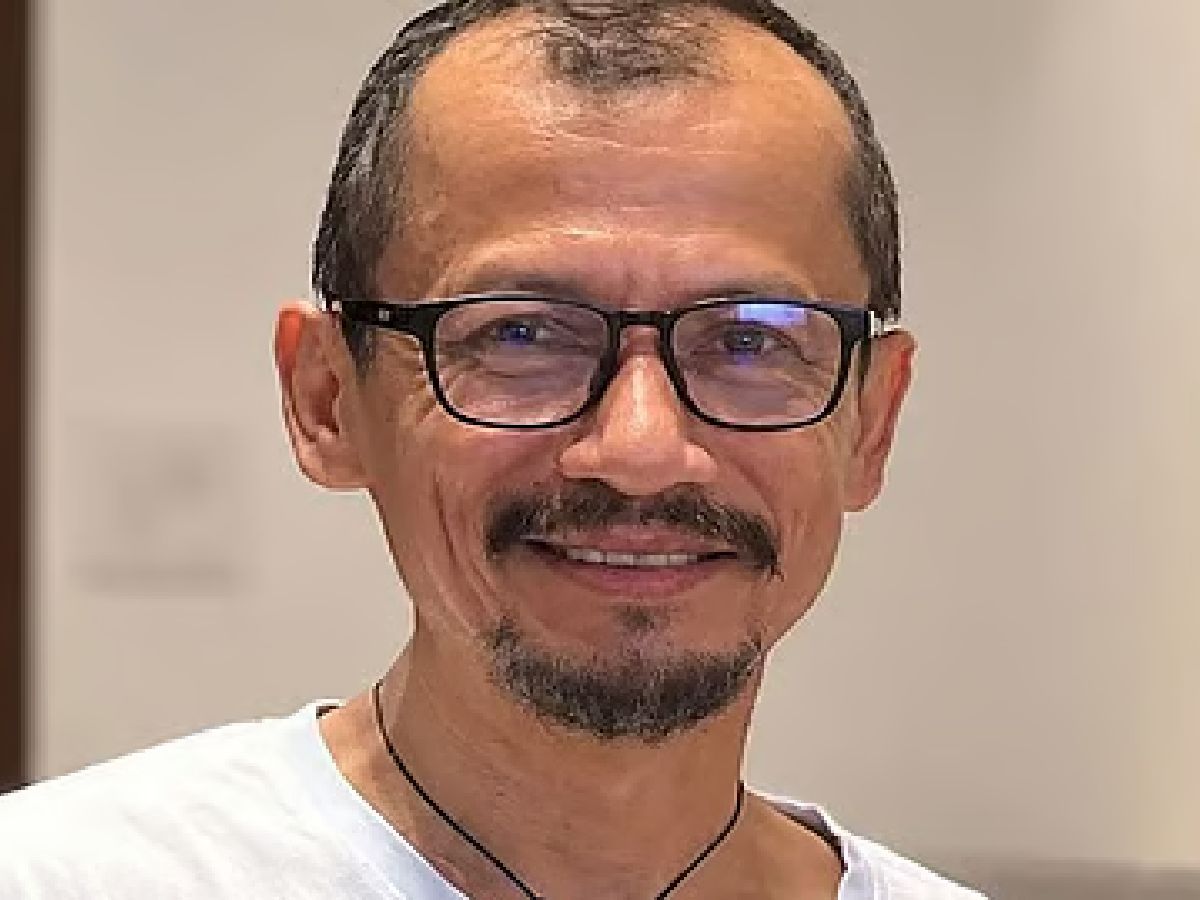
The family of Manipur-born musician Chongtham Vikram Singh — beaten to death outside his southeast Delhi home — on Tuesday appealed for justice and an impartial probe into his murder, saying they wanted accountability, not revenge.
Speaking at a press conference at Manipur Bhawan here, Singh’s wife Joshna Chongtham said the family is struggling to come to terms with the death of the 54-year-old musician.
“I have lost my husband; my son has lost his father — a peace-loving musician who lived a peaceful life. I am struggling to come to terms with the loss. Vikram, a husband, father, son, brother, and above all a musician — loved by those around him, and those familiar with his work. His death is a loss that cannot be expressed in words,” she said.
Recounting the events of the night, Joshna said, Around 11:30 pm on September 6, her husband went downstairs to complain about a ruckus on the street outside. After a while, he came running back. He was pursued upstairs by some eight men who assaulted him brutally outside his apartment before fleeing.
Subsequently, when Singh complained of breathlessness, he was taken to Holy Family Hospital.
His blood pressure had dropped to extreme lows, and around 6 am the following the day, he passed away, the family shared.
The family appealed for an end to violence, urging that no other person should have to endure a similar tragedy.
“We do not seek revenge. We want justice. He had a name, a family and a life that mattered. We ask only that his memory be respected, our grief be given dignity and justice be done,” Chongtham’s wife said, expressing gratitude for the support she had received from well-wishers following the incident.
Singh, a resident of southeast Delhi’s Kilokari for more than two decades, was assaulted by a group of delivery workers and dhaba staff after he objected to them shouting and drinking alcohol outside his apartment building, according to police.
The Sunlight Colony police station received a PCR call regarding the assault late Sunday. Singh was taken to Holy Family Hospital by his 20-year-old son Yaiphaba, a law student, where he later succumbed to his injuries, police said.
Seven men have been arrested in this connection so far, and a juvenile has been apprehended.
Singh’s body is currently at the AIIMS mortuary and will be taken to Manipur on Wednesday, the family said.
At Manipur Bhawan, well-wishers recalled Singh’s musical legacy, built over decades.
Singh was lead guitarist of legendary Manipur rock band Phoenix in the early 1980s and was regarded as one of the pioneers of the state’s rock music scene. He began his career with a band named Ultra Vires before joining Phoenix, and later a local band Eastern Dark.
After moving to Delhi around 2004, he continued to work as a musician and music teacher, conducting classes and workshops. His musical repertoire spanned Hindustani music, rock and roll and jazz, among other genres.
He also worked with singer Mame Khan for around a decade and was associated with Coke Studio. According to people who knew his work, Singh was a musician whose life was inseparable from his art.
“He was a person who lived for art and music. He was a versatile artist and touched almost every genre. His family is also a well-known family of artists in Manipur,” said Michael Oinam, Singh’s neighbour from Manipur.
Singh was the eldest of three brothers. His mother, Chongden Kamla, was a lead singer with All India Radio, Oinam said.
Members of the North East India Forum Against Racism (NEIFAR), who were also present at the press conference, alleged that Singh’s killing was an instance of racial violence and said the incident reflected the discrimination endured by people from Northeast in the capital.
Members of the forum alleged that the assault was not an isolated incident of harassment faced by people from Northeast in and around Sunlight Colony. They claimed that members of the community have repeatedly faced racial slurs, intimidation and physical harassment in the area.
In a recent incident, they alleged, a woman from Northeast was pushed from a second-floor staircase, though details of the incident could not be independently verified.
Residents from Northeast also alleged that racial stereotyping was a part of their everyday interactions in the area. A woman said she was frequently subjected to racial slurs when speaking to people and was at times asked whether she worked at a massage parlour, reflecting stereotypes that women from Northeast have endured in Delhi.
Community members said such incidents go beyond verbal abuse, creating a sense of insecurity among people from Northeast living in the capital.
Also Read: Lutyens’ bungalows: addresses that turned into legacy
A member of the forum said people from Manipur had come to Delhi to seek safety and build their lives, but continued to face violence and discrimination.
“They are killing us in Manipur, and they are killing us here. People come to Delhi for safety. Is this the India we want to live in, where citizens cannot live a life of peace with their families?”