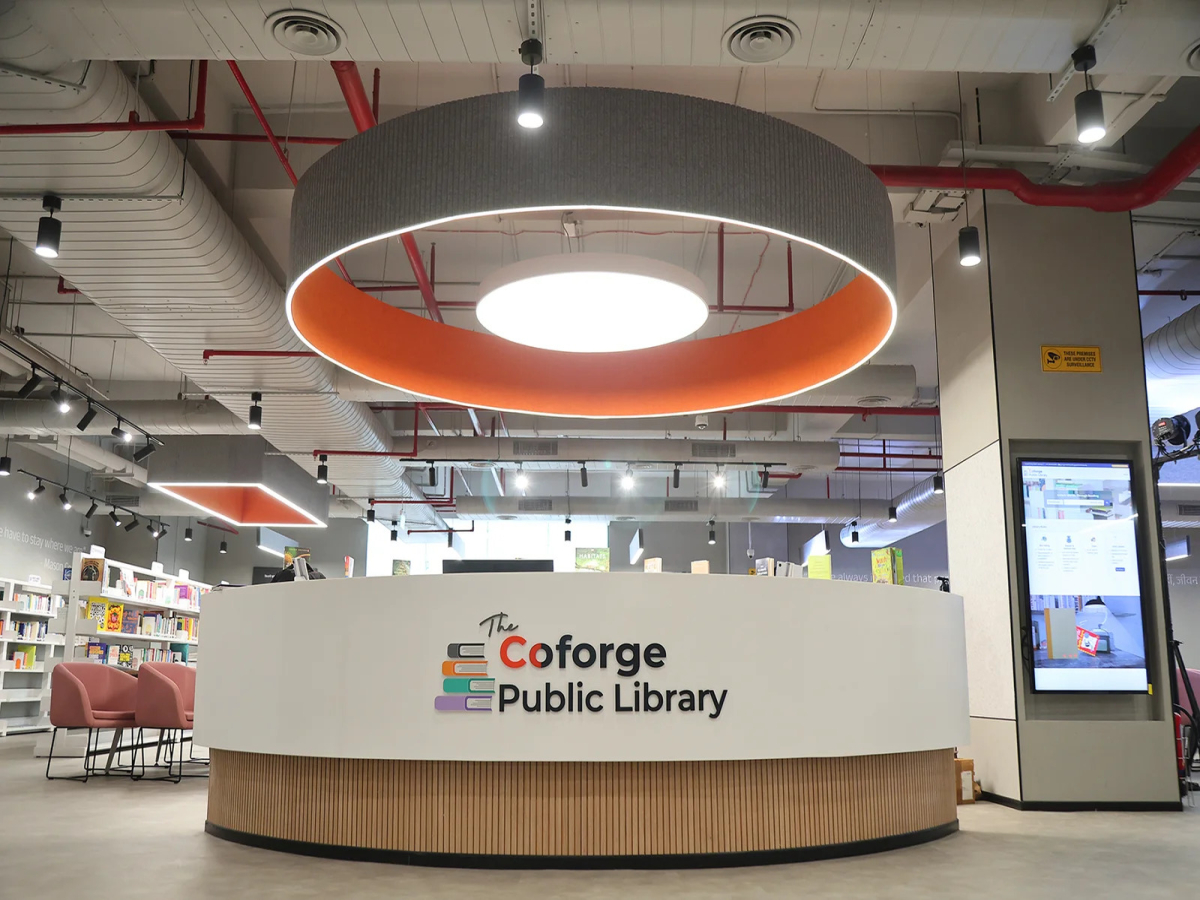
In an age when reading increasingly competes with screens, notifications and digital distractions, Coforge is taking a different approach by creating public libraries designed around books, quiet reading and community access.
The first Coforge Public Library opened in Noida in February 2024, according to Coforge’s Chief Brand & Sustainability Officer Anuradha Sehgal. She said the initiative was conceived to give people from different walks of life free access to knowledge and opportunities to learn and grow.
“Our vision is to support India’s journey towards comprehensive development by providing individuals from all walks of life the opportunity to access knowledge, learn and grow,” Sehgal said.
“Our mission is to build a lasting and impactful network of free public libraries across India that serve as beacons of hope, inclusivity and community empowerment, and sanctuaries of knowledge and lifelong learning,” she added.
According to Sehgal, each Coforge Public Library has more than 15,000 books, and the collections continue to grow in response to reader feedback.
Wide range of genres
She said the libraries cover a wide range of genres, including fiction, history, politics, arts, philosophy, psychology, sociology, comics and graphic novels, autobiographies and biographies, self-help, religion, spirituality, cooking and parenting.
The libraries also have collections in Hindi and other languages, including Telugu and Urdu at the Hyderabad facility, Sehgal said. She added that the libraries have more than 4,500 children’s books in English and Hindi, with Telugu books also available in Hyderabad.
The Vasant Kunj library also has a Braille section, she said.
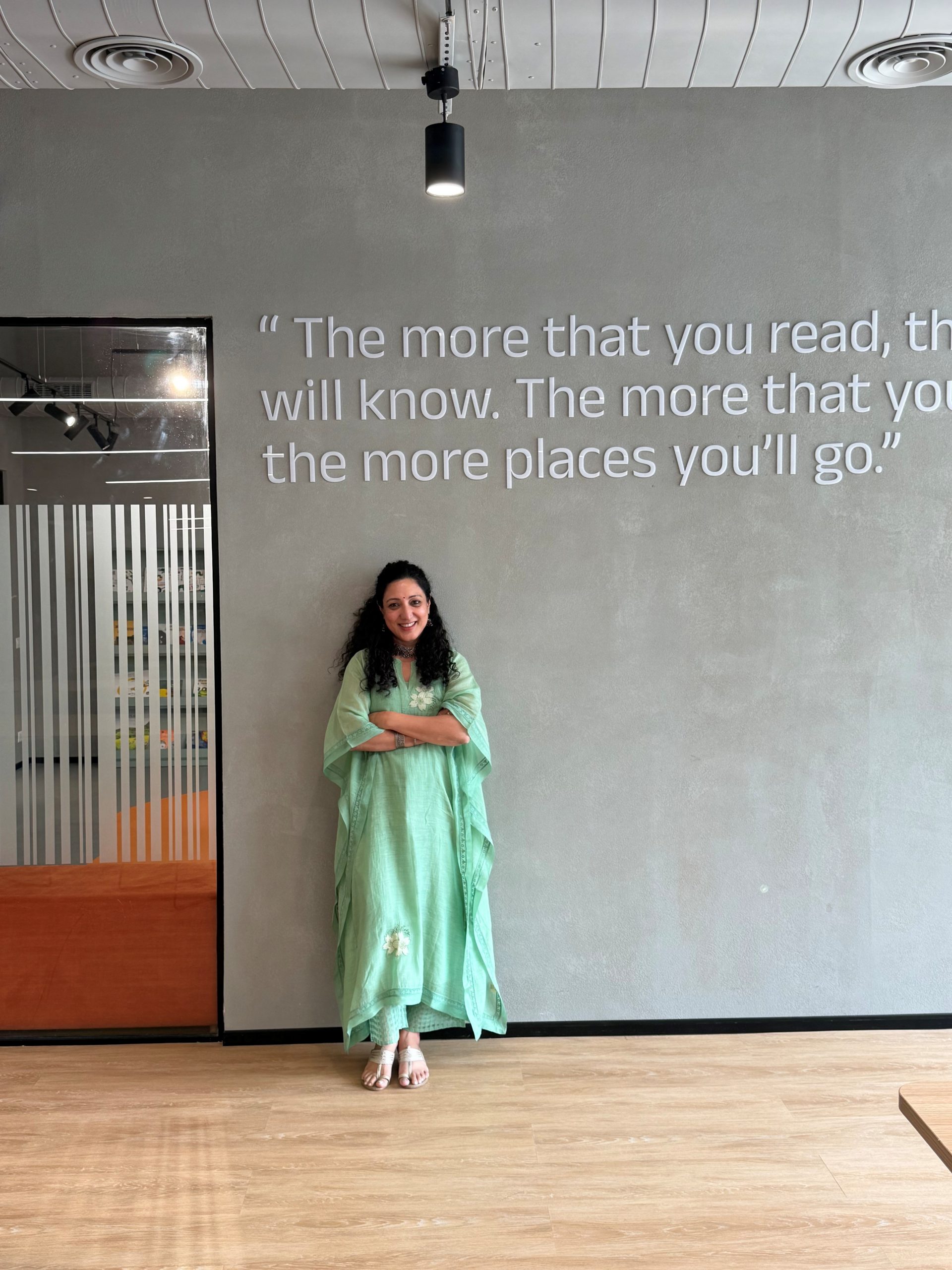
For readers in neighbourhoods where access to bookstores can be limited, the library has become a more convenient way to discover books.
Faizan Ahmad Wani, 28, a Chattarpur resident and an avid reader, said the Vasant Kunj library had made books more accessible to him.
“There are no nearby bookstores or book cafés in Chattarpur, so I would have to go to Saket or Hauz Khas. Now, this library in Vasant Kunj is just 15-20 minutes away. It is a beautiful space for book lovers, with a vast and diverse collection, including works by some of my favourite authors and some interesting titles,” he said.
For others, the library has served as an entry point into reading itself.
Arjun Deva, 23, a Vasant Vihar resident, said he hadn’t been particularly interested in books before visiting the library with a friend.
“I was never really into books, but a friend took me there once, and I gradually became more inclined towards reading. Now I go once or twice a week and spend a couple of hours there. It is a calming space. I have started reading fiction, and I am really enjoying it,” he said.
Rashi Tanwar, 25, a Jawaharlal Nehru University scholar who frequently visits the library, said the space offered a useful break from the distractions of studying online.
“I often need to read for long hours, and the library gives me an environment where I can simply sit with a book without the constant pull of my phone or other distractions. The collection is quite varied, and I have discovered books here that I may not have picked up otherwise,” she said.
For Manoj Dwivedi, 43, a private school teacher, the appeal lies in the library’s atmosphere and its free access.
“I think libraries are important because they give people a quiet place to read without having to spend money. I also like the atmosphere here. It feels like a proper reading space rather than a café or a place where people come mainly to use their laptops,” he said.
The initiative has so far recorded a footfall of 3,27,000, which includes 16,435 schoolchildren from 392 schools, Sehgal said.
She said the visitor base is diverse, but families with young children, students and elderly form the largest groups. Coforge is also making efforts to bring children from underserved sections of society into its libraries.
“We are making extra efforts to get children from underserved segments into the library, and we are happy to see that segment of visitors growing,” Sehgal said.
Designed as reading spaces
The libraries are open from 9 AM to 8 PM throughout the year, including public holidays, Sehgal said.
She said visitors can enter free of charge and use the on-site reading areas, comfortable seating, air-conditioning and curated book collections. Digital catalogues, RFID-tagged books and interactive kiosks are available to help readers locate books.
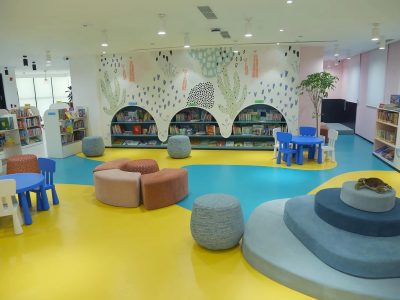
Visitors can also borrow books against a refundable security deposit, while children from government and NGO-run schools are exempt from paying the deposit.
Accessibility is another consideration in the design of the libraries, she said. The facilities have aisles wide enough for two wheelchair users to pass through and are designed to provide access to people with disabilities.
Each library also has a separate, soundproofed Kids Zone, Sehgal said, allowing children to read aloud, sing and explore books without disturbing those using quieter reading areas.
She said the libraries are designed to be well lit, with ample natural light, and are staffed by librarians and other personnel, with CCTV monitoring for additional security.
The libraries also conduct storytelling and reading-based activities for children.
In August, Coforge introduced a ‘Reading Passport’ and ‘Reading Journal’ for children. Sehgal said the passport allows children to record the books they have completed and track their progress, while the journal encourages them to record new vocabulary, key learnings, favourite characters and memorable moments.
In September, the libraries distributed 10,000 books to children visiting the facilities as part of an initiative inspired by Dolly Parton’s Imagination Library, Sehgal said.
She added that experts from Parag, a Tata Trusts initiative focused on promoting children’s reading through quality literature, have trained librarians and community volunteers in storytelling.
Keeping screens out
One defining feature of the Coforge Public Libraries is their restriction on personal books and electronic devices.
Sehgal said visitors are not allowed to bring outside books, laptops or tablets into the library. Visitors can leave personal laptops and tablets in lockers, but are discouraged from using mobile phones.
She said the policy is intended to keep libraries focused on reading rather than becoming co-working or remote-study spaces.
“The intention is to reduce digital distractions and prevent the libraries from becoming co-working or remote-study spaces and protect them as spaces for reading books and quiet reflection,” Sehgal said.
She acknowledged that the policy could make the libraries less suitable for people who want to study using their own books, laptops or digital resources.
“We recognise that restrictions on personal books and devices make the Coforge Public Libraries less suitable for people who want to work or study from their own materials,” she said.
However, Sehgal said the decision was deliberate because several options already exist for studying and co-working, while dedicated reading spaces are less common.
“Our policy reflects a deliberate choice to encourage the community, especially children, to read books by providing them access to a great collection of books and a distraction-free and encouraging environment,” she said.
Taking books to schools
The library initiative also extends beyond its physical premises, with librarians and community volunteers visiting government and NGO-run schools in surrounding areas.
She said teams from each library visit schools within a 5-10 km radius every week to conduct fun, reading-based activities with children.
The schools are also invited to bring students to the libraries. Since some of the schools do not have their own buses, Coforge arranges transportation, Sehgal said.
At the libraries, she said, children receive guided tours, are introduced to the collections and are encouraged to participate in reading-led activities.
Sehgal said parents, teachers and librarians are encouraged to support children in using the tools, which are intended to promote regular reading, comprehension, critical thinking, creativity and self-expression.
Reaching underserved communities
Some Coforge Public Libraries are located inside shopping malls. However, the choice of location is guided by accessibility and the communities the libraries can serve rather than by the mall setting itself, said Sehgal.
“All Coforge Public Library locations are selected with a clear social objective: to serve dense population clusters, including underserved urban and peri-urban communities such as bastis, villages and low-income neighbourhoods where access to quality reading infrastructure is limited,” she said.
She said the libraries are intended to offer barrier-free access to people across socio-economic groups.
According to Sehgal, every prospective library location is assessed against three broad requirements: barrier-free access, accessibility for people with physical disabilities, and compliance with legal, commercial and safety requirements.
The Vasant Kunj library, for instance, is located in Vasant Square Mall, which Sehgal described as a mixed-use local centre with budget retailers, coaching classes, banks, small businesses and eateries.
She said the library serves communities in and around Masoodpur, Mahipalpur, Chhattarpur, Rangpuri, Mehrauli and Kishangarh, among other nearby neighbourhoods.
Coforge is also looking to expand its presence through public spaces. Sehgal said the organisation is engaging with the Greater Noida Authority and the Delhi government to secure suitable public spaces within or near community catchments for future libraries.
The broader objective, Sehgal said, is to build a network of free public libraries that can provide access to books while creating spaces for reading, learning and community participation.
“Our mission is to build a lasting and impactful network of free public libraries across India,” she said, “that serve as beacons of hope, inclusivity and community empowerment, and sanctuaries of knowledge and lifelong learning.”