Union Home Minister Amit Shah inaugurated and laid the foundation stones for 43 Delhi Jal Board (DJB) projects worth Rs 8,941.22 crore on October 22 in a major infrastructure push, even as the Delhi government is planning a major overhaul of the Capital’s water supply and sewage pipelines.
Among the key projects is a 124 million gallons per day (MGD) sewage treatment plant at Okhla, built at a cost of Rs 1,161 crore. Eight existing STPs will also be upgraded at Rs 1,041 crore, increasing their combined capacity from 78.2 MGD to 140.8 MGD.
The projects further include 29 decentralised STPs and sewage pumping stations in Outer Delhi, costing Rs 3,113.67 crore, to cover 358 unauthorised colonies and 113 villages. A 1,034-km sewer network worth Rs 1,691 crore is also planned.
Other projects include a 477 million litres per day water treatment plant at Chandrawal, costing Rs 298.3 crore, which will replace existing facilities dating back to 1935 and 1955 and serve around 22 lakh people, and a 4.5-km trunk drain at Mundka worth Rs 225.02 crore.
Ground reality
According to the Delhi Pollution Control Committee’s estimates from a February 2026 report, at least 31.8% of all unauthorised colonies do not have sewer lines attached to households. While the Economic Survey of Delhi pegs the total number of piped water beneficiaries at 93.5% of its households, gaps still persist in its actual availability.
At Karol Bagh’s Bapa Nagar, residents say the situation is marginally better in winter due to reduced demand, but throughout the year, getting water is an uphill battle.
“During summer, we often go two or three days without water. We buy water from shops for Rs 20 a drum. Honestly, considering how dirty the water is, it makes no sense to use it without a filtration system. It’s better to buy water from grocery stores,” said Chandrika, a resident.
Households in Bapa Nagar rely heavily on Rs 20 drums to meet their daily needs, from drinking to washing clothes and bathing. While some residents previously extended a water line from a local temple’s booster pump, the arrangement was discontinued after a few months, leaving them to fend for themselves.
Thousands of complaints
Between 2021 and 2025, the Delhi Jal Board (DJB) received more than 43,000 complaints from residents over contaminated drinking water, with the annual number rising from just over 2,500 in 2021 to around 12,000 in 2022. Over the past two years, the board has received an average of 26 complaints a day about foul-smelling or discoloured water.
The complaints reflect the scale of the problem across the Capital, with residents in several neighbourhoods reporting discoloured water, sewage-like odours and an unreliable supply.
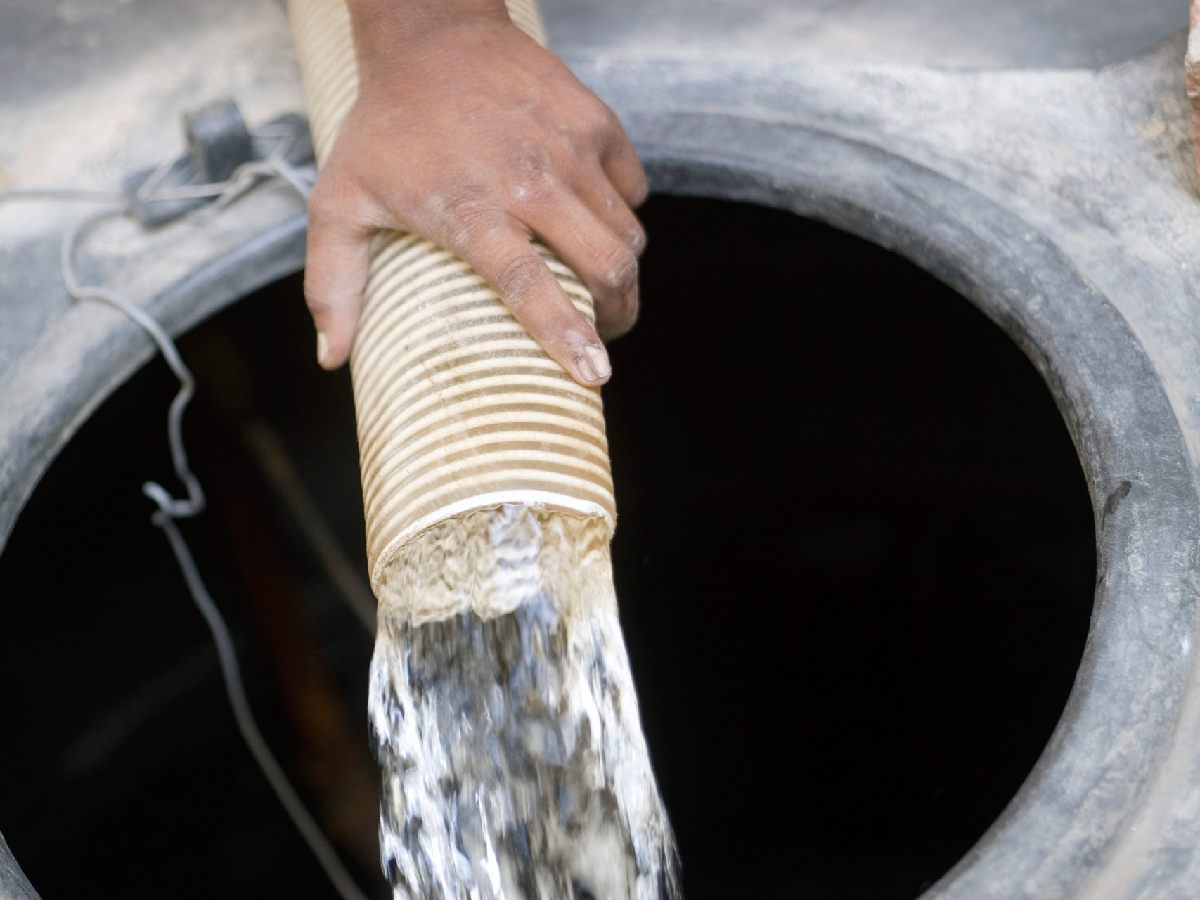
In Mahavir Enclave, residents said they had been without clean tap water for more than six months. The supply alternates between a thick yellow liquid resembling urine, both in appearance and smell, and relatively clear water carrying a strong stench of raw sewage. Despite repeated complaints to the DJB, residents said little had been done to address the problem, leaving them dependent on private tankers that arrive only twice a week or expensive tube wells amid a depleting groundwater table.
In Dwarka’s Nasirpur, residents traced the deterioration in water quality to sewage infrastructure upgrades carried out around eight months ago. Authorities had replaced shallow surface pipes with deeper, wider underground mains to address long-standing complaints of overflowing sewage. However, residents said the water supply had since become increasingly contaminated.
‘Brackish white fluid’
“The supply switches between a brackish white fluid, a rough-textured brown liquid smelling heavily of human waste, and a bright yellow stream with a pungent odour,” said Rita Sharma, a resident.
Residents also alleged that DJB tankers rarely visit the area and, when they do, supply water to only a handful of households, leaving others to make their own arrangements.
Similar complaints have emerged from Humayunpur village, where residents said the water flowing from their taps is often pitch-black and carries an oily residue that clogs and damages domestic water purifiers. Many families have been forced to rely on commercially supplied water jars, adding to their household expenses.
“The situation is such that we have to keep registering complaints after complaints with the DJB, but we have not received anything akin to a solution yet. Even the more posh Safdarjung households receive brackish water, but due to them mostly using groundwater, they are not affected as much,” said Parveen Tomar, a resident of Humayunpur who lives in a rented flat.
Also Read: City markets present uneven picture of pre-Deepavali clean-up
CAG audit
The problem is also reflected in the Comptroller and Auditor General (CAG) findings. A performance audit of the DJB found that 55% of groundwater samples tested by its zonal laboratories between 2017-18 and 2021-22 were substandard and unfit for human consumption. Of the more than 16,000 samples analysed, nearly 9,000 failed basic chemical and biological safety parameters.
The audit also flagged worsening water shortages, alongside the DJB’s failure to periodically revise water tariffs and recover thousands of crores of rupees in outstanding dues from consumers.
A senior DJB official, speaking on condition of anonymity, attributed much of the deterioration to ageing underground pipelines, many of which have not been replaced or refurbished in decades. The official said the corroded network was vulnerable to cracks and leakages, allowing sewage and other external contaminants to enter drinking water lines.
Urban planner Pushkar Pawar, who is empanelled with the Municipal Corporation of Delhi, pointed to inadequate urban zoning and weak enforcement as additional factors contributing to contamination.
He said, “Small industrial units engaged in heavy engineering, machine washing, chemical blending and spray painting often operate alongside residential areas, discharging wastewater containing industrial solvents, chemical residues and heavy oils into local drainage networks. With stormwater channels running parallel to drinking water pipelines, contaminants can enter the supply through cracks in ageing infrastructure.”
According to a Hindustan Times report, the DJB has proposed to execute an overhaul of South Delhi’s water supply network. The project is slated to amount to Rs 6,044 crore over the next three years to replace 732.65 km of old pipelines, lay 606 km of new lines and develop infrastructure for round-the-clock water supply across 12 assembly constituencies.
The three-year project aims to improve water supply to around 25 lakh people across an area of 247 square kilometres, including several localities that face acute shortages and recurring water quality concerns during summer. In older planned colonies such as Hauz Khas and Panchsheel, ageing distribution lines and leakages have raised concerns over contamination, particularly when damaged pipes allow pollutants to enter the supply network.