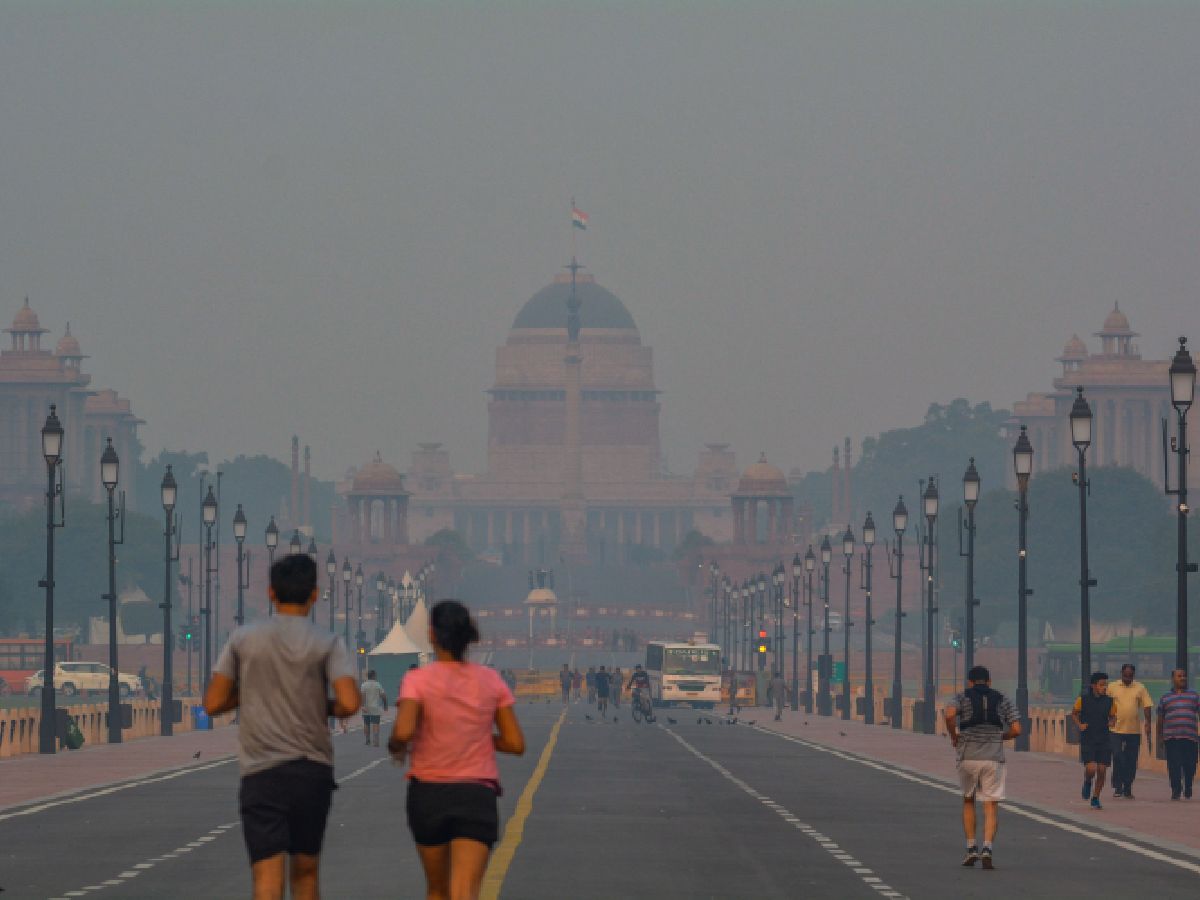
Delhi’s air pollution levels witnessed a significant increase on Saturday, with the Air Quality Index (AQI) climbing 67 points from the previous day to reach 293, placing the city in the ‘poor’ category. Unfavourable weather conditions and vehicular emissions were among the major factors behind the deterioration.
Of the 59 air quality monitoring stations that reported readings, 29 registered ‘very poor’ air quality, while an equal number recorded ‘poor’ levels. Only one station reported air quality in the ‘moderate’ category. Chandni Chowk emerged as the worst-affected location, with an AQI of 388.
The AQI recorded on Saturday was the highest since November 14, when the city registered 367, falling in the ‘very poor’ category.
Delhi had witnessed a gradual improvement in pollution levels over the preceding week, with the AQI remaining in the ‘poor’ category. The index stood at 220 on November 25, increased slightly to 224 on November 26 and reached 226 on November 27, before witnessing a substantial jump on Saturday.
PM10 was identified as the predominant pollutant on Saturday. These particles, measuring 10 micrometres or less in diameter, can enter the respiratory tract when inhaled.
Real-time source apportionment estimates indicated that vehicles were the biggest source of PM2.5 pollution in the capital, contributing 27.1 per cent of the estimated pollution load.
Biomass burning accounted for 22.9 per cent, while waste burning contributed 18.5 per cent. Secondary organic aerosols made up 17.2 per cent of the pollution, followed by secondary inorganic pollutants at 10.4 per cent. Industrial emissions contributed 2.9 per cent, coal burning 0.5 per cent, and mineral dust and ash and mixed combustion accounted for 0.3 per cent each.
Secondary organic aerosols are fine airborne particles that develop when gases emitted by vehicles, industries and other sources undergo chemical reactions with substances present in the atmosphere.
As per the Central Pollution Control Board (CPCB) classification, an AQI reading of zero to 50 falls under the ‘good’ category, 51 to 100 is ‘satisfactory’, 101 to 200 is ‘moderate’, 201 to 300 is ‘poor’, 301 to 400 is ‘very poor’ and 401 to 500 is categorised as ‘severe’.
The worsening air quality was also linked to unfavourable weather conditions that limited the dispersal of pollutants. The India Meteorological Department (IMD) estimated the maximum mixing depth over Delhi at 1,100 metres on Saturday, while the ventilation index was recorded at 1,800 square metres per second.
A reduced mixing depth prevents pollutants from dispersing vertically, while a ventilation index below 6,000 square metres per second, along with average wind speeds below 10 kilometres per hour, creates conditions unfavourable for pollution dispersion.
The IMD’s Air Quality Early Warning System has predicted that Delhi’s air quality could deteriorate further and enter the ‘very poor’ category on November 29 and remain there on November 30. It is expected to improve to the ‘poor’ category on December 1.
The forecast for the following six days suggests that pollution levels are likely to fluctuate between the ‘poor’ and ‘very poor’ categories.
The maximum mixing depth is expected to be 1,350 metres on November 29, 1,400 metres on November 30 and 1,100 metres on December 1.
Meanwhile, the ventilation index is forecast to remain low at 3,500 square metres per second on November 29, 3,000 on November 30 and 1,800 on December 1.