
Delhi continues to face a troubling challenge — it consistently ranks highest among all Indian states for cases of repeat offenders. According to data from the National Crime Records Bureau (NCRB), the national capital once again topped the list for incidents of repeat offences in 2023.
However, NCRB data also reveals a steady decline in the proportion of repeat offenders in recent years.
Decline in numbers but persistent concerns
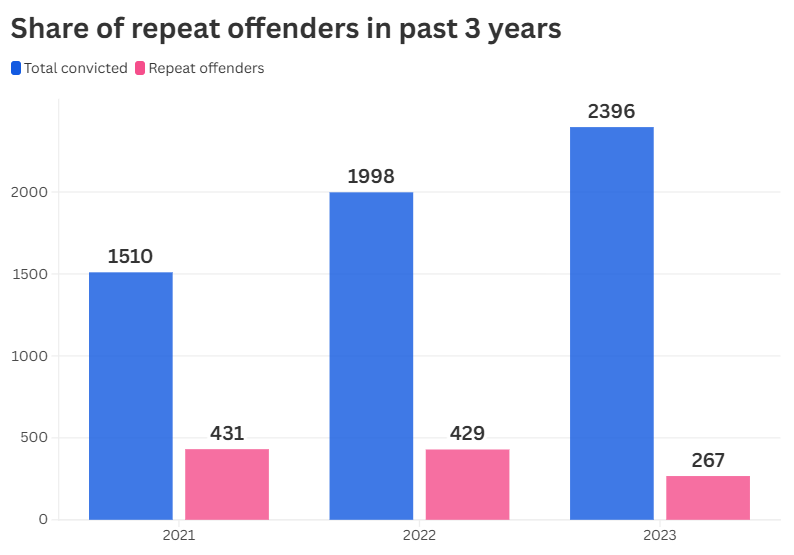
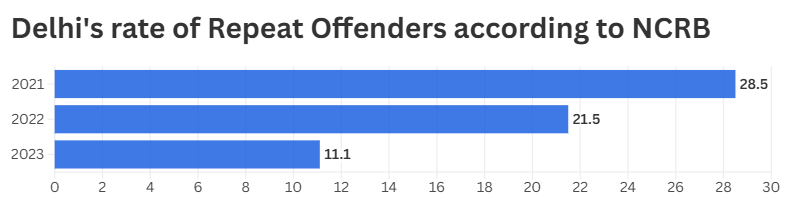
In 2023, Delhi recorded a repeat offence rate of 11.1%, down from 21.5% in 2022 and 28.5% in 2021. The number of convicts during 2023 stood at 2,396, of which 267 were habitual offenders. In comparison, 2022 saw 1,998 convicts and 429 repeat offenders, while in 2021, 1,510 convicts included 431 habitual offenders.
A senior police officer said that data from 2024 and 2025 so far shows a further drop in repeat offenders, particularly in serious crimes.
Police measures and legal provisions
Senior officers attribute this reduction to a series of measures introduced this year. “The police have introduced several initiatives. Firstly, we maintain records of habitual offenders, and beat officers monitor them closely. Secondly, Deputy Commissioners of Police conduct externment proceedings. Repeat offenders are summoned to the DCP’s office for a hearing and asked to account for their activities,” said a senior officer.
He added that stricter laws such as the Maharashtra Control of Organised Crime Act (MCOCA) and Section 111 of the Bharatiya Nyaya Sanhita have been invoked more frequently. The latter enables authorities to treat repeat offenders under laws pertaining to organised crime.
Under Section 111, punishment includes a minimum sentence of three years, which may extend to life imprisonment, along with a base fine of Rs 2 lakh. “The police also obtain release lists from prisons to keep track of such offenders,” the officer said.
Crackdown on street and organised crime
Earlier this year, the West District of the Delhi Police launched a campaign to curb crime and public nuisance. A multifaceted strategy was used to address street and organised crime and control habitual offenders.
According to an official statement, over 650 individuals involved in street crimes were apprehended in July 2025 — including 24 robbers, 28 snatchers, 21 burglars, and 75 thieves. More than 55 cases were registered under the Arms Act, the Excise Act, the Gambling Act, and the Narcotic Drugs and Psychotropic Substances (NDPS) Act. Ten proclaimed offenders were traced, leading to recoveries of cash, mobile phones, two-wheelers, and jewellery.
Delhi Police stated, “Action against street criminals: With the arrest of 24 robbers, 14 cases were resolved, alongside the recovery of Rs 46,440 in cash and one mobile phone. Of the 24 arrested robbers, nine are repeat offenders. With the arrest of 28 snatchers, 20 cases were resolved. Of the 28 arrested snatchers, 16 are repeat offenders.”
Following the arrest of 21 burglars, 49 cases were resolved with recoveries of mobile phones, cash, and other items. Of the 21 arrested burglars, 11 were repeat offenders. The arrest of 75 thieves led to 103 theft cases being solved, with recoveries of vehicles, mobile phones, and cash. Of the 75 thieves, 40 were repeat offenders.
History-sheeters ordered to leave the city
In 2024, the Delhi Police took strict action against more than 1,100 habitual offenders, ordering them to leave the city under provisions of the Delhi Police Act. The move aims to prevent crimes and ensure public safety by removing individuals whose activities threaten peace and order.
According to a senior officer, 1,130 individuals were “externed” — that is, legally ordered to leave Delhi — under Sections 47 and 48 of the Delhi Police Act, which empower authorities to remove persons likely to commit offences.
“A total of 1,130 people were externed from different districts of Delhi. They were found fit for externment proceedings under Sections 47 and 48 of the Delhi Police Act (removal of persons about to commit offences),” the officer said. Individuals are issued notices to explain why they should not be externed; if their explanation is unsatisfactory, the externment is carried out.
Data from previous years shows a fluctuating trend in externments: 268 in 2015, 215 in 2016, 133 in 2017, 79 in 2018, 302 in 2019, 176 in 2020, 311 in 2021, 716 in 2022, and 619 in 2023.
Another senior officer explained, “Section 47 of the Delhi Police Act allows the Commissioner of Police to extern individuals whose actions or movements pose a threat to public safety or property, or who are believed to be involved in offences involving force, violence or intimidation.”
Also Read: Over 53% of railway accidents in India’s megacities happened in Delhi: NCRB
Externment, he added, disrupts criminal activity by relocating offenders to unfamiliar territories. “Once externed, it becomes challenging for a criminal to build new criminal links and restart activities in an unfamiliar new state,” he said.
Need for counselling and rehabilitation
While the police focus on enforcement, some experts stress the need for psychological intervention. Delhi-based criminal psychologist Anuja Kapur said, “Prisoners need proper counselling, and there is a significant lack of professional support in this area.”
However, another psychologist associated with an NGO working with inmates at Tihar Jail argued that counselling alone is insufficient. “The rise in repeat offenders stems from their lack of fear of punishment. Law enforcement agencies must closely monitor offenders and prevent crimes, as is done in other countries. Additionally, they need to conduct thorough investigations to ensure offenders are not acquitted,” he said.