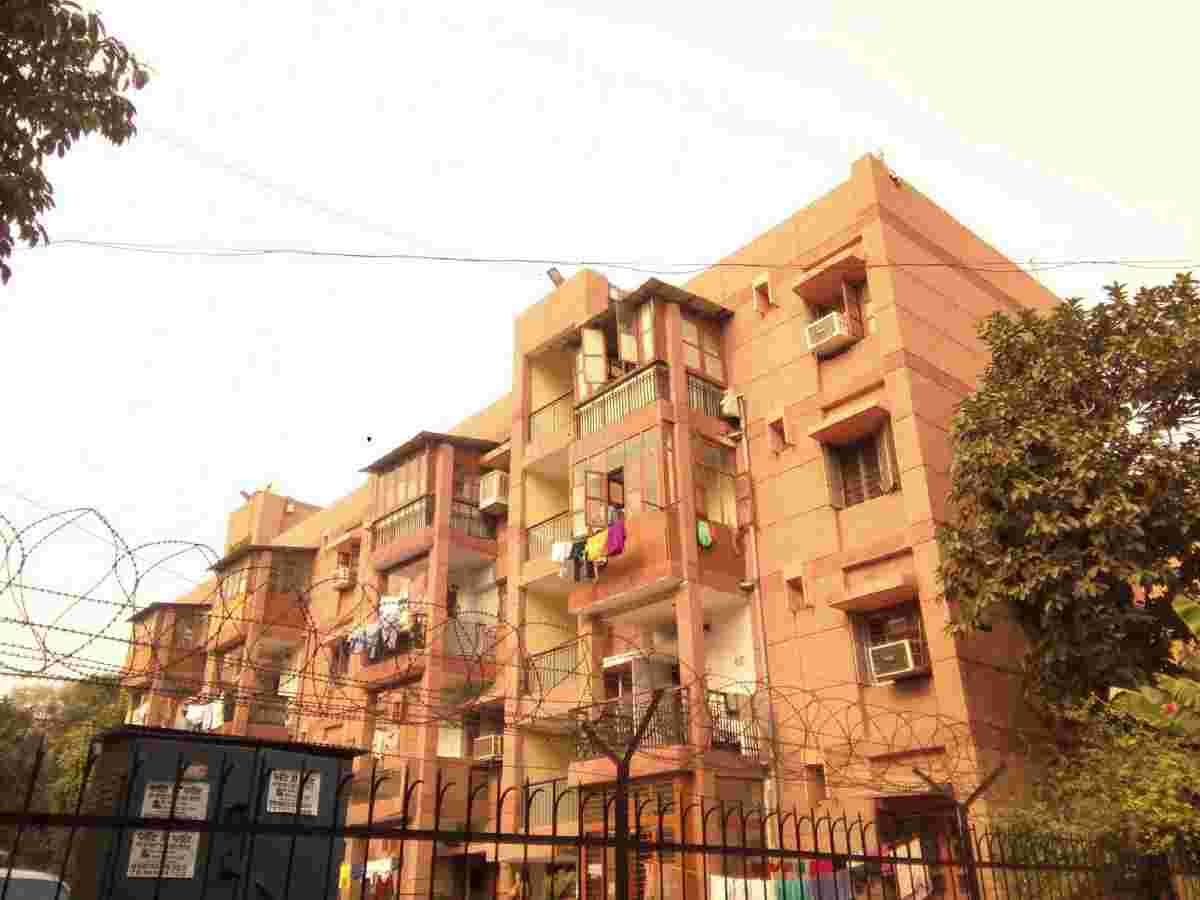
Albert Square New Delhi
While walking through the Gole Market area, one can still find the ruins of the single-storeyed quarters that the British government had built for its middle-level staff. Tucked among these last remnants of the Capital’s first residential colony, built in the early 1920s, are rows of four-storeyed and some multi-storeyed flats.
These were constructed from the 1970s onwards after the single-storeyed quarters scattered across the Gole Market area, from the rear of Ram Manohar Lohia Hospital to Chitra Gupta Road, were demolished. Having served as homes for many generations of sarkari babu families, they are now set to be consigned to the pages of modern Delhi’s history. They too will be demolished, making way for several central government offices and residential complexes.
Thus, Gole Market is becoming the first area in New Delhi to be redeveloped for the third time in a little more than 100 years. The area, also known as the DIZ Area, is set for major changes under the Central Vista Redevelopment Project.
Birth of Gole Market
The name “Gole” means round or circular in Hindi. The market building, designed as an octagonal structure inside a roundabout, was one of the first markets in New Delhi. It was created to serve the daily needs of thousands of government employees who had moved to the new capital.
The residential colony around Gole Market came up in the 1920s for middle-level central government officials. These were single-storeyed houses with verandas, tiled roofs, high ceilings of about 14 feet, fireplaces, and small courtyards at the back. The design was simple but practical for Delhi’s climate. High ceilings kept the houses cool in summer, and there were separate areas for kitchens and bathrooms.
“The Gole Market residential area had many squares and places named after British officials, governors, viceroys, and military leaders. This reflected the colonial era. I remember we had Robert Square, Lake Square (small and big), Telegraph Square and Telegraph Place, Outram Square, Dalhousie Square, Wilson Square, Hastings Square, Cornwallis Square, Clive Square, Albert Square, Havelock Square, and more,” recalls Sanjeev Vashist, a Kanpur IIT alumnus who lived at Telegraph Square with his family for more than two decades.
“The hallmark of Gole Market was its inclusive character. It had a large concentration of Tamil and Bengali families. Bollywood star Hema Malini, Indian Davis Cup tennis star Ramanathan Krishnan, towering local leader Sikander Bakht all lived in the squares of Gole Market for many years. These quarters were laid out neatly with lawns in front, where children played and families slept on charpoys during hot nights,” recalls Pritam Dhariwal, a veteran local social worker from the DIZ Area.
Reading Road, now Mandir Marg, was an important area nearby. As Gole Market developed, several schools came up along the road, such as Harcourt Butler School, Raisina Bengali School, St Thomas’ School, and MB School. Former Indian Test cricketer Ramesh Saxena and actor Satish Kaushik were alumni of Harcourt Butler School. Playback singer Mukesh, Congress leader Rajesh Pilot, and well-known cricketer Mohinder Amarnath were alumni of MB School.
Changes over the decades
The single-storeyed quarters lasted until around the 1970s or early 1980s. Many were demolished gradually. In their place, the government built four-storeyed and eight-storeyed flats. These multi-storeyed buildings housed government employees for decades.
The Gole Market building itself has faced several changes. By the late 20th century, shops selling sweets, groceries, and meat had become old and dilapidated. In the 2000s, the New Delhi Municipal Council declared parts of it unsafe. There were plans to turn it into a museum. Shopkeepers protested, but the courts supported restoration efforts.
Today, the market area is a mix of heritage and daily commerce, with plans to convert the historic Gole Market building into a museum, possibly one celebrating women achievers.
Redevelopment and the future
Now, the Gole Market area is part of wider changes in central Delhi. The Central Vista Redevelopment Project, which started around 2019–2020, aims to modernise the administrative heart of India.
As part of broader government housing redevelopment under General Pool Residential Accommodation, the old flats in the DIZ Area, about 1,392 units spread over 31.6 acres, will be demolished. Plans include building modern high-rises with around 1,472 Type V flats for senior officials, along with premium units, commercial spaces, and green areas.
“The goal is to create better, more efficient housing and offices. It will bring modern facilities, sustainability, and a new look befitting a rising India. The project involves large-scale planning by architects and the government. It promises green infrastructure, waste recycling, and better public spaces. However, it has faced debates on costs, heritage impact, and priorities, especially during tough times like the pandemic,” says Ujjwal Upadhyay, a young South Delhi-based architect.
A neighbourhood of memory
Gole Market tells the story of Delhi’s growth. From a colonial housing colony for officials to a vibrant, diverse neighbourhood, it has witnessed India’s journey from British rule to Independence and now to a modern global power. The squares named after British figures are mostly gone, replaced by new flats and roads. The 1970s buildings, too, will soon disappear.
“I have spent many years in the Gole Market area from the 1960s to the 1990s. I had my schooling at Raisina School, which was within shouting distance from my house. For old residents like me, it brings nostalgia and memories of simple homes, community life, festivals, and walks in clean air. For new generations, it offers better living conditions,” says Rathin Das, a veteran journalist based in Ahmedabad.
As redevelopment takes place, balancing progress with history will be key. Preserving stories, photographs, and some structures can help future Delhiites remember their roots. Gole Market’s transformation is not just about buildings; it reflects how cities evolve with time.
Each day of closure costs shops in Khan Market and Connaught Place between Rs 60,000…
Delhi generates nearly 15,000 tonnes of waste daily, prompting the government to deploy 1,000 mechanical…
Delhi Police has issued an NOC for the Congress rally at Ramlila Maidan on November…
CJP chief Abhijeet Dipke received conditional bail following his arrest for participating in a Connaught…
The DPCC has floated ₹104 crore tenders to test pilot pollution-control technologies across 40 key…
MCD pushes Bhalswa cleanup to Feb 2027 due to agency transition, leaving over 10 lakh…



