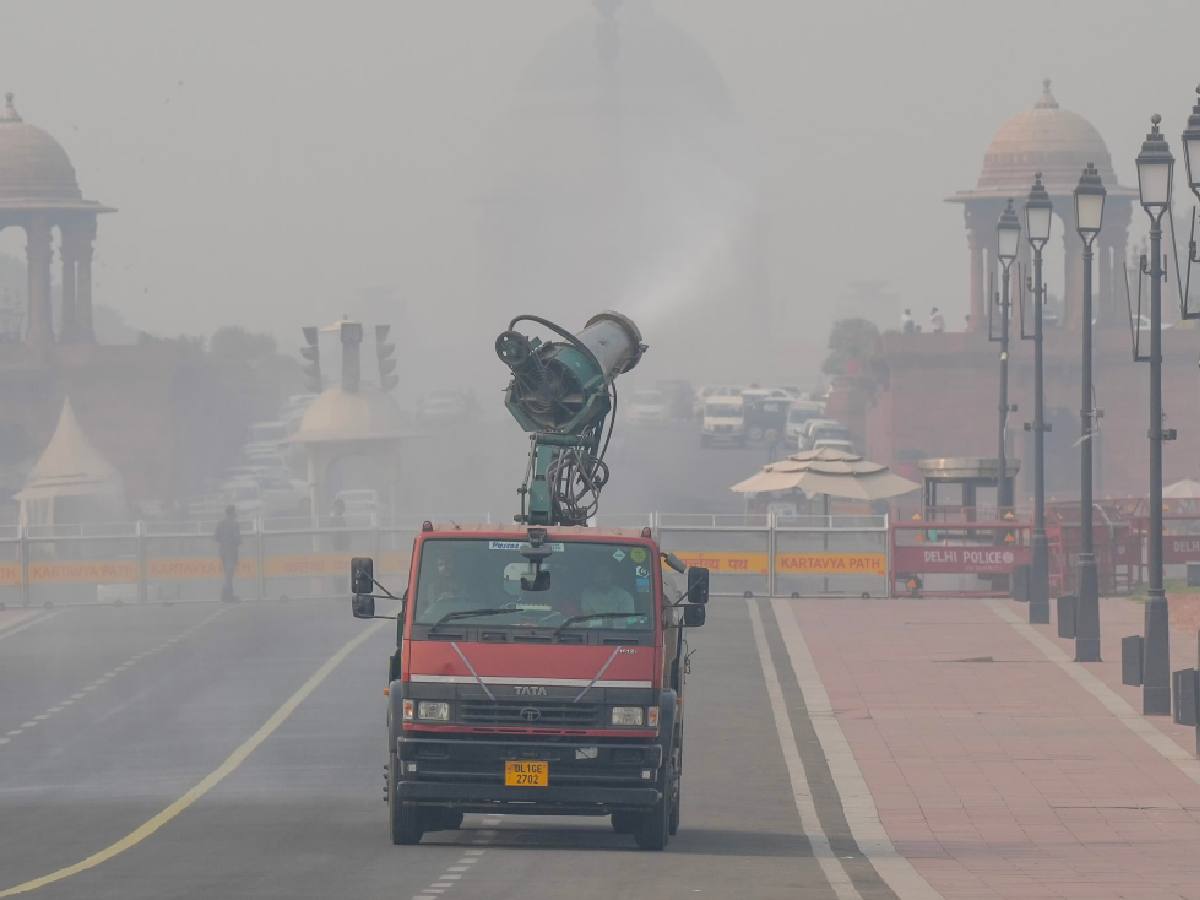
Delhi continued to breathe polluted air on Tuesday, with the air quality index (AQI) remaining in the ‘poor’ category for the 10th straight day. PM2.5 continued to be the major pollutant.
Of the 58 monitoring stations that reported data, 34 recorded ‘poor’ air quality, 19 fell in the ‘moderate’ category and five registered ‘very poor’ levels.
The Delhi Cantonment station reported the highest pollution level in the city, with an AQI of 346. According to the Sameer app, this was its worst reading since May 8.
Interestingly, the station, which has generally reported relatively cleaner air this month, had earlier recorded ‘satisfactory’ air quality on one day and remained in the ‘moderate’ category for more than 10 days.
As per the Central Pollution Control Board (CPCB), an AQI of 0-50 is classified as ‘good’, 51-100 as ‘satisfactory’, 101-200 as ‘moderate’, 201-300 as ‘poor’, 301-400 as ‘very poor’ and 401-500 as ‘severe’.
Delhi’s AQI had stood at 280 on November 19 before improving to 270 on November 20, 265 on November 21 and 239 on November 22. It climbed to 260 on November 23 before dropping to 227 on Tuesday.
Meanwhile, 404 farm-fire incidents were detected across seven states on Monday, according to the Consortium for Research on Agroecosystem Monitoring and Modelling from Space (CREAMS) laboratory of the Indian Agricultural Research Institute.
Uttar Pradesh accounted for the highest number of cases at 174, followed by Madhya Pradesh with 154, Punjab (37), Rajasthan (25), Haryana (10), Uttarakhand (three) and Delhi (one).
With the latest incident, the total number of stubble-burning cases detected in Delhi this year has reached seven. All these incidents have been reported from the North district, the institute said.
The India Meteorological Department’s Air Quality Early Warning System has predicted that Delhi’s air quality will remain ‘poor’ between November 24 and 27. The forecast for the following six days suggests that pollution levels could range from ‘poor’ to ‘very poor’.
The maximum mixing depth, which determines how high pollutants can disperse in the atmosphere, is expected to be 1,000 metres on November 24 and 25, rising to 1,400 metres on November 26 before declining to 1,100 metres on November 27.
The ventilation index, another indicator of the atmosphere’s ability to disperse pollutants, is forecast at 5,000 square metres per second on November 24, 2,500 on November 25, 4,000 on November 26 and 2,000 on November 27.
The IMD considers a ventilation index below 6,000 square metres per second, along with average wind speeds below 10 kmph, unfavourable for the dispersion of pollutants.