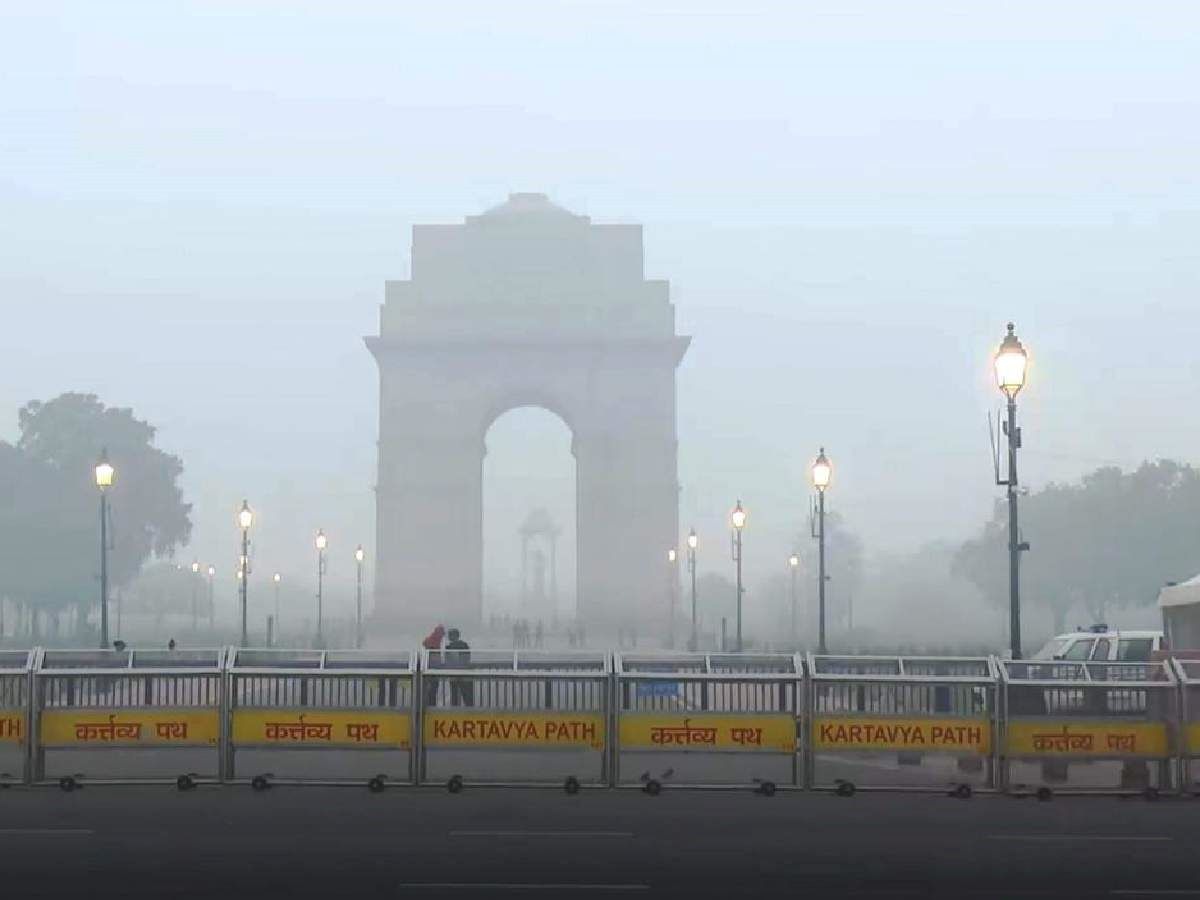
Delhi woke up to slightly cleaner air on Friday, though pollution levels in the national capital remained firmly in the ‘poor’ category. At 8 a.m., the city’s average Air Quality Index (AQI) stood at 268, marking an improvement from Thursday’s ‘very poor’ level of 373.
Data from several key monitoring stations indicated a modest decline in pollution levels. Anand Vihar recorded an AQI of 282, Dwarka Sector-8 288, Punjabi Bagh 293, ITO 280, Nehru Nagar 270, and Okhla Phase 2 255 — all still within the ‘poor’ range. Some areas, however, showed a more notable recovery, entering the ‘moderate’ category: CRRI Mathura Road reported an AQI of 198, Chandni Chowk 194, and Lodhi Road 199.
Also Read: Is the Yamuna really clean or just an eyewash?
In neighbouring regions, air quality remained mixed. Noida continued to struggle under heavy pollution, while Rohtak in Haryana emerged as the worst-hit location across the NCR, slipping into the ‘severe’ zone with an AQI of 426.
The marginal improvement followed a suffocating Thursday, when thick haze blanketed the capital, sharply reducing visibility and triggering widespread complaints of eye irritation, cough, and breathlessness. According to the Central Pollution Control Board (CPCB), 37 of Delhi’s 38 monitoring stations had recorded ‘very poor’ or ‘severe’ air quality that day, with areas like Vivek Vihar, Anand Vihar, Wazirpur, and Bawana breaching the 400 mark. Average concentrations of PM2.5 and PM10 stood at 184.4 µg/m³ and 301.9 µg/m³ respectively — far exceeding safe limits.
Experts attributed Thursday’s spike to stagnant weather conditions that trapped pollutants near the surface, compounded by falling temperatures and rising humidity. The India Meteorological Department’s (IMD) Decision Support System identified the transport sector as the biggest contributor to Delhi’s PM2.5 levels (around 16%), followed by stubble burning (6%) and local emissions (4%). Neighbouring cities like Ghaziabad and Noida added roughly another 16% to the capital’s pollution load.
Satellite data from October 29 detected 283 farm fires in Punjab and 10 in Haryana, highlighting the continued role of crop residue burning in worsening regional air quality.
Meteorologists said weak wind speeds and a shallow thermal boundary layer are preventing pollutants from dispersing. “The dip in minimum temperature helps form a layer of haze as pollution settles in the lower atmosphere,” Mahesh Palawat of Skymet Weather told PTI.
Doctors across Delhi reported a spike in respiratory complaints. “Almost every patient says their cough, breathlessness, and chest tightness have worsened since Diwali,” said Dr. Vivek Nangia, head of pulmonology at Max Super Speciality Hospital.
The IMD has forecast shallow fog for Friday, with daytime temperatures around 30°C and lows near 18°C. While the capital saw a slight reprieve, experts warn that air quality is likely to remain ‘poor’ until stronger winds arrive to disperse pollutants. Haze is expected to persist during early mornings and late evenings through the week, with visibility on Thursday having dropped to 1,000 metres at Palam and 800 metres at Safdarjung amid calm wind conditions.