
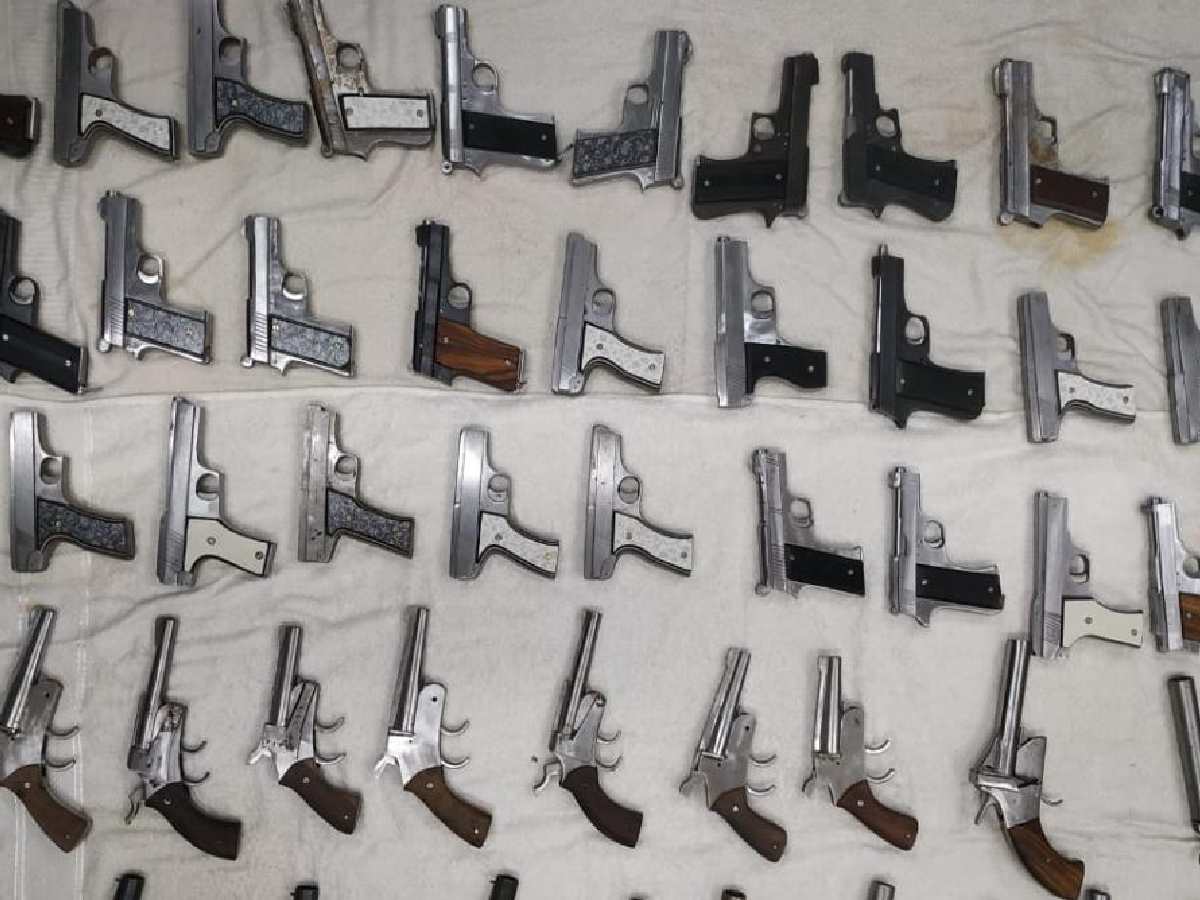
Delhi Crime: On July 15, a resident of North East Delhi’s Kardampuri area flaunted his country-made pistol, popularly known as a desi katta, on social media in an audacious display of bravado. The police swiftly tracked him down after the video went viral. Acting on a tip-off, they laid an elaborate trap and arrested the accused, identified as 23-year-old Salman, who has been booked under the Arms Act at Jyoti Nagar Police Station.
In another incident, Nand Nagri Police Station received a case from Guru Teg Bahadur Hospital after a man was shot. The victim, 30-year-old Vinay, told the police that 46-year-old Sameer Sharma opened fire on him after Vinay’s rickshaw touched Sharma’s car. Sharma was arrested along with a female accomplice and booked under the Arms Act.
Also read: Illegal construction surges on Yamuna floodplains despite court orders
Rising violations of the Arms Act
According to Delhi Police data, gunrunning across Delhi’s borders with Uttar Pradesh has contributed to the worrying trend. Between January 1 and March 31, 2025, 1,049 cases were registered under the Arms Act, compared to 957 during the same period in 2024.
The Arms Act, 1959, categorises firearms into two groups: Prohibited Bore (PB) and Non-Prohibited Bore (NPB). PB firearms include all automatic and semi-automatic weapons (except pistols), as well as rifles and pistols of specific calibres such as .303, 7.62 mm, .455, .45 mm rimless, and 9 mm. Smooth-bore firearms with barrel lengths under 20 inches are also considered PB and are illegal for civilian possession.
The Act extends to bladed weapons, banning civilian possession of implements longer than nine inches, including swords, khukris, and large knives, to curb their criminal misuse.
Seizures show scale of the problem
Data paints a grim picture of the proliferation of illegal arms. Up to August 31, 2024, police seized over 800 firearms, 2,500 rounds of ammunition, and 2,000 sharp-edged weapons.
Shahdara district reported 118 cases by August 31, 2024, resulting in 134 arrests. Police recovered 37 kattas, five desipistols, 65 live cartridges, four spent cartridges, one magazine, and 92 knives. In Rohini, 140 cases were recorded by September 15, with 69 firearms and 115 other weapons seized. By comparison, Rohini logged 211 cases in 2023, with 118 firearms recovered.
Citywide, 2,170 cases were registered under the Arms Act in the first eight months of 2024, resulting in the seizure of 892 firearms, 2,546 rounds of ammunition, and 2,074 sharp-edged weapons. In 2023, 3,579 cases were recorded, with 1,521 firearms and 4,316 rounds of ammunition seized.
Over the past four and a half years, the Delhi Police have registered 15,472 cases, confiscating 6,650 firearms, 21,660 rounds of ammunition, and 24,737 sharp-edged weapons. In 2022, a large-scale operation dismantled networks selling sharp-edged weapons through e-commerce platforms.
Historical data reveals that in 2020, 3,089 cases were recorded with 2,339 firearms seized, while 2021 saw 2,923 cases and 1,707 firearms. In 2022, 3,693 cases were registered, with 1,560 firearms and 16,698 sharp-edged weapons confiscated.
A senior police officer said, “We have dismantled numerous gangs in Uttar Pradesh and Madhya Pradesh, seizing large quantities of weapons. Our network of informants has been key to identifying these groups, and we have also shut down several illegal manufacturing units.”
Police face manpower crunch
Deputy Commissioner of Police (North East Delhi) Ashish Mishra said there was no clear pattern in terms of the age groups of offenders or the locations where illegal weapons were recovered. “We are facing a significant challenge with a shortage of personnel, which is hampering efforts to apprehend offenders and seize illicit weapons effectively,” he said.
However, another senior official argued that the rise in seizures was a positive sign. “Unlike many crimes, cases involving illegal weapons are rarely reported by the public. The increase in seizures shows proactive policing and sufficient enforcement,” he said.
Nand Nagri: A hub for gunrunning
Nand Nagri has long been infamous as a hub for arms smuggling and organised crime, owing to its proximity to Loni in Ghaziabad, a major centre for country-made pistols.
In April 2024, a police officer was shot dead on the Nand Nagri flyover by an acquaintance. A February raid on an illegal weapons unit in Loni led to the seizure of 33 fully assembled pistols and 25 partially constructed ones.
Local resident Rekha Vishwakarma said, “The firearms smuggled through Loni into Nand Nagri are then distributed across the National Capital. Many youths here are unemployed and take whatever work they can find, often turning to crime out of necessity. Some do it for the thrill, but most are driven by desperation.”
Praveen Singh, another resident, added that violence had become normalised. “We hear about deaths almost every day. If someone isn’t murdered, they’re attacked by blade-wielding criminals. Snatchings and robberies are routine. Residents have stopped reporting crimes. Even the local police chowki is shut most of the time,” he said.
A source familiar with the area said gangs such as Hashim Baba’s dominate the gunrunning business, though some smaller groups operate independently. In 2024, Mukesh, an accused in the Red Fort murder case, lived partly in Nand Nagri and partly near Loni Border. The area, residents said, witnessed two murders in a fortnight, yet no significant police action followed.
Also Read: Plan to clean Yamuna by diverting Ganga water draws experts’ flak
High-risk clusters under police watch
In March 2024, Delhi Police flagged 11 areas in the North East district under six police stations—Seelampur, Shastri Park, Gokalpuri, Khajoori Khas, Welcome, and Nand Nagri—as high-risk zones for violent crime, crimes against women, and organised criminal activity. Their proximity to the Uttar Pradesh border has made them particularly vulnerable.
To tackle the issue, police plan to set up Cluster Security Committees (CSCs) in these high-risk areas. Officials say “demographic” and “topographic” factors unique to these clusters drive crime rates, which have guided the selection of areas for intervention.
North East Delhi consistently records the highest incidence of heinous crimes in the capital. The CSCs aim to create targeted action plans to curb crime and strengthen security in these vulnerable areas.