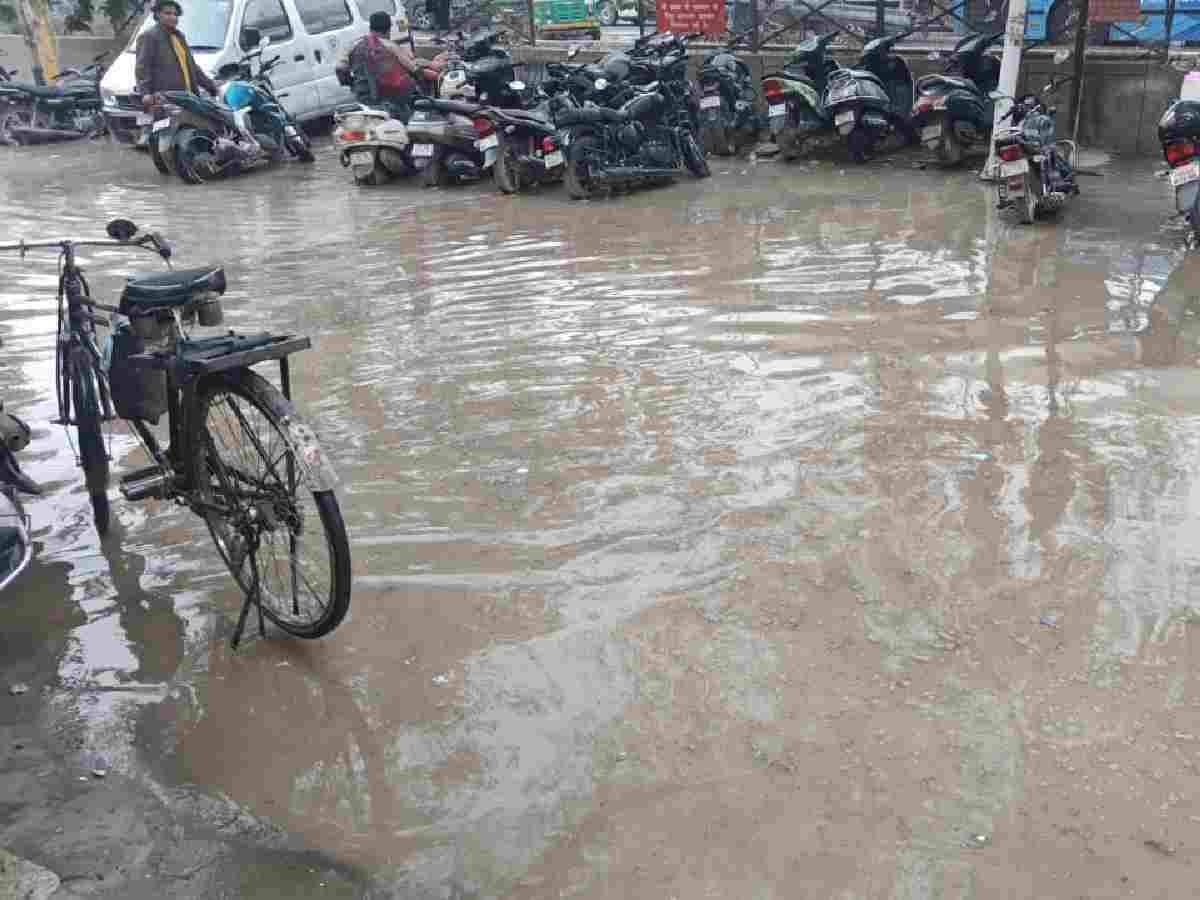
Commuters have faced several hardships for nearly a month on a vital stretch of Mathura Road between ITO junction and Supreme Court metro station, caused by persistent waterlogging due to leaking Delhi Jal Board (DJB) pipeline.
Local shopkeepers said the problem began when excavation work damaged an underground water main. The affected section carries heavy traffic towards Pragati Maidan, Bharat Mandapam and Delhi Zoo, resulting in slow-moving queues, slippery surfaces and frequent gridlock, especially during rush hours.
The leakage has turned the carriageway into a shallow lake, forcing vehicles to plough through water and worsening congestion. On November 26, the situation deteriorated further when VIP movements prompted Delhi Police to divert vehicles through the flooded lanes, leading to longer delays and several vehicles getting stuck.
Despite repeated complaints to the DJB, no repair work has started. Commuters have voiced frustration at the prolonged inaction on a prominent route serving the Supreme Court and major convention venues.
Extent of waterlogging complaints
Across the city, multiple stretches have been affected by persistent waterlogging, with numerous complaints being received by the Public Works Department (PWD). According to data submitted to the PWD Sewa portal, there are 27 unresolved waterlogging complaints for the year. Many relate to extensive maintenance and sewer leakage under the remit of the DJB, with some complaints dating back to August.
In October alone, data showed 317 instances of waterlogging, of which four complaints remain unresolved.
Districts across Delhi face waterlogging despite winter
On November 28, at Bali Nagar in West Delhi, resident Ryan Ohri reported significant water seepage in the neighbourhood.
“A large amount of water has been standing next to the pavement in front of Food Scouts restaurant, The Home Shop, and the 369 store for months now,” the complaint stated.
It added that the stagnant water was causing a “significant mosquito problem in the area” and requested urgent attention.
In East Delhi, a road along Dashmesh Public School at Vasundhara Enclave has remained blocked because of severe waterlogging. According to officials, the condition of the road is linked to extensive DJB maintenance to repair the sewage system. “It will be fixed when the maintenance work is over with,” a DJB official said anonymously.
On November 26, a resident complained that a section of Burari main road had been flooded by sewage water. “The waterlogging is not because of the sewage work being done by the DJB,” the complainant said on condition of anonymity. They added that “the water is overflowing from the footpath’s cracks”. However, PWD officials stated in the portal that the leakage was due to DJB maintenance.
Some complaints point to the deteriorating condition of roads. Archana Prawalia, a resident near Loni Pusta in East Delhi, said the potholes along the stretch had created chronic waterlogging.
“The road from Loni Pusta to Loni Depot is in a very poor condition. There are numerous potholes along the entire stretch,” she said.
She added that the route, used daily by more than 10,000 commuters from Baraut, Baghpat and Shamli, becomes blocked “each time there is some seepage issue”, turning the daily journey into a “drag”.
PWD officials said the tendering process for the road’s repair is currently underway.
Kirari’s prolonged agony
Much of North West Delhi continues to face severe waterlogging due to long-standing administrative inaction. Residents of Nithari in Kirari said the road leading up to and inside the Sarvodaya Kanya Vidyalaya has seen persistent waterlogging for three years.
“The accumulated water has disrupted the smooth movement of students and staff, causing considerable inconvenience,” a complaint filed on October 8 stated.
Residents said no repair work has taken place since then. While some water has receded, minimal logging remains due to the absence of a functional drainage system and deteriorating infrastructure.
Since the COVID-19 pandemic in 2020, chronic waterlogging in Nithari has worsened owing to neglected maintenance. The school, built on low-lying land, is regularly flooded by rainwater and seepage from a nearby natural pond. An additional “artificial” pond created by illegal dumping blocks natural drainage and aggravates the situation.
After every downpour, the premises turn into a lake with waist-deep water. With no proper drainage or sewerage system, even in dry weather residents are left with stagnant pools into which waste is discharged, causing sewers to overflow. The adjacent Sarvodaya Boys and Girls School is also affected, though less severely.
Visitors encounter an eerie, empty campus where makeshift bridges of benches act as the only means to cross the flooded courtyard; without handrails, one slip could mean falling into the water. The neighbourhood remains submerged for days, leaving children confined to their homes and isolating the village. Knee-deep lanes, broken health and education facilities and years of civic neglect have become entrenched in Nithari.
Government and departmental responses
On November 13, the Delhi Government approved Rs 220 crore to build a 4.5-km stormwater drain along the railway line from Mundka Halt to Najafgarh, with a supplementary drain parallel to the Delhi–Bhatinda line.
The project aims to resolve chronic waterlogging in the severely affected Kirari constituency and neighbouring areas, benefiting over 70 unauthorised colonies and several low-lying settlements lacking proper sewerage systems. Construction on Northern Railway land will begin once tendering is completed, with all permissions and an MoU already in place.
A similar project was introduced by the Aam Aadmi Party Government in 2021, but there was little substantive progress.
Separately, the DJB has authorised superintending engineers (maintenance) to award emergency and routine repair works up to Rs 10 lakh without calling for tenders. Works above Rs 25 lakh require e-tenders, while those above Rs 50 lakh need newspaper advertisements.
This delegation of financial powers is intended to enable quicker response to urgent issues such as broken pipelines and equipment repairs. Each award will require prior concurrence from the Member (Water) and designated officers, with a monthly report submitted to the CEO by the seventh of every month.
This decision follows the allocation of Rs 9,000 crore to the water and sewerage sector in the Government’s first budget, including Rs 500 crore specifically for repairs to the ageing DJB pipeline network.