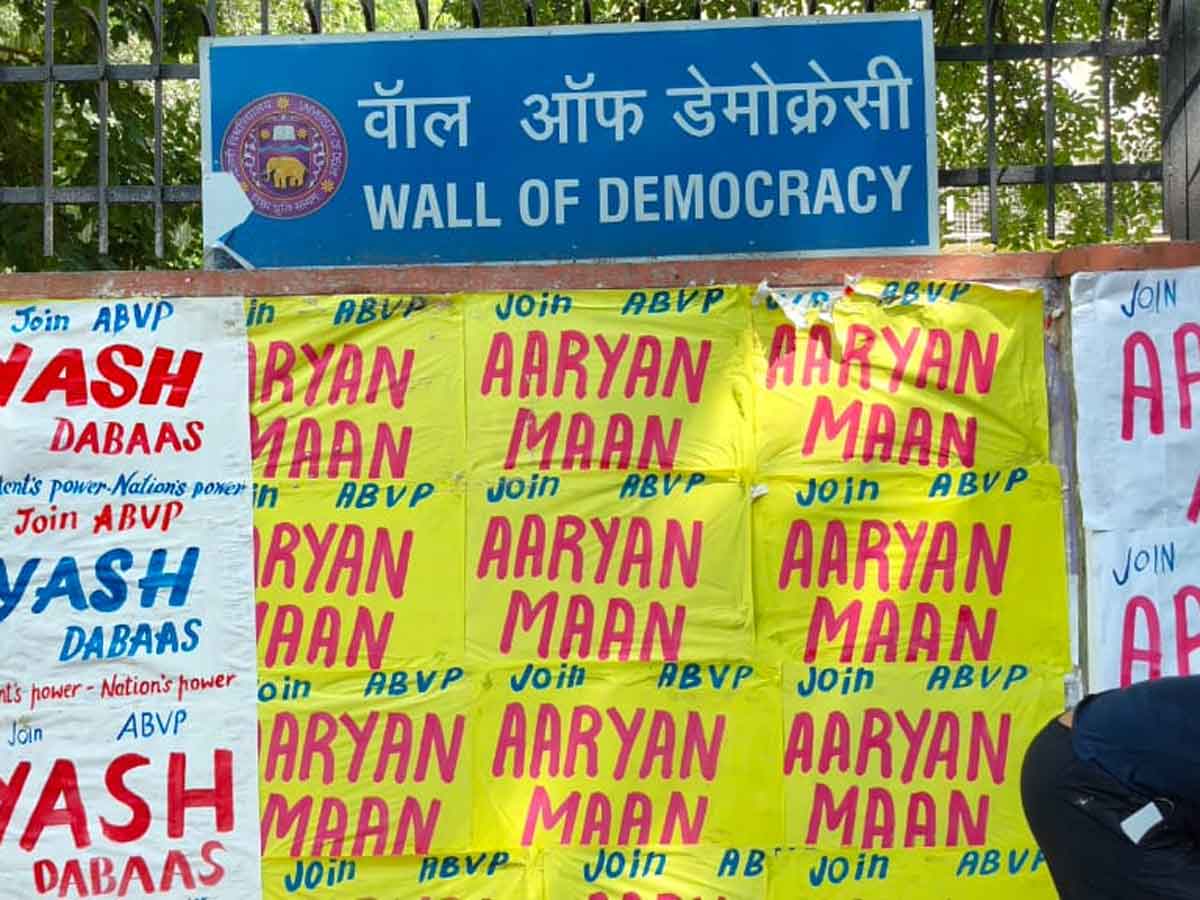
After releasing anti-defacement guidelines for the Delhi University Students’ Union (DUSU) elections, the university permitted candidates to use a designated ‘Wall of Democracy’ across multiple campuses for campaign posters.
However, the move has triggered strong criticism from candidates and their supporters. The varsity did not clarify how space on the wall would be allocated, leading to disputes over banner placement.
Posters guarded by SUVs
The introduction of these walls without any demarcated areas has stirred outrage among candidates. Many have deployed cars at each location to guard their posters and banners from rivals, creating a tense and confrontational atmosphere on campus.
Students have sarcastically labelled these spaces the “Wall of War”, alleging that candidates frequently clash over poster placements. At times, these confrontations have escalated into heated exchanges between rival parties.
Students voice concern
Speaking to Patriot, Ankit, a fresher at the Faculty of Arts, Delhi University, said, “The contestants have deployed one SUV at every location of these walls to guard their posters and banners. The students are fighting even on the placement of banners, which is a very sorry state of affairs.”
He added that all this chaos was the result of administrative negligence: “They should have thought about it before making such rules.”
‘A battleground, not democracy’
“What we are witnessing on campus is honestly shocking. The so-called ‘Wall of Democracy’ has turned into a battleground,” said Tushar Sharma, a second-year student at Kirori Mal College. He noted that candidates had gone so far as to deploy SUVs and cars to guard their posters from being torn or replaced by rivals.
Sharma said that instead of healthy campaigning, fights and heated arguments were breaking out over something as basic as banner placement. This, he argued, reflected poor planning by the administration.
“If the authorities really wanted to bring discipline through these anti-defacement rules, they should have clearly demarcated spaces for each candidate,” he explained. As students, they had expected fair and issue-based campaigning, but what they were experiencing was “intimidation and power play”.
He urged the university to take responsibility and resolve the situation before it spiralled further out of control.